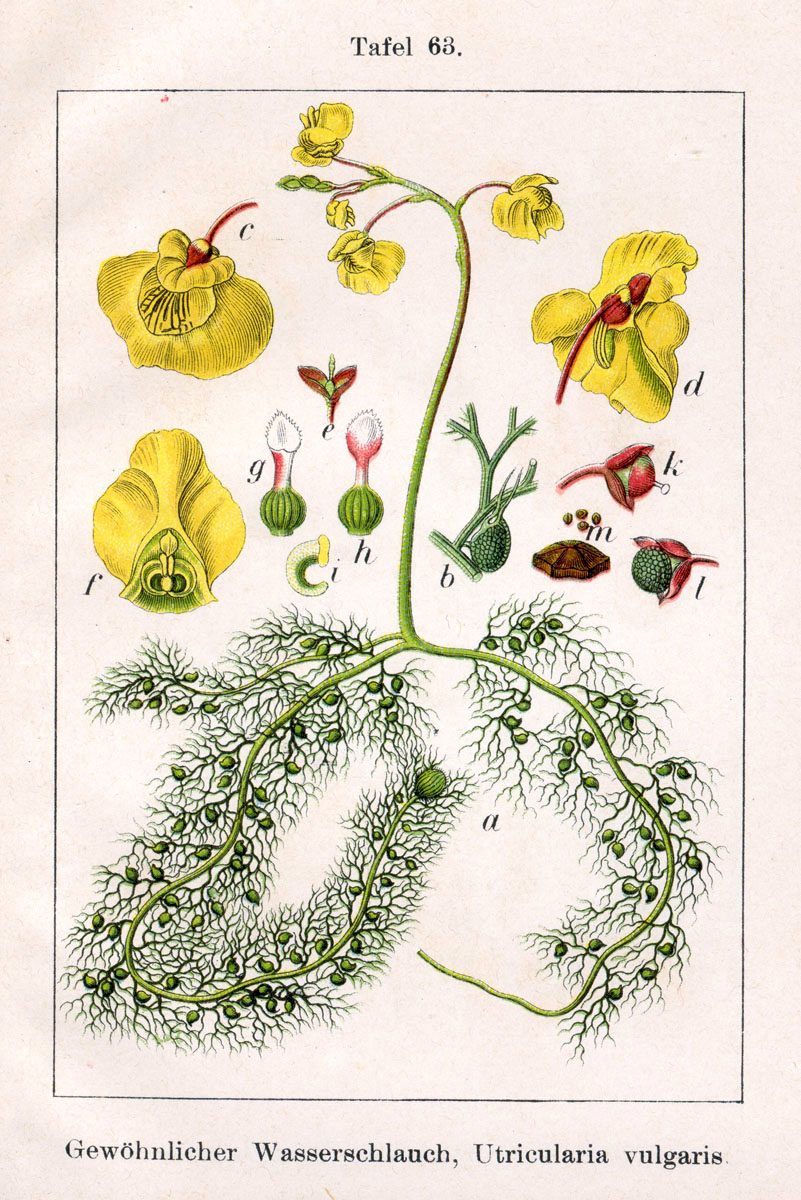
Photo: Johann Georg Sturm (Painter: Jacob Sturm) · Public domain
Greater bladderwort
Utricularia vulgaris
A rootless aquatic carnivorous plant, the greater bladderwort catches tiny prey with bladder traps that suck in water in a flash — among the fastest movements in the plant world.
Characteristics
A carnivore that floats
The greater bladderwort is an aquatic carnivorous plant with no roots at all: it lives floating just below the surface of ponds and still waters, forming long submerged stems that in a single season can exceed a metre. Its leaves are finely divided into thread-like segments and carry hundreds of tiny bladder-shaped traps (the 'utricles'), which give it its name. In summer it sends up erect stalks above the water bearing showy golden-yellow flowers.
Habitat and distribution
It is widespread across much of Europe and Asia, in still, nutrient-poor fresh waters — ponds, marshes, slow channels — where catching small organisms makes up for the scarcity of nitrogen. In winter the whole plant contracts into compact resting buds (turions) that sink to the bottom, to resprout in spring.
Ultra-fast traps
Its bladder traps are a masterpiece of natural engineering. Each bladder, sealed and held under negative pressure by the plant, has a sensitive trapdoor fitted with trigger hairs. When a tiny aquatic animal — a crustacean, a larva, a protozoan — brushes one of these hairs, the door springs open and water, sucked in by the internal vacuum, drags the prey inside in a fraction of a millisecond. It is one of the fastest movements known in the plant world.
Curiosities
Despite its microscopic ferocity, it is entirely harmless to humans. Its prey are minute organisms, invisible to the naked eye. In aquaria or ponds it is grown by enthusiasts as an oxygenating botanical curiosity.
Conservation
The IUCN lists the species as Least Concern. Like all freshwater plants, however, it suffers from the drainage of wetlands and from eutrophication, which alters the nutrient-poor environments it needs.
Flowering season
Practical tips
Water needs: Aquatic: floating in still water — always check soil moisture before watering.
Prefers Full sun: provide the right light and rotate the plant for even growth.
Recommended soil: None: rootless free-floating. Refresh the substrate every 1-2 years.
Dust the leaves with a damp cloth to support photosynthesis.
Feed during the growing season (spring-summer) and stop in winter.
Pros
- Bladder traps among the fastest movements in plants
- Showy yellow flowers above the water
- Oxygenates and enlivens garden ponds
Cons
- Lives only in still, nutrient-poor water
- Sensitive to eutrophication
- Microscopic prey: harmless to humans