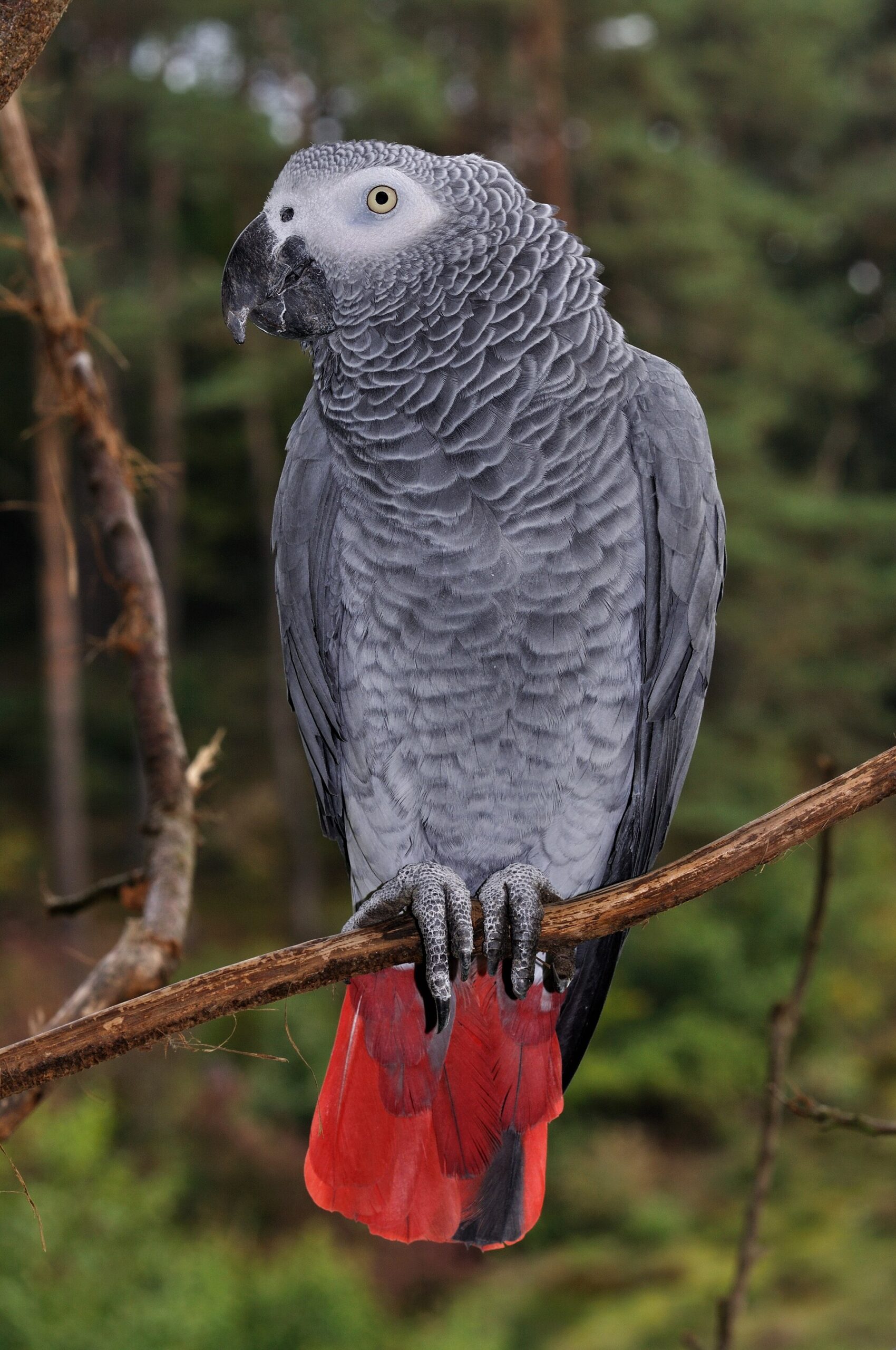
African Grey Parrot
Psittacus erithacus
Characteristics
Temperament
Extremely intelligent, sensitive, social. Able to mimic the human voice and learn complex concepts.
Diet
Granivorous-frugivorous: parrot seed mix, fresh vegetables (peppers, broccoli, carrots), small amounts of fruit, calcium supplements.
The African Grey Parrot (Psittacus erithacus) is a bird of the Psittacidae family, widely regarded as one of the most intelligent birds on the planet. Native to central and western Africa, it is famous for its remarkable ability to mimic the human voice and for cognitive skills that, according to some studies, are comparable to those of a five-year-old child.
Classification and category
The African Grey belongs to the order Psittaciformes, class Aves. Two main forms are historically recognised: Psittacus erithacus erithacus (the Congo African Grey) and Psittacus erithacus timneh (the Timneh), which is now often classified as a separate species. It is a medium-sized bird, around 33 cm long and weighing on average 400 grams.
Habitat and distribution
The natural habitat of the African Grey Parrot consists of tropical rainforests, wooded savannas and lowland forests of equatorial Africa. Its range covers the Congo Basin, the Ivory Coast, Cameroon, Gabon, the Democratic Republic of the Congo, Uganda and parts of Guinea. It prefers primary and secondary forests, where it gathers in large flocks particularly at dawn and dusk.
Due to widespread deforestation and the illegal wildlife trade, the species was upgraded to Endangered on the IUCN Red List in 2016. The collection of wild specimens is now regulated by CITES Appendix I, which prohibits international commercial trade.
Diet
The African Grey Parrot has a predominantly herbivorous, granivorous and frugivorous diet. In the wild it feeds on seeds, fruits, nuts, berries, flowers and occasionally small insects. One of its preferred food sources is the fruit of the African oil palm (Elaeis guineensis).
In captivity, it requires a balanced diet of specific seed mixes, fresh vegetables (carrots, peppers, broccoli, leafy greens), moderate amounts of fruit and mineral supplements, particularly calcium to prevent the bone deficiencies that are common in the species.
Physical features
The African Grey's plumage is a uniform grey with varying lighter and darker shades depending on the area of the body, while the tail stands out with its vivid scarlet red. The beak is strong and black, the eyes are pale yellow in adults and dark in juveniles. The overall length of the bird is around 33 cm.
Males and females are virtually identical in appearance: sexual dimorphism is almost impossible to detect by eye, and a DNA test is normally used to determine sex.
Behaviour and curiosities
The African Grey Parrot is famous for its exceptional cognitive abilities. Research conducted by psychologist Irene Pepperberg on her subject "Alex" demonstrated that these birds can grasp abstract concepts such as quantity, colour, shape and the relationship of difference between objects. In the wild they form monogamous pairs and maintain the bond throughout life.
They are particularly long-lived birds: in captivity they can reach and exceed 50 years of age, whereas in the wild their lifespan is shorter due to predators and environmental pressures. As pets they require a huge amount of mental stimulation: boredom and loneliness can trigger self-destructive behaviours such as feather plucking. For this reason it is considered a demanding companion, suitable only for experienced owners willing to devote daily hours of interaction.
Pros
- Intelligenza eccezionale
- Longevo (50+ anni)
- Legame profondo con il proprietario
- Capace di imitare la voce
Cons
- Specie minacciata (Endangered IUCN)
- Richiede ore di interazione quotidiana
- Predisposto a feather plucking
- Costo e impegno elevati