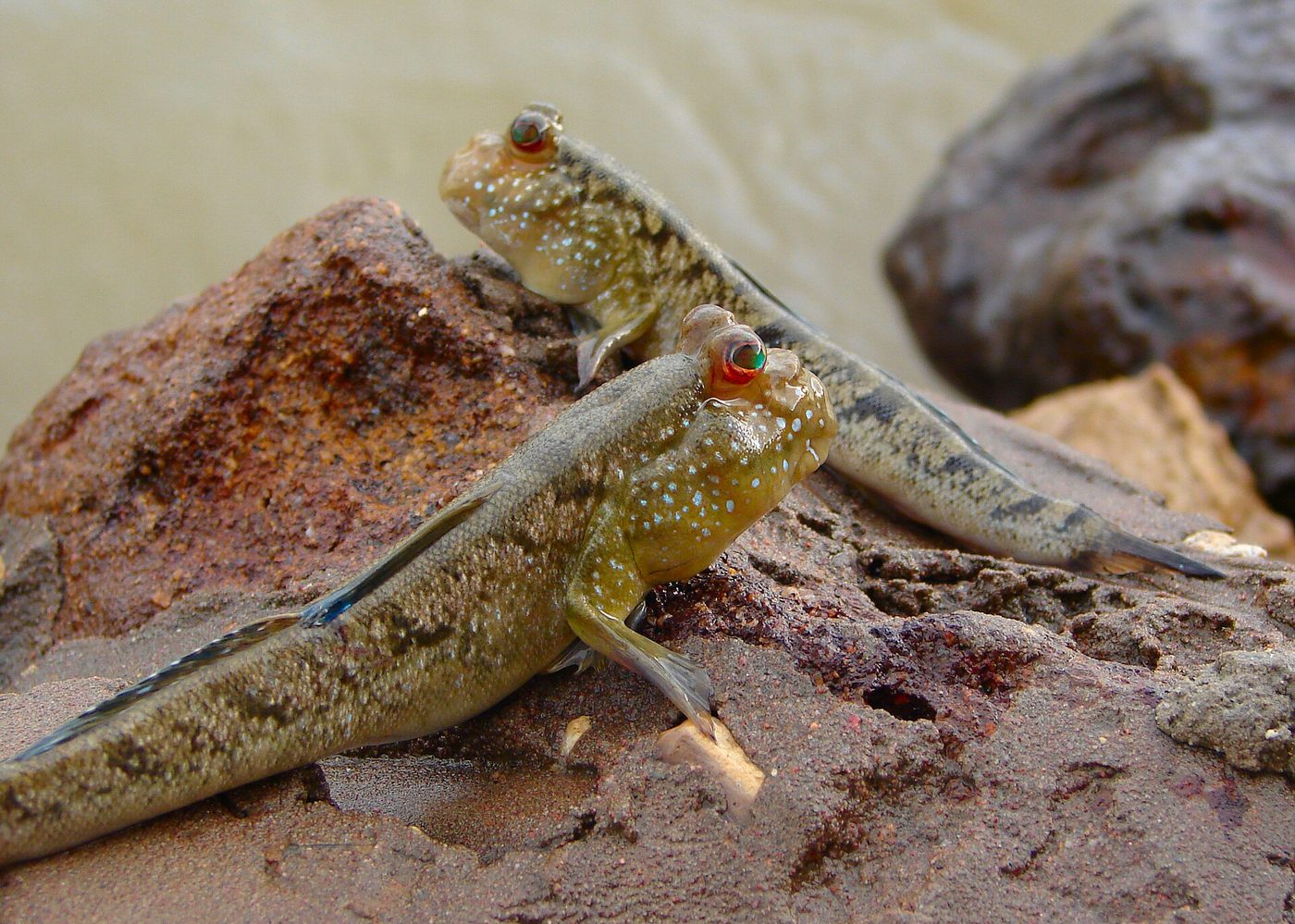
Photo: Bjørn Christian Tørrissen · CC BY-SA 4.0
Atlantic mudskipper
Periophthalmus barbarus
The Atlantic mudskipper is an amphibious fish of African mangroves that walks and hops on the mud, breathes through its skin and stays out of water for hours.
Characteristics
Temperament
Amphibious and active; walks and hops on mud, defends its burrow.
Diet
Omnivorous: small arthropods, invertebrates and plant matter.
The fish that walks on mud
The Atlantic mudskipper (Periophthalmus barbarus) is a fish of the goby family with a remarkably amphibious lifestyle. It has large, bulging eyes set close together on top of its head — like a frog's — giving it a wide field of view to watch its surroundings. Its sturdy, muscular pectoral fins work like little legs with which it "walks" and climbs over the mud; its powerful tail lets it make real leaps. It can reach about 25 cm in length.
Habitat and range
It lives in the intertidal zones of mangroves along the tropical Atlantic coasts of Africa, from Senegal to Angola, including the islands of the Gulf of Guinea. It tolerates fresh, salt and brackish water, always near the coast.
Behaviour and diet
It spends much of its time out of the water, on the mudflats exposed at low tide, where it searches for food. It can absorb oxygen through its skin and mucous membranes (cutaneous respiration), provided it stays moist, so it can remain on land for hours. It feeds mainly on small arthropods and other invertebrates, but also on mangrove plant matter. Males dig burrows in the mud and defend them with lively displays.
Did you know?
It is the only mudskipper species along the Atlantic coasts: all its other relatives live in the Indo-Pacific. Its life half in water and half on land makes it one of the most fascinating examples of adaptation among fish.
Conservation
The IUCN lists it as Least Concern. It is still widespread, but it depends entirely on the health of mangroves, fragile coastal ecosystems threatened by deforestation and pollution.
Pros
- An amphibious fish that walks and hops on mud
- Breathes through its skin out of water
- Least Concern, still widespread
Cons
- Depends entirely on mangroves
- Sensitive to coastal pollution
- Must stay moist to breathe on land