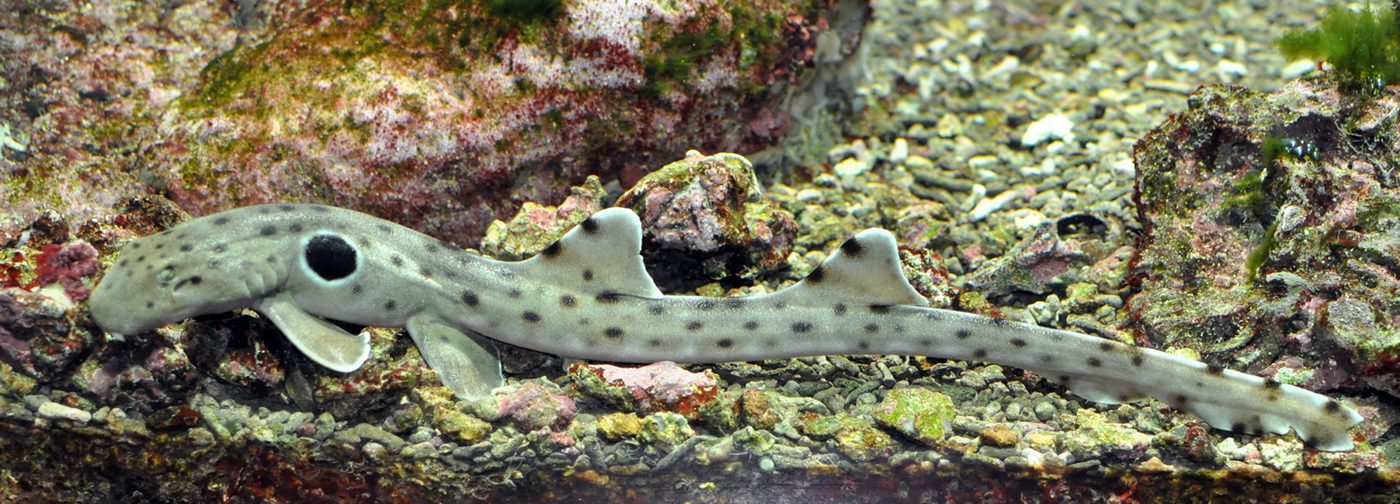
Photo: This illustration was made by Citron You must credit this : Citron / CC-BY-SA-3.0 · CC BY-SA 3.0
Epaulette shark
Hemiscyllium ocellatum
The epaulette shark is a small tropical shark that 'walks' across the seabed on its fins and survives at extremely low oxygen levels.
Characteristics
Temperament
Nocturnal and quiet; 'walks' on the bottom with its fins.
Diet
Carnivorous: small invertebrates and fish on the seabed.
The shark that walks
The epaulette shark (Hemiscyllium ocellatum) is a small shark of the family Hemiscylliidae, the long-tailed carpet sharks. Its name comes from a large white-margined black spot behind each pectoral fin, reminiscent of military epaulettes. It has a slender, light-brown body scattered with dark spots, a short head and broad, paddle-shaped paired fins. Its rear part, from peduncle to tail, makes up over half its length. It can reach about a metre.
Habitat and range
It lives in shallow tropical waters off Australia and New Guinea, among coral reefs, from the shallows down to around fifty metres. It frequents reef flats and tide pools.
Behaviour and adaptations
Its most remarkable feature is the ability to "walk": it uses its sturdy pectoral and pelvic fins like legs to move slowly over the bottom and even to travel from one pool to another out of the water when the tide recedes. It is also exceptionally tolerant of low oxygen: it can survive for hours in near-anoxic water by slowing its metabolism, a rare adaptation among vertebrates. It feeds on small invertebrates and fish on the seabed.
Did you know?
Because of these abilities it is studied as a model for understanding how tissues withstand oxygen shortage, with possible medical applications. It is entirely harmless to people.
Conservation
The IUCN lists it as Least Concern. It is not considered threatened, partly thanks to its wide distribution on the Great Barrier Reef, but it depends on the health of coral reefs.
Pros
- 'Walks' on the bottom and between tide pools
- Survives at extremely low oxygen levels
- Entirely harmless to people
Cons
- Depends on healthy coral reefs
- Small and vulnerable to large predators
- Range limited to Australia and New Guinea