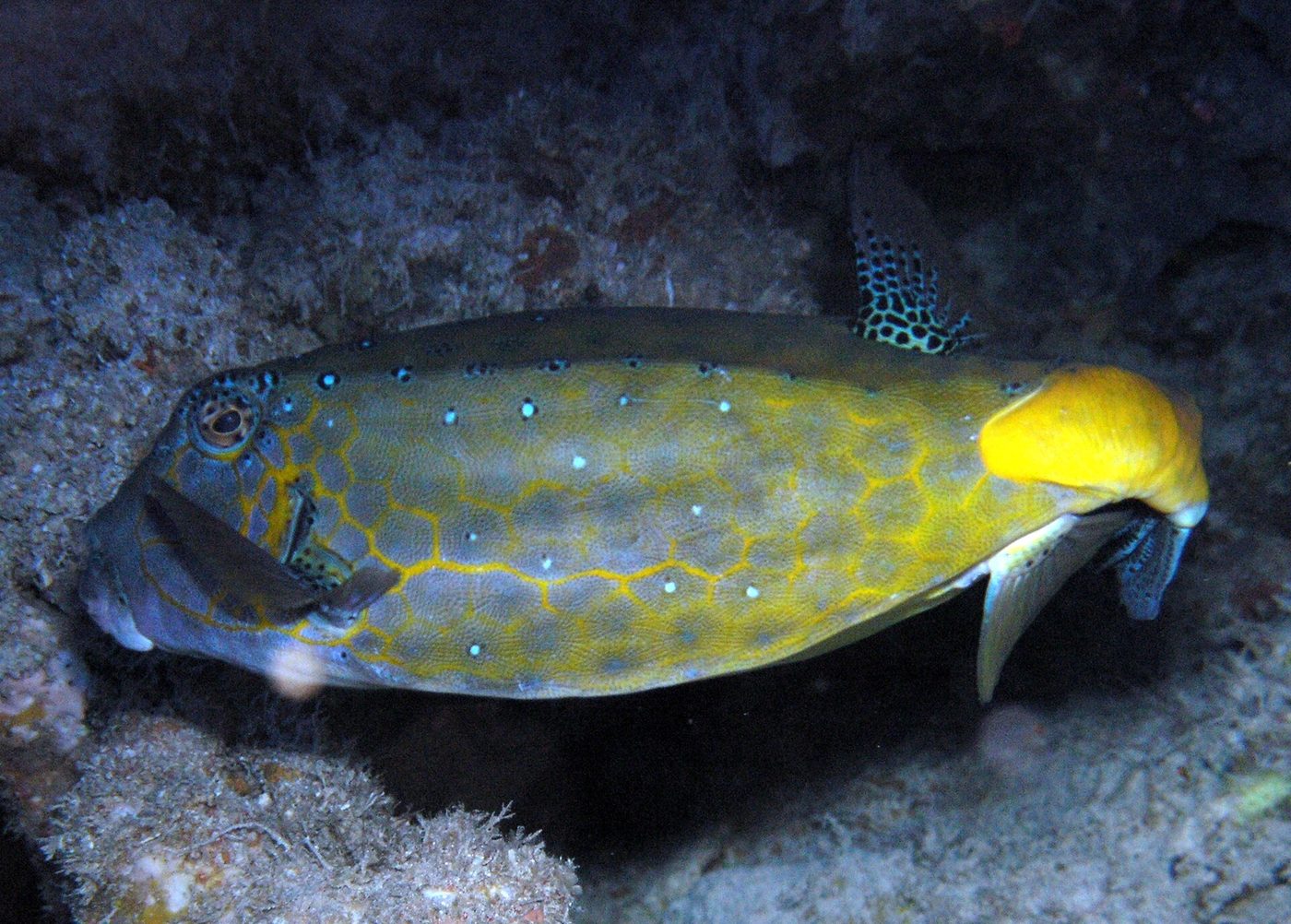
Photo: J. Petersen · CC BY 2.5
Yellow boxfish
Ostracion cubicus
A small reef fish with a cube-shaped body and bright yellow, black-spotted colouring, the yellow boxfish secretes a toxic mucus when threatened.
Characteristics
Temperament
Slow, solitary, with a rocking, hovering motion
Diet
Omnivore: algae, small invertebrates, bottom organisms
A fish shaped like a dice
The yellow boxfish owes its name to its unmistakable shape: the body is encased in a sturdy bony armour with a square cross-section, so that it resembles a small cube. Juveniles are a bright yellow dotted with black spots, a very vivid livery that fades with age towards duller, bluish and brownish tones. The fins are small and translucent, and the fish moves with a characteristic hovering, rocking motion rather than the darting typical of other fish.
Habitat and distribution
It is widespread on the coral reefs of the Indian and Pacific Oceans, from the Red Sea and East Africa to the Pacific islands. It favours lagoons and sheltered parts of the reef; the young often hide among the branches of Acropora corals. Since 2011 it has also been recorded in the eastern Mediterranean, which it likely entered through the Suez Canal.
Behaviour and defence
The rigid armour limits its movements but offers excellent protection. Its most effective weapon, however, is chemical: when stressed or injured, it secretes from its skin a mucus containing a toxin (ostracitoxin) capable of killing other fish nearby — a well-known risk to aquarists, since in a closed tank it can even poison itself. It feeds on algae, small invertebrates and bottom-dwelling organisms.
Curiosities
The boxy shape inspired car designers who studied its aerodynamics for a concept car, long believing it to be a model of efficiency; later studies revised those conclusions. It remains a fish of unusual charm, popular in the aquarium trade but hard to keep.
Conservation
The species is common and widespread and is not considered threatened. Like all reef dwellers, however, it depends on the health of coral ecosystems.
Pros
- Unmistakable cubic shape and yellow livery
- Protective bony armour and chemical defence
- Very photogenic on the reef
Cons
- Toxic mucus dangerous to other fish in an aquarium
- Hard to keep in captivity
- Depends on the health of coral reefs