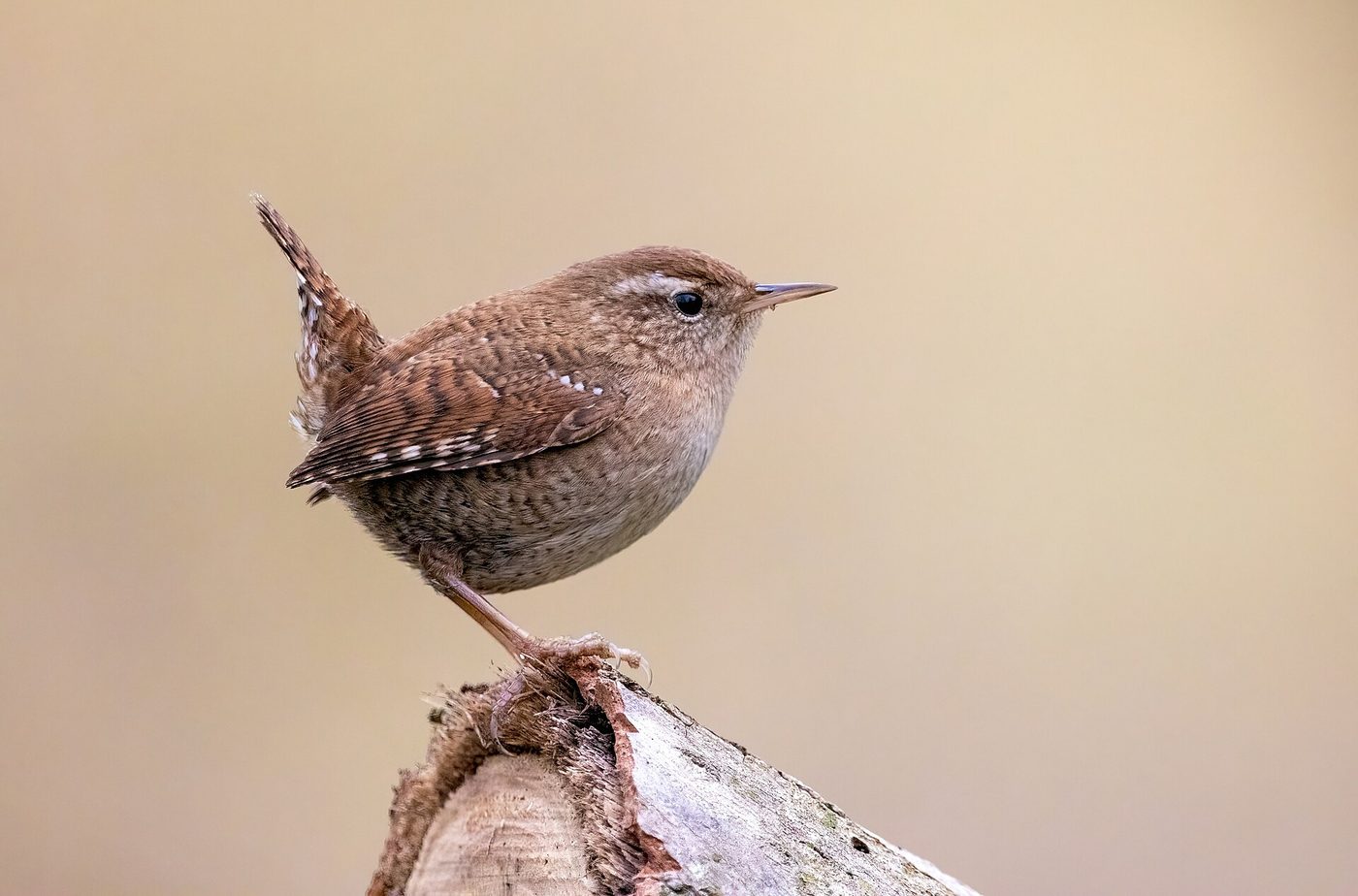
Photo: Alexis Lours · CC BY 4.0
Eurasian wren
Troglodytes troglodytes
The wren is one of Europe's smallest birds: a tiny brown ball with a cocked-up tail and a song astonishingly loud for its size.
Characteristics
Temperament
Lively, restless, shy but vocal
Diet
Insectivore: spiders, insects, larvae and eggs
Description
The wren is a tiny passerine of the family Troglodytidae, just 9–10 cm long and weighing only a few grams. It has a rounded, compact body, russet-brown finely barred with darker markings, a thin, slightly curved bill and, above all, a short tail often held cocked upright, which makes it unmistakable. The sexes look alike.
Habitat and distribution
It is widespread across much of Europe, North Africa and Asia. It frequents woodland with dense undergrowth, hedges, gardens, low walls and stony ground, wherever there are nooks to slip into. It loves sheltered, shady corners, where it creeps among the low branches and vegetation like a little mouse.
Behaviour
It is a very lively bird, always on the move, searching the thick of the vegetation for spiders and insects. Despite its minute size, the male has a long, ringing, extremely powerful song, out of all proportion to its body. It builds ball-shaped nests with a side entrance; the male makes several, and the female chooses which one to lay her eggs in. On cold nights several wrens huddle together in the same roost to keep warm.
Behaviour and folklore
Its scientific name, Troglodytes ('cave-dweller'), refers to its habit of slipping into cavities and crevices. In many European traditions the wren is regarded as the 'king of birds': one fable tells how it won the contest to fly highest by hiding among the eagle's feathers and taking off at the last moment.
Conservation
It is a common, widespread species, classed as least concern. Its numbers can crash sharply after very harsh winters, but recover quickly thanks to the high number of broods.
Pros
- Present year-round, even in gardens
- Powerful, recognisable song
- Useful: feeds on insects and spiders
Cons
- Hard to spot, keeps to dense cover
- Suffers greatly in harsh winters
- Short average lifespan