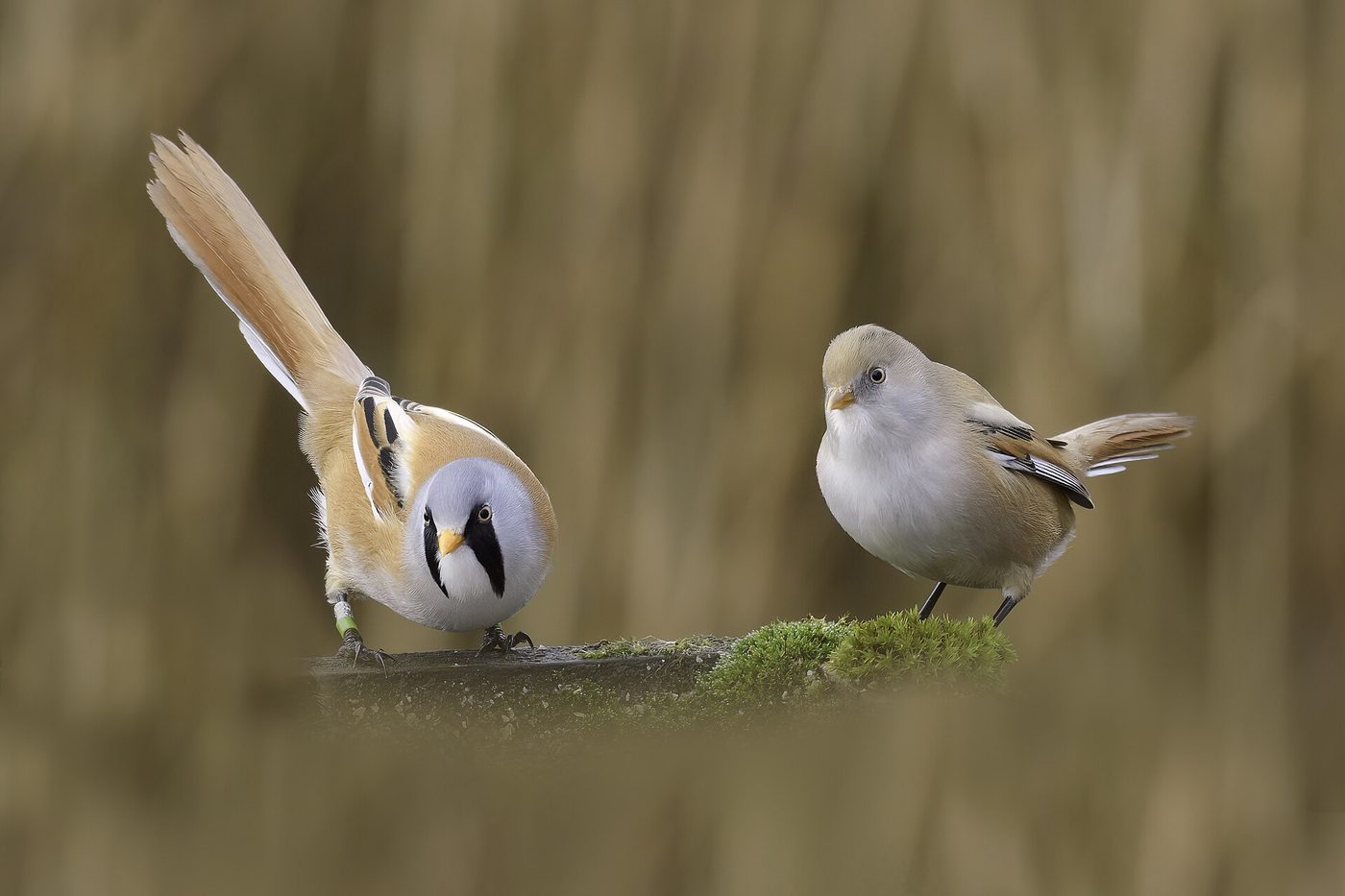
Photo: caroline legg · CC BY 2.0
Bearded reedling
Panurus biarmicus
A lively little bird of Eurasian reed beds, the bearded reedling is named for the male's black moustaches and spends its whole life among the marsh reeds.
Characteristics
Temperament
Social, noisy, acrobatic among reeds
Diet
Insects in summer, reed seeds in winter
The acrobat of the reed beds
The bearded reedling is a small, long-tailed passerine with warm colours: a tawny-orange body and wings variegated in black and white.
(Note: the mass value given by Wikidata, 1.88 kg, is plainly wrong for a bird of this size; its true weight is only about fifteen grams.)
The male is recognisable by its blue-grey head and two conspicuous black patches at the sides of the bill, like long moustaches, hence the name. It is the only species in the family Panuridae: long classified among the tits, it is now known to have no close relatives.
Habitat and distribution
It lives almost exclusively in the large Phragmites reed beds of wetlands, lakes and marshes across the temperate zone of Europe and Asia, into North Africa. It rarely leaves the reeds, among which it climbs and moves with great agility.
Behaviour and diet
It is social and noisy, moving in small parties with constant metallic calls. In spring and summer it feeds on insects and spiders caught among the stems; in winter it switches to a diet of reed seeds. This change is accompanied by a remarkable transformation of the digestive tract, which adapts to the tougher food. It nests low among the reeds and may raise several broods in a season.
Curiosities
Young bearded reedlings choose their habitat very early: within days of fledging they "imprint" on reed beds, which binds them to this environment for life. On cold days they are often seen clinging to the stems, balanced by their long tails.
Conservation
The IUCN lists the species as Least Concern. It depends closely on reed beds, however: the drainage and degradation of wetlands threaten its populations locally.
Pros
- Male's black moustaches are unmistakable
- The only member of its family
- Remarkable seasonal diet switch
Cons
- Closely tied to reed beds
- Sensitive to wetland drainage
- Not a cage bird