Photo: Arpingstone · Public domain
Victoria crowned pigeon
Goura victoria
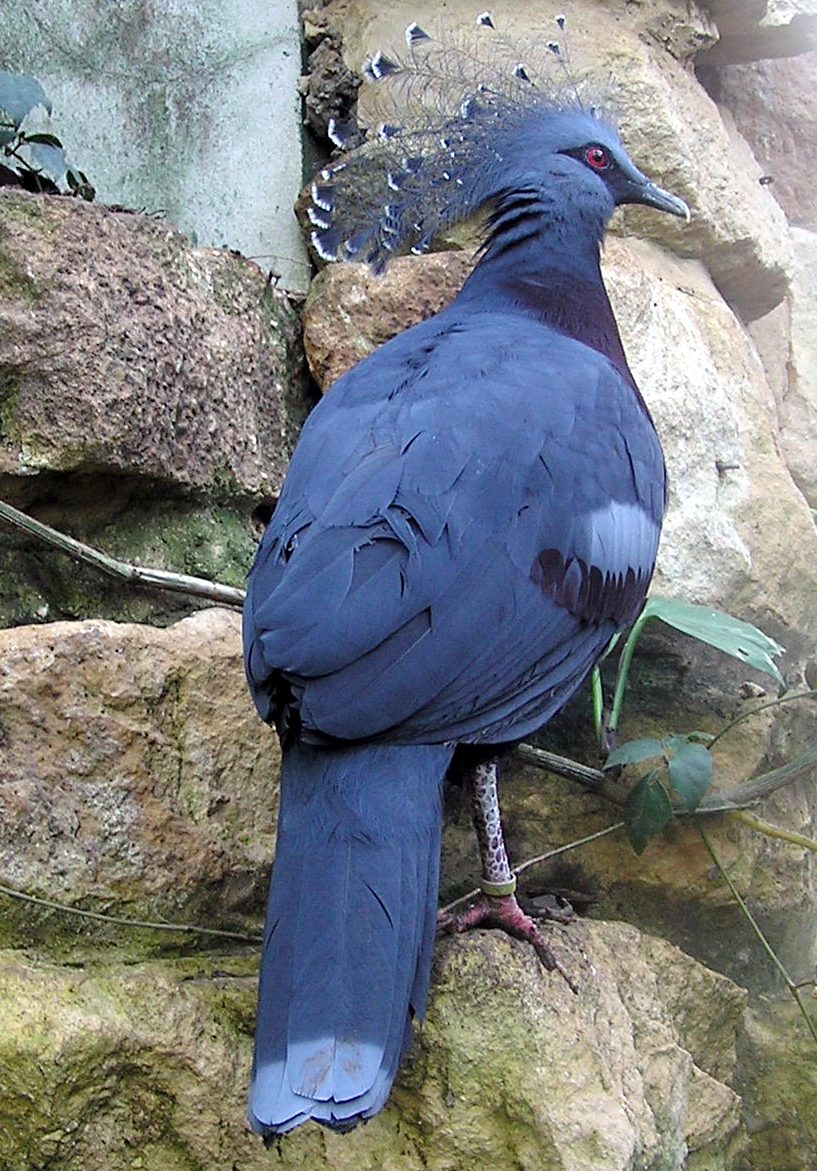
As large as a turkey and adorned with an elegant lace-like crest, the Victoria crowned pigeon is the largest living pigeon, a jewel of the forests of New Guinea.
Characteristics
Temperament
Calm, ground-dwelling, lives in pairs or small groups
Diet
Omnivore: fallen fruit, seeds and small invertebrates
The largest of the pigeons
The Victoria crowned pigeon is the largest living pigeon, comparable in size to a turkey. Its plumage is an elegant blue-grey, enhanced by a maroon-red breast and bright red eyes. But its most fascinating feature is its crest: a broad fan of blue feathers, thin and delicate as lace, with characteristic white tips, which the bird holds erect on its head like a crown. It is precisely to this crown, and to Queen Victoria, that it owes its name.
Habitat and distribution
It is endemic to New Guinea, where it lives in lowland rainforests and swampy areas. Unlike most pigeons, it is a mainly ground-dwelling bird: it spends much of its time walking on the ground, among the forest litter, and flies up into the trees mainly to rest or to reach safety.
Behaviour and feeding
It feeds above all on fruit fallen to the ground, seeds and small invertebrates, which it gathers by walking calmly through the undergrowth. It is a bird of quiet behaviour and solemn movements. It gives deep, hollow calls, resembling a 'whoop', which resound through the forest. It lives in pairs or small groups and builds bulky nests in the trees.
Conservation
The Victoria crowned pigeon is classified as a near-threatened species. Hunting, both for its meat and for its splendid feathers, and the loss of forest habitat have reduced its populations. Its beauty, which makes it sought after, is at the same time one of the causes of the pressures it faces. The protection of the forests of New Guinea is essential for its future.
Pros
- The largest living pigeon
- Elegant lace-like crest with white tips
- Regal, unmistakable appearance
- Calm and solemn behaviour
Cons
- Near-threatened species
- Hunted for meat and feathers
- Depends on the forests of New Guinea