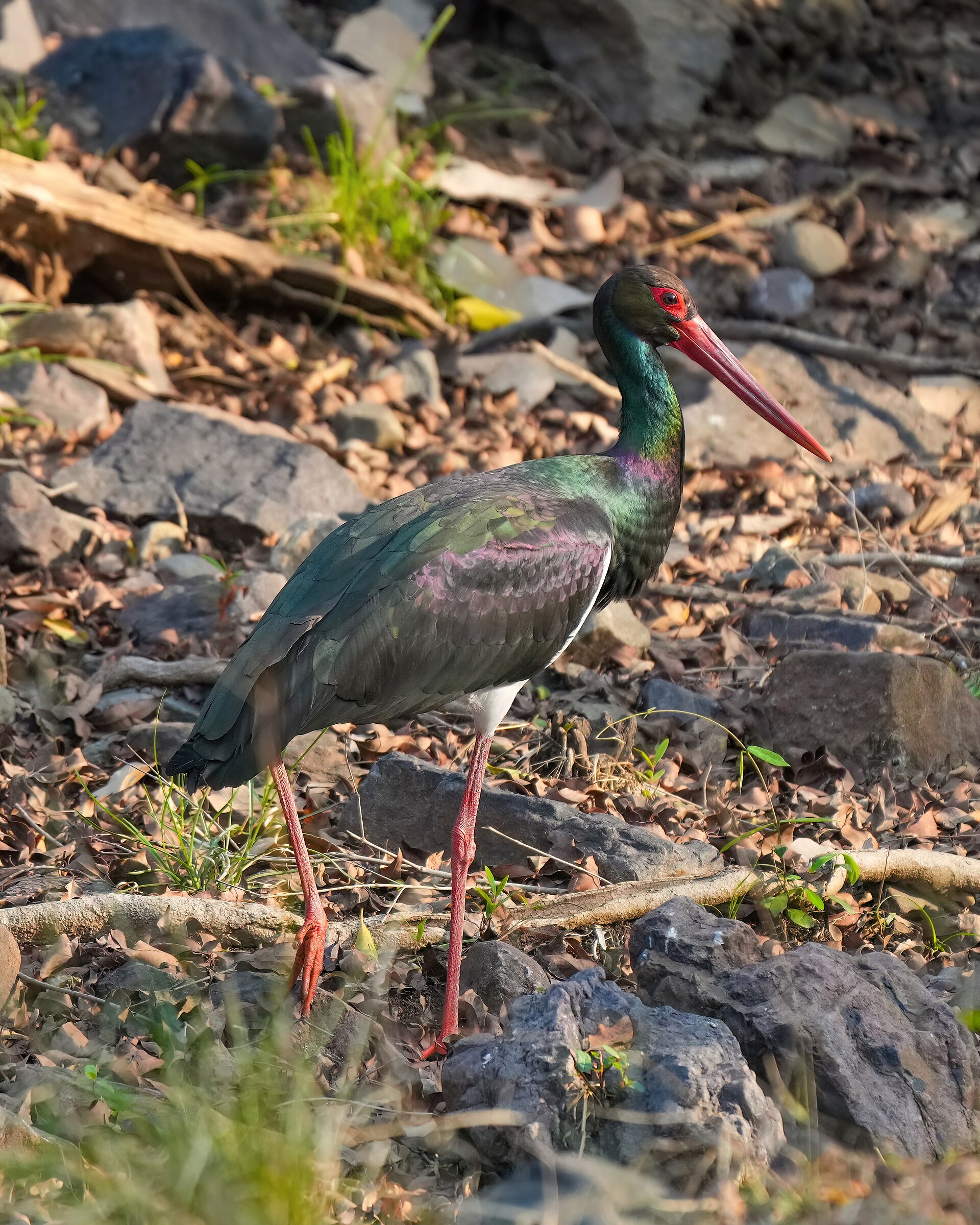
Black Stork
Ciconia nigra
Characteristics
Temperament
A large wild wading bird, diurnal and migratory, of a timid, shy, solitary nature — the opposite of the sociable white stork. It lives in scattered pairs or alone, far from humans, in mature forests near rivers and wetlands, and takes flight at the slightest disturbance. It hunts patiently in shallow water, mainly fish. It is NOT a pet: it is protected, rare and sensitive wildlife, to be observed at a distance and safeguarded by protecting the mature woods and clean waters it needs.
Diet
A predator of shallow fresh waters, with a more fish-based diet than the white stork. It feeds mainly on fish, as well as amphibians (frogs, toads, tadpoles), aquatic insects, crustaceans and molluscs, and occasionally small reptiles and mammals. It hunts by wading slowly in the shallow, clear waters of rivers, streams and ponds, scanning the bottom and catching prey with quick jabs, usually alone or in small groups. Its dependence on fish and clean water closely ties it to the health of freshwater environments.
The Black Stork (Ciconia nigra) is one of the most fascinating and elusive large wading birds in Europe: the wild, forest-dwelling counterpart of the famous white stork. Famous for:
- Glossy black plumage: black with green and purple metallic sheens, in contrast with the white belly
- Red bill and legs: a bright red, like the ring of bare skin around the eye
- A timid, solitary nature: unlike the white stork, it avoids humans and loves undisturbed forests
- Life in the woods: it nests in tall trees or on cliffs, away from prying eyes
- The great migration: it travels thousands of kilometres to winter in Africa
- Rarity: much less common and harder to observe than its white cousin
IUCN status: Least Concern (LC) globally, but rare and localized in Europe. It enters the portal in the group of wading birds, alongside the White Stork and the Shoebill: together with the white stork it forms a perfect pair of "opposites" — one white, gregarious and tied to humans, the other black, solitary and wild.
Classification and category
Order Ciconiiformes, family Ciconiidae (the storks), genus Ciconia — the same as the white stork (Ciconia ciconia). In the portal it is placed among the wading birds, the group of large, long-legged birds tied to wetlands. The comparison with the white stork is the best way to get to know it: the white stork is white with black wings, lives near humans, nests on roofs, chimneys and poles in highly visible colonies, and is tied to farms and villages; the Black Stork is mainly black with a white belly, shy and solitary, nests hidden in mature forests and avoids human-altered environments. Not to be confused with the herons (which fly with the neck folded in an "S", while storks fly with the neck outstretched) or the ibises. Etymology: "Ciconia" is simply Latin for "stork"; "nigra" means "black". The name immediately distinguishes it from its better-known white-plumaged relative. Parameters: Height about 95-100 cm. Wingspan about 145-155 cm. Weight about 3 kg (slightly smaller than the white stork). Longevity: remarkable, it can exceed 15-18 years in the wild and more in captivity. Reproduction: it builds a large stick nest in mature trees or on rock faces, away from disturbance; it usually lays 3-5 eggs, incubated by both parents.
Habitat and distribution
The Black Stork is a long-distance migrant with a very wide range but sparse populations: it breeds across much of Europe (in a localized way, including Italy) and temperate Asia; some populations are resident in the Iberian Peninsula and southern Africa; it winters in sub-Saharan Africa for the European populations, and southern Asia for the eastern ones. Preferred habitats — the forest-plus-water combination: mature, undisturbed forests, especially if crossed by watercourses; rivers, streams, ponds, marshes and wetlands, where it feeds; and rock faces and gorges, used locally for nesting. Unlike the white stork, deeply tied to open environments and humans, the Black Stork is a forest-dwelling, shy species that requires tranquillity and well-preserved environments. To feed it frequents shallow waters, but to nest it needs old undisturbed forests. This requirement makes it sensitive to disturbance, to the felling of woods and to the loss of wetlands. In recent decades, however, in several areas of Europe it has shown signs of slow recovery and expansion, returning to breed in regions from which it had disappeared. IUCN: Least Concern globally, thanks to its vast range, but in Europe it remains a rare, localized and protected species whose populations must be monitored carefully.
Diet
The Black Stork is a predator of shallow waters, with a more "fish-based" diet than the white stork. It eats: fish (the main component of its diet, caught in rivers, streams and ponds); amphibians (frogs, toads and tadpoles); aquatic insects, crustaceans and molluscs; and occasionally small reptiles and small mammals. Hunting techniques: patient wading (it walks slowly in shallow, clear water, scanning the bottom); the bill strike (it catches fish and prey with quick jabs); and solitary feeding (it feeds alone or in small groups, in quiet, secluded environments). Crucially, its strong dependence on fish and clear fresh water ties the Black Stork to the health of rivers and wetlands. This is why, like many aquatic predators, its presence is also an indicator of the quality of freshwater environments.
Physical features
A large, elegant wading bird with a sharp contrast between glossy black and white. Colours and plumage: black head, neck, back and wings, with splendid green, purple and bronze metallic sheens in the light; white belly and lower breast, clearly visible in flight; a long straight bill, long legs and an eye-ring of a bright red colour in adults. The body: a large, slender body, typical of storks; long legs suited to wading; broad wings, perfect for soaring flight and long migrations. Performance: flight with the neck outstretched (unlike herons), often soaring on thermals; great migratory stamina; and a cautious nature that makes it fly off at the slightest disturbance.
Behaviour and curiosities
The Black Stork is a solitary, timid, reserved bird, the exact opposite of the sociable white stork. It lives in scattered pairs or alone, away from sight, and is considered one of the hardest birds to observe among the large European wading birds. It is diurnal and migratory, facing huge journeys every year.
The "dark twin" of the white stork: the best way to understand the Black Stork is to compare it with the more famous white stork; they are close relatives but with opposite lifestyles: the white is gregarious, conspicuous and tied to humans, nesting in highly visible colonies on roofs and bell towers; the black is solitary, shy and wild, nesting hidden in forests; it is a beautiful example of how two similar species can "divide the world" by occupying different environments and lifestyles. The stork that doesn't bring babies: the famous legend that storks bring newborns concerns the white stork, always tied to European houses and villages; the Black Stork, living hidden in forests and far from humans, stayed out of this folklore, keeping instead a more "mysterious", wild aura; in some traditions, precisely for its reserve and dark colour, it has been surrounded by different beliefs, sometimes tied to the mystery of the forest. The journey to Africa: like many storks and raptors, the Black Stork is a migrant that exploits warm air currents (thermals) to soar while saving energy; for this reason it avoids long crossings over the open sea and channels its movements through "funnels" such as the Strait of Gibraltar or the Bosphorus, where great numbers of gliding birds can be seen on migration; European black storks thus reach sub-Saharan Africa, then return in spring. The stork that "talks": the white stork is famous for being almost mute and for communicating mainly by clattering its bill (the characteristic rattle); the Black Stork, instead, is a little more vocal: besides bill-clattering, it also gives some calls, though it remains an overall discreet bird; a small difference reflecting the different biology of the two species. The return to the woods: after suffering strong declines in the past, in various European countries the Black Stork is slowly returning, recolonizing forests and river valleys from which it had disappeared; this return is considered a good sign for forest and river environments, because the species requires mature woods and clean water: where the black stork returns, the environment is often in good health. The nest that lasts years: the Black Stork builds large stick nests in old trees or on rock faces, in quiet places, and tends to reuse and enlarge them for many years; a nest can thus grow from season to season, becoming an imposing structure and a fixed point of the pair's territory, a sign of these birds' fidelity to their nesting sites.
Pros
- Magnifico trampoliere, controparte selvatica e "misteriosa" della cicogna bianca
- Indicatore di ambienti sani: richiede foreste mature e acque pulite
- In lenta ripresa ed espansione in varie aree d'Europa
- Grande migratrice: affascinante esempio di volo veleggiato e di viaggi transcontinentali
Cons
- NON è un animale da compagnia: è fauna selvatica protetta, rara e schiva
- Molto sensibile al disturbo umano e al taglio delle vecchie foreste
- Dipende da zone umide e fiumi puliti: soffre il degrado degli ambienti d'acqua
- Difficilissima da osservare; popolazioni europee localizzate e da monitorare