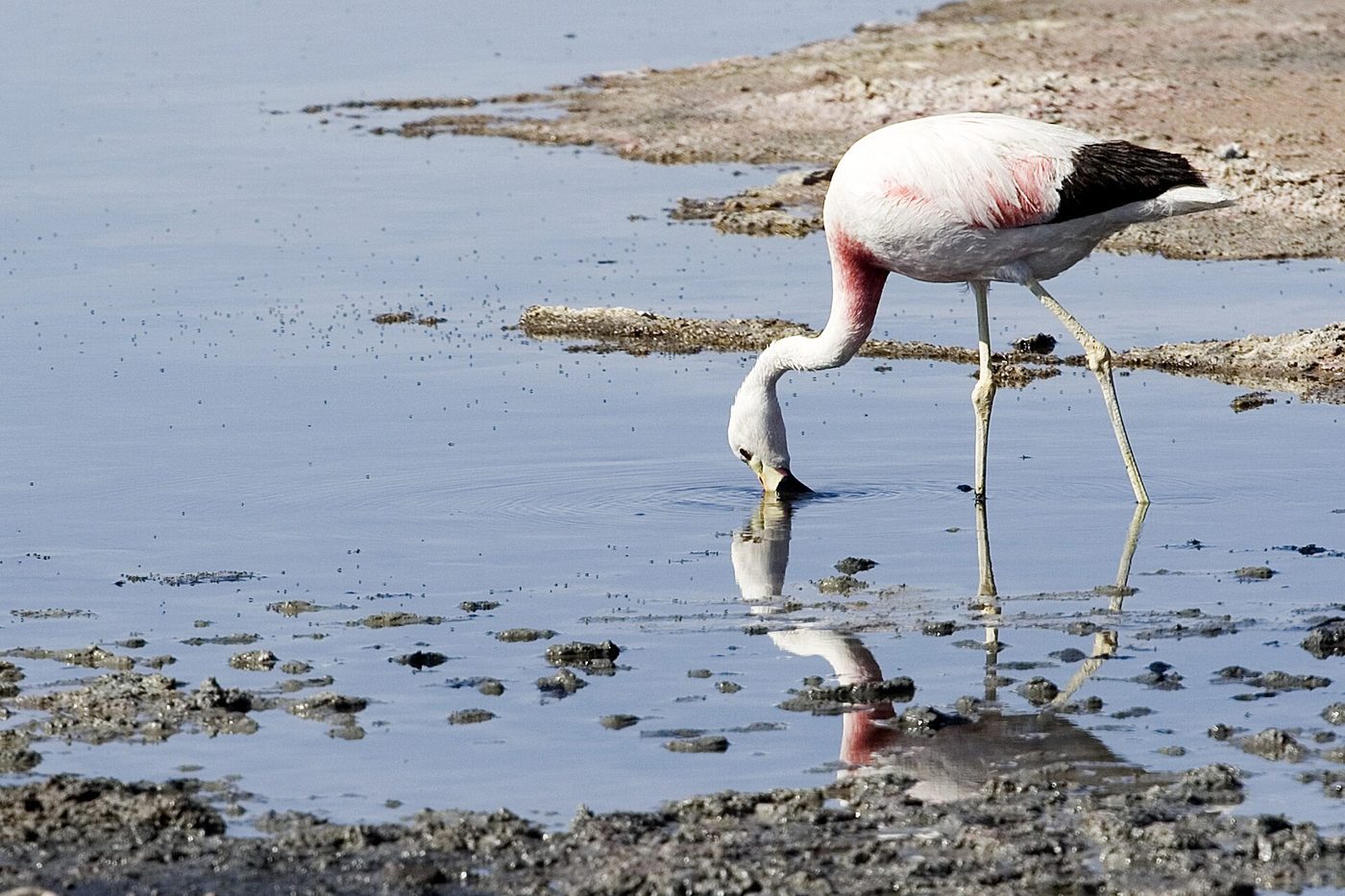
Photo: Luca Galuzzi (Lucag) · CC BY-SA 2.5
Andean flamingo
Phoenicoparrus andinus
An elegant bird of the high-altitude salt lakes, the Andean flamingo is the only flamingo with yellow legs and the largest in South America.
Characteristics
Temperament
Colonial, gregarious, specialised
Diet
Filter feeder: almost exclusively diatoms (algae)
A unique flamingo
The Andean flamingo is the largest of the South American flamingos and stands out for a feature that makes it unique in its family: its yellow legs and feet, whereas all the other flamingos have them pinkish or greyish. Its plumage is a pale pink, with dark red streaks on the neck and upper breast, and in flight the flight feathers form a sharp black triangle on the back. Its bill is pale yellow with a black tip. Like all flamingos, it has long legs and a long, sinuous neck.
Habitat and distribution
It lives in the mountainous regions of the Andes, across southern Peru, Bolivia, northern Chile and north-western Argentina. Its environment is the high-altitude salt lagoons of the Andean plateau, situated thousands of metres above sea level, where conditions are extreme, with strong temperature swings and thin air. It lives in colonies, often together with other flamingo species.
Feeding
The Andean flamingo has an extremely specialised diet: it feeds almost exclusively on diatoms, tiny algae that it filters from the shallow water of the salt lakes. It plunges its upturned bill into the water and, thanks to special filtering lamellae, retains the algae, separating them from the water and mud. It is precisely the pigments in this food that give the plumage its pink colour.
Conservation
The Andean flamingo is classified as a vulnerable species. It is threatened by egg collection, disturbance of its colonies, mining activity and alterations to the delicate water balance of the Andean lakes. The protection of the high-altitude lagoons on which it depends entirely is essential for its survival.
Pros
- The only flamingo with yellow legs
- The largest flamingo in South America
- Adapted to extreme high-altitude lakes
- Elegant and unmistakable
Cons
- Vulnerable species
- Highly specialised diet and habitat
- Depends on the fragile Andean salt lakes