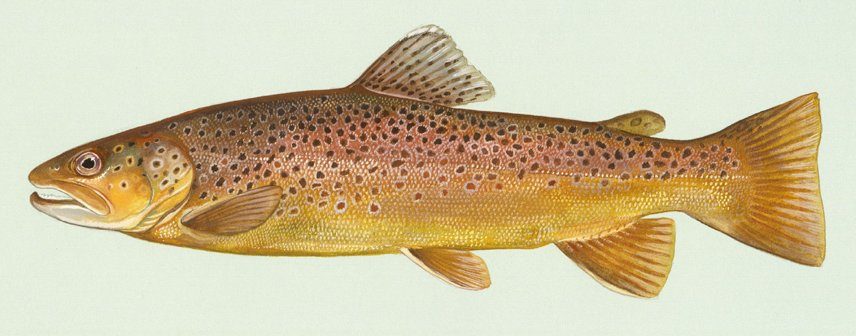
Photo: Duane Raver, U.S. Fish and Wildlife Service · Public domain
Brown trout
Salmo trutta
Sovereign of cold, clear waters, the brown trout is one of the most fascinating fish of our streams: elegant, voracious and extraordinarily variable.
Characteristics
Temperament
A solitary, territorial predator, lying in ambush among rocks and banks. Active chiefly at dawn and dusk; very demanding of water quality.
Diet
Carnivore: aquatic insects, larvae and invertebrates when young; also fish and insects fallen into the water as an adult.
A fish of a thousand liveries
The brown trout is a freshwater fish with a tapered, muscular body, built for life in currents. Its most fascinating feature is the extreme variability of its livery: the back may be brown, greenish or grey, the flanks golden or silvery, sprinkled with characteristic black and red spots often ringed by a pale halo. Two individuals from the same stream can look very different, and the colouring adapts to the environment and the type of water.
It is a member of the salmonid family, the same as the salmon, and like its relatives it needs well-oxygenated water.
Where it lives
The brown trout favours cold, clear, well-oxygenated water: mountain streams, fast-flowing rivers and alpine lakes. Water quality is fundamental to it, so much so that its presence is regarded as an indicator of healthy river environments. It likes to hide under banks, among roots and behind boulders, from where it watches the current in wait for prey.
An ambush predator
It is a voracious, opportunistic predator. When young it feeds mainly on aquatic insects, larvae and small invertebrates, while as an adult it also hunts other fish, tadpoles and insects fallen into the water. It hunts chiefly at dawn and dusk, using the current to take prey by surprise.
Breeding
Breeding takes place in autumn and winter. The female moves upstream to shallow water with a gravel bed, where she digs a small depression with her tail in which to lay her eggs. The gravel bed and flowing water ensure the oxygenation needed for the development of the fry, which hatch in spring.
Conservation
Globally the species raises no particular concern, but many local populations of native brown trout are in difficulty. The main threats are pollution and alterations of watercourses, the building of barriers that block migrations, and the stocking of farmed trout that alter the genetic heritage of native populations.