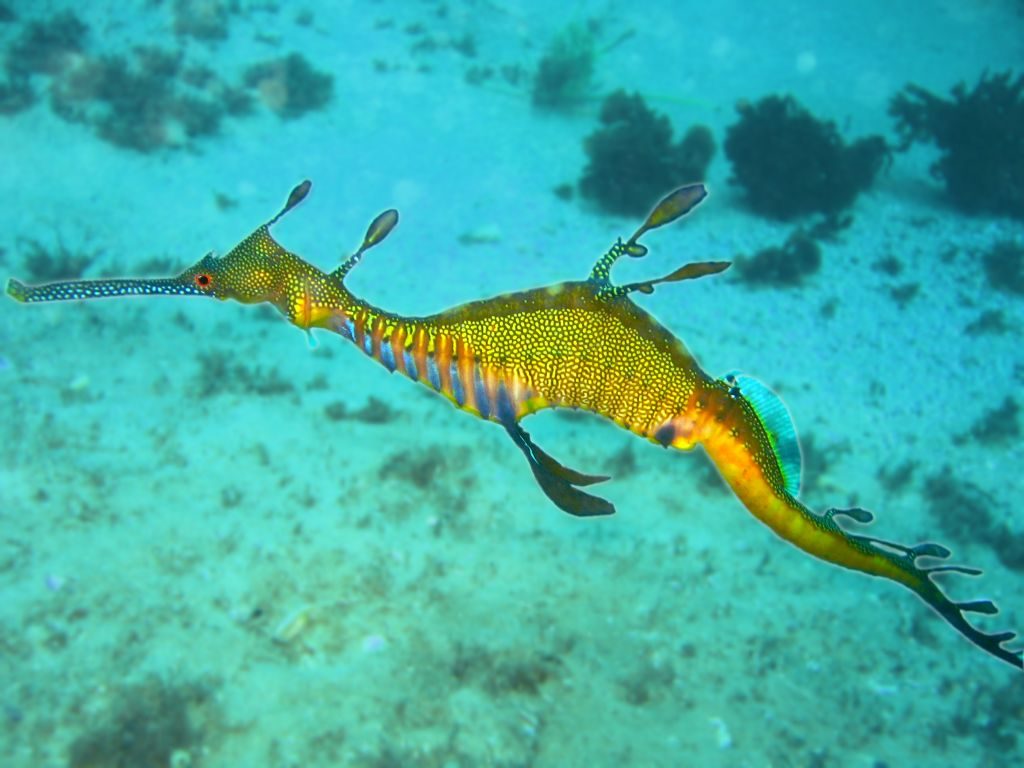
Weedy seadragon
Phyllopteryx taeniolatus
The weedy seadragon is a relative of seahorses, endemic to Australia, adorned with leaf-like appendages that camouflage it among the seaweed.
Characteristics
Temperament
Slow and cryptic; hovers motionless among the weed.
Diet
Carnivorous: tiny planktonic crustaceans sucked up with the snout.
A seahorse disguised as seaweed
The weedy or common seadragon (Phyllopteryx taeniolatus) is a fish of the family Syngnathidae, the same as seahorses and pipefishes. Adults are reddish, marked with yellow and purple stripes and adorned with small leaf-like appendages that mimic kelp or seaweed fronds, providing perfect camouflage; a few short spines add protection. Like seahorses, it has a tubular snout and a fused, toothless jaw with which it sucks in prey at lightning speed. It can reach about 45 cm in length.
Habitat and range
It is endemic to the temperate waters of southern Australia, where it inhabits seaweed meadows and kelp-covered rocky reefs, usually in shallow water. It moves slowly, propelled by tiny, almost transparent fins that are nearly invisible in motion.
Behaviour and diet
It feeds on tiny planktonic crustaceans, such as mysids, which it sucks up with its long snout. As in seahorses, it is the male that takes charge of the eggs: the female transfers them to the underside of the male's tail, where they stay attached and develop until they hatch.
Did you know?
The "leaves" covering its body are not for swimming but only for camouflage; movement comes from its transparent fins, so it seems to hover motionless among the weed. It is the marine faunal emblem of the state of Victoria in Australia.
Conservation
The IUCN lists it as Vulnerable. Loss of coastal habitats, pollution and illegal collection threaten the species, which has a restricted range and slow ability to recover.
Pros
- Spectacular camouflage among seaweed
- The male broods the eggs on his tail
- Marine emblem of the state of Victoria
Cons
- Vulnerable species with a restricted range
- Sensitive to loss of coastal habitats
- Slow to recover its numbers