Photo: Luc Viatour · CC BY-SA 3.0
Copperband butterflyfish
Chelmon rostratus
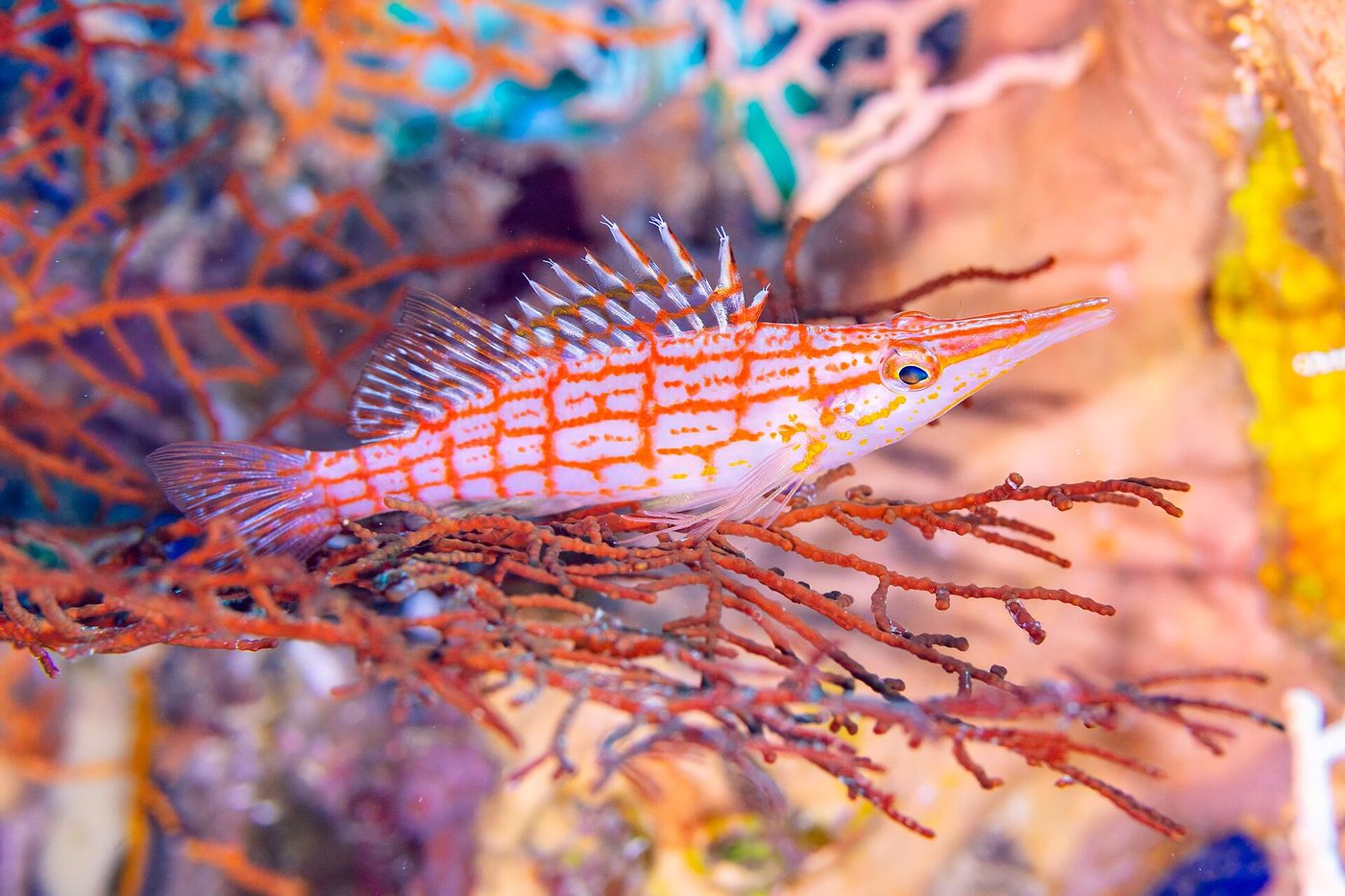
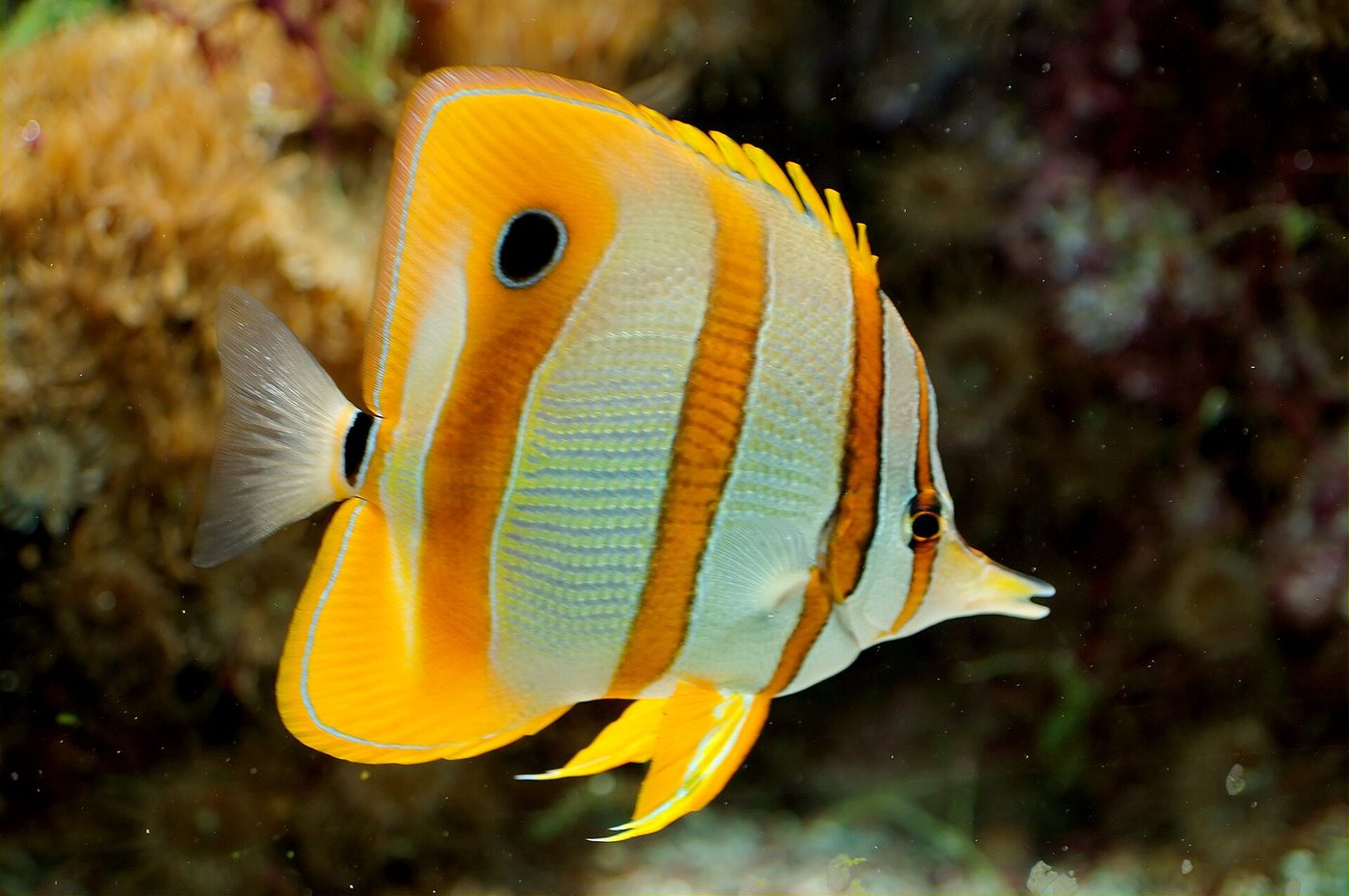
An elegant reef fish of the Indo-Pacific, the copperband butterflyfish has a long tweezer-like snout and a silvery body crossed by orange bands.
Characteristics
Temperament
Diurnal, reserved, methodical explorer
Diet
Carnivore: invertebrates, worms, crustaceans, polyps
A fish with tweezers
The copperband butterflyfish is one of the most elegant and recognisable reef fish. It has a tall, laterally compressed body of a silvery white, crossed by four or five vertical bands of a coppery orange, and a conspicuous black eye-shaped spot on the rear dorsal fin — a false eye that confuses predators. Its most distinctive feature is the snout, drawn out into a long, slender, tweezer-like beak.
Habitat and distribution
It lives on the coral reefs and estuaries of the western Pacific and Indian Oceans, often in coastal, even turbid, waters. It frequents the nooks and crevices of the coral, where it finds food and shelter.
Behaviour and diet
The long tweezer snout is a precision tool: it lets the fish probe the narrowest crevices of the reef to extract small invertebrates, worms, crustaceans and polyps. It is a diurnal fish, often seen singly or in pairs methodically exploring the seabed.
In the aquarium
It is one of the most sought-after marine fish among aquarists for its beauty, but has a reputation for being delicate and hard to feed: many individuals struggle to accept food in captivity. It is often valued because it eats the pest anemones (Aiptasia) that plague reef tanks. It needs mature, well-established tanks.
Conservation
The IUCN lists the species as Least Concern: it is common with stable wild populations. Fishing pressure for the aquarium trade is the main interaction with people.
Pros
- Unique tweezer snout and elegant livery
- Eats pest Aiptasia anemones
- Common and not threatened in the wild
Cons
- Delicate and hard to feed in an aquarium
- Needs mature, well-established tanks
- Not for marine-aquarium beginners