Spotted handfish
Brachionichthys hirsutus
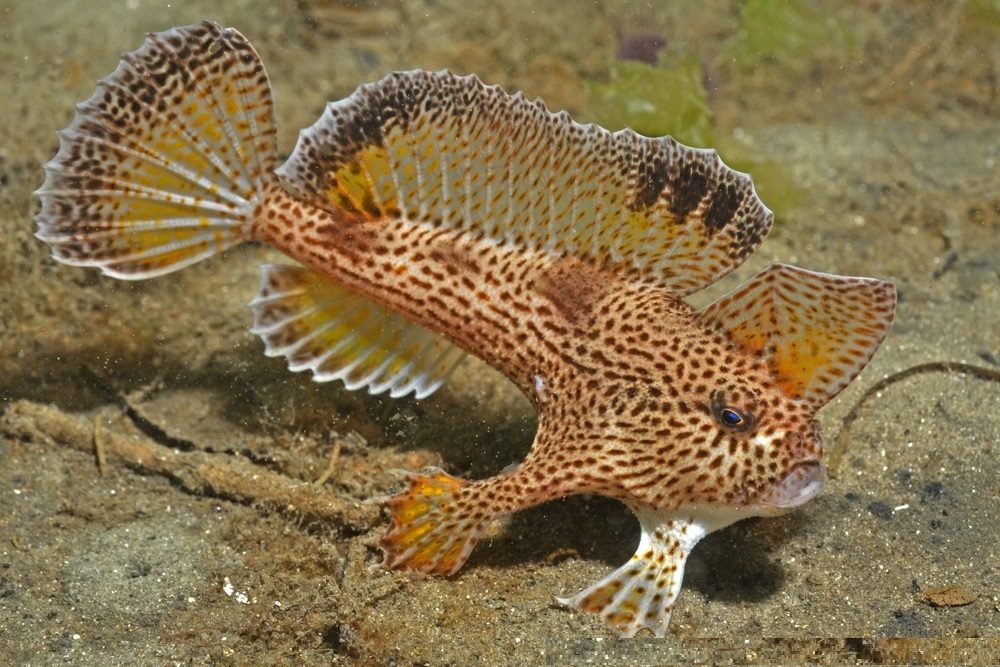
A very rare, critically endangered Tasmanian fish, the spotted handfish does not swim but 'walks' along the seabed on fins shaped like little hands.
Characteristics
Temperament
Sedentary, walks the bottom on its fins
Diet
Carnivore: small bottom invertebrates and worms
A fish that walks along the bottom
The spotted handfish is one of the most unusual and rare fish in the world. Rather than swimming, it moves by "walking" along the seabed: its pectoral and pelvic fins are modified into appendages resembling small hands with fingers, which it uses to step along. Its body is whitish, dotted with brown spots, and on its head it carries a small fleshy "lure", a legacy of its kinship with the anglerfishes. It is small, only a few centimetres long.
Habitat and distribution
It has an extremely restricted range: it lives only in the estuary of the River Derwent and nearby waters, in Tasmania, on sandy and muddy bottoms at modest depths. It is a sedentary species tied to a very specific environment.
Behaviour and reproduction
It is a predator that hunts small invertebrates and worms on the bottom. The female lays her eggs by attaching them to vertical structures such as seaweed or stalks, and guards them. This very reliance on specific spawning supports makes it vulnerable to habitat change.
Curiosities
Its gravest threat is an invasive species: the Northern Pacific seastar, introduced to Tasmania, which preys on the eggs and destroys the supports on which they are laid. Programmes are under way that place artificial spawning structures on the seabed to help the species reproduce.
Conservation
The IUCN classifies the species as Critically Endangered. Besides the invasive seastar, threats include estuary pollution, disturbance of the seabed and its tiny range, making it one of the most at-risk marine fish in the world.
Pros
- Walks the bottom instead of swimming
- Fins modified into unique 'hands'
- A flagship for Tasmanian marine conservation
Cons
- Critically endangered, among the rarest fish in the world
- Tiny range, highly vulnerable
- Threatened by an invasive seastar