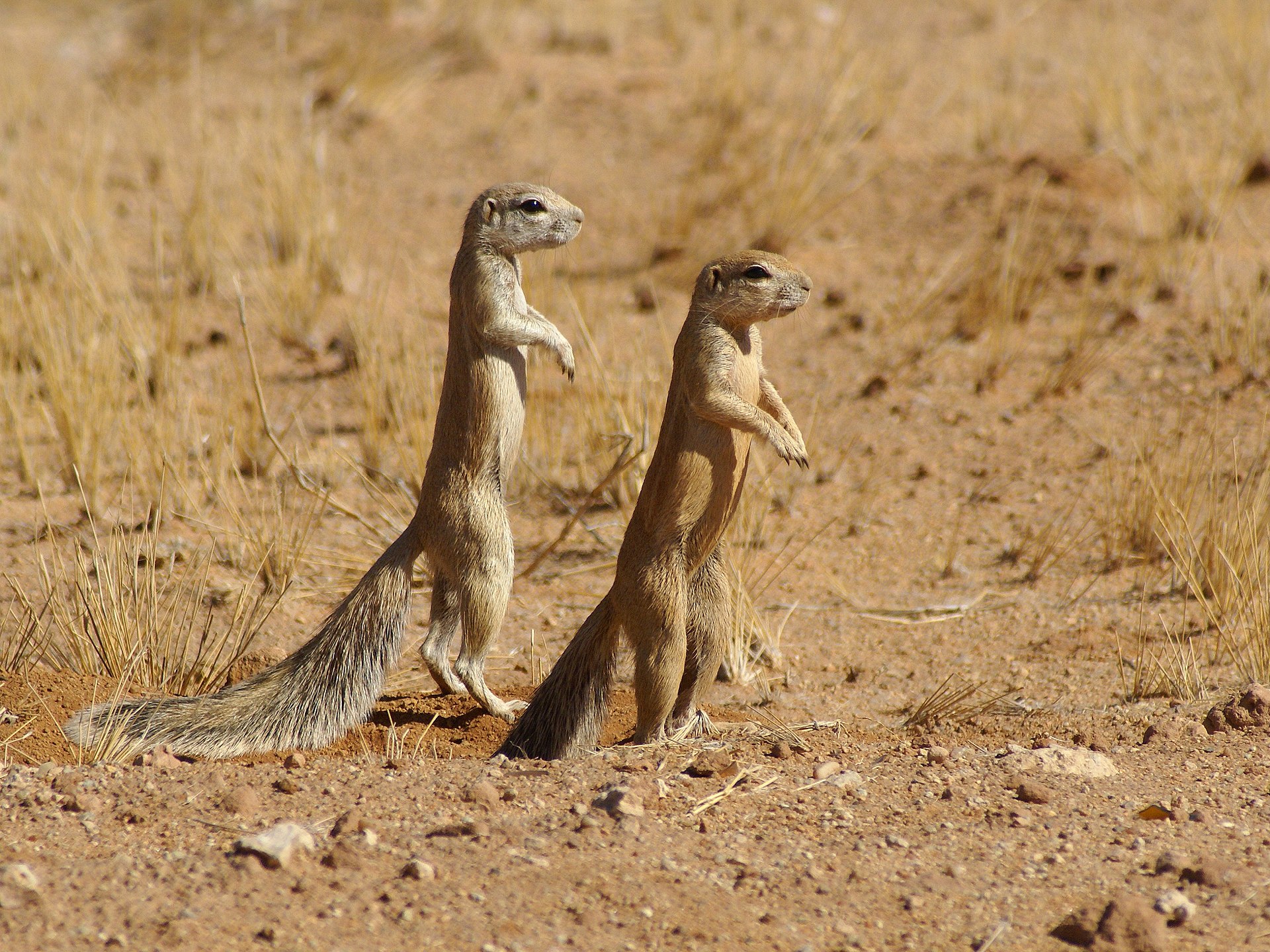
Cape Ground Squirrel
Xerus inauris
Characteristics
Temperament
A wild ground squirrel, diurnal, social and cooperative, perfectly adapted to the arid savannas of southern Africa. It lives in colonies organised in extensive burrow systems, where the groups share refuge, vigilance and communication. It is an active, alert animal that stands upright as a sentinel and quickly takes refuge underground at the first alarm; famous for using its large bushy tail as a parasol against the desert sun. It is NOT a pet: it is native wildlife, to be observed and safeguarded in its environment, where its burrows also offer shelter to other species.
Diet
Mainly herbivorous, adapted to aridity: it feeds above all on bulbs, roots and tubers — precious reserves of water and nutrients in the desert — as well as seeds, grasses and shoots, occasionally supplementing with insects. It forages by day staying near the shelters, and uses its sturdy claws to unearth bulbs and roots. Like many desert animals, it gets most of its water directly from food and drinks rarely. By exploiting the underground parts of plants, it manages to find food and water even in a poor, dry environment.
The Cape Ground Squirrel (Xerus inauris) is one of the most characteristic rodents of the arid savannas of southern Africa: a ground-dwelling, social, tireless squirrel, famous for using its tail as a sunshade. Famous for:
- The parasol tail: it holds its large bushy tail raised over its back to shelter from the sun
- Ground life: unlike the tree squirrels, it lives and digs in the ground
- The white flank stripe: a pale band along each side of the body
- Sociability: it lives in cooperative colonies in extensive burrow systems
- Sentinel behaviour: it stands upright on its hind legs to scan for dangers
- Coexistence with other animals: it often shares its burrows with meerkats and mongooses
IUCN status: Least Concern (LC). It enters the portal among the sciurids, alongside the Prairie Dog, the Souslik and the Eastern Chipmunk: with them it shares the "ground" and colonial life typical of ground squirrels, here represented by a species perfectly adapted to the African desert.
Classification and category
Order Rodentia, family Sciuridae (the squirrels), in the group of African ground squirrels (subfamily Xerinae). The species is Xerus inauris. In the portal it is placed among the sciurids, i.e. the ground squirrels and allies. It is useful to tell it apart from similar animals or those sharing its environment: the tree squirrels (like the red squirrel or Finlayson's, in the portal) — they live in trees, while the Cape ground squirrel is strictly ground-dwelling; the Prairie Dog and the Souslik (in the portal) — other ground and colonial sciurids, but of other continents and of different appearance; the meerkats and mongooses — they often share the habitat and burrows, but are NOT rodents (they are small carnivores), though they have similar social habits. The combination of sandy body with a white flank stripe + large bushy tail used as a parasol + colonial ground life in southern Africa is this species' "identity card". Etymology: the genus name Xerus comes from Greek and evokes the "dry", arid environment in which it lives; "inauris" refers to features of the ear; "Cape" recalls the South African region. Parameters: Length a body of about 20-25 cm, plus an almost equally long tail. Weight roughly 500-700 g. Appearance a slender, sandy body, a wide, bushy "fan" tail. Longevity: a few years in the wild. Reproduction: tied to colonial life; the young are born and grow up safe in the burrows.
Habitat and distribution
The Cape Ground Squirrel is a typically African, arid rodent: its range covers southern Africa — South Africa, Botswana, Namibia and neighbouring areas, with the Kalahari as its emblematic environment. Preferred habitats — open, dry environments with soil suitable for digging: arid savannas and semi-deserts; dry grasslands, steppes and scrub areas; and sandy and hard ground in which to build the burrow systems. It is a diurnal, ground-dwelling and strongly social animal: it lives in colonies that occupy wide networks of underground burrows, where the groups (generally females with young) find refuge from the heat, the night cold and predators. The burrows offer a stable microclimate, precious in an environment of extreme temperatures. During the day the squirrels come out to forage nearby, always alert, and quickly return underground at the first alarm. The ability to dig and colonial life are at the centre of its survival strategy in the desert. IUCN status: Least Concern (LC). It is common and widespread in its arid range, and plays an important ecological role: its burrows are also used by other animals.
Diet
The Cape Ground Squirrel is mainly herbivorous, with a diet suited to arid environments. It feeds on: bulbs, roots and tubers (important reserves of water and nutrients in the desert); seeds, grasses and shoots; and occasionally insects and other animal material. Feeding habits: diurnal foraging (it comes out to look for food in daylight hours, staying near the shelters); digging (it uses its sturdy claws to unearth bulbs and roots); and water efficiency (like many desert animals, it gets most of its water from food). Crucially, by feeding largely on bulbs and underground plant parts, the Cape ground squirrel manages to obtain food and water even in a poor, dry environment, exploiting what is found below the surface.
Physical features
A slender-looking ground squirrel, made famous by its tail. The tail — the distinguishing trait: large, bushy and flattened "fan"-like, flecked with dark and light; used as a parasol (held raised and curved over the back to make shade); and also a signalling function among colony members. The body and coat: short, sandy-coloured fur, camouflaged in the desert; a characteristic white stripe along each flank; and pale underparts. The adaptations: sturdy legs with strong claws, of a digger; the ability to stand upright on its hind legs, as a sentinel; and a good tolerance of heat, thanks to behaviour (parasol, burrows) more than to particular physical traits.
Behaviour and curiosities
The Cape Ground Squirrel is a diurnal, social, cooperative animal, whose life revolves around the colony and the extreme desert environment. It is known above all for a behaviour as simple as it is ingenious: the use of its tail as a sunshade.
The umbrella tail: this species' most famous trait is the use of its large bushy tail as a parasol; while foraging under the scorching desert sun, the squirrel raises and curves its tail over its head and back, creating a portable patch of shade that helps it not to overheat; it is an elegant behavioural solution to one of the main problems of desert life: heat. Life in the colony: the Cape ground squirrel is a very social animal; it lives in organised colonies, with groups of females and young sharing extensive burrow systems, and bands of males that move between the groups; cooperation, shared vigilance and communication are essential for survival in an environment full of predators and dangers. The desert "flatmates": one of the most fascinating features of this species is its coexistence with other animals; the Cape ground squirrel often shares its burrows with meerkats and yellow mongooses, in a kind of desert "co-op"; although very different animals (squirrels are rodents, meerkats small carnivores), they gain mutual benefit from communal life, for example in watching for predators. The upright sentinel: like many social rodents of open environments, the Cape ground squirrel often stands upright on its hind legs to scan its surroundings; in this "sentinel" posture it checks for the arrival of raptors, snakes and other predators, ready to raise the alarm and send the group into the burrows. The animal that does not hibernate: unlike some of its relatives of temperate areas (such as marmots and sousliks), the Cape ground squirrel does not hibernate: it lives in a hot climate and stays active all year; its main challenge is not cold, but heat and aridity, which it faces with behaviours such as the parasol-tail and refuge in the cool burrows. The "engineer" digger: by digging its wide burrow networks, the Cape ground squirrel modifies the ground and creates shelters used by many other animals; it is, on a small scale, an "ecosystem engineer": its tunnels offer shelter and a stable microclimate in an otherwise hostile environment.
Pros
- Roditore affascinante e dagli straordinari adattamenti al deserto (coda-parasole)
- Molto sociale e cooperativo: vive in colonie con vigilanza condivisa
- Ingegnere dell'ecosistema: le sue tane offrono rifugio a molte altre specie
- IUCN Least Concern: comune e diffuso nell'Africa meridionale arida
Cons
- NON è un animale da compagnia: è fauna selvatica autoctona
- Strettamente legato agli ambienti aridi e aperti: sensibile alle alterazioni dell'habitat
- Localmente può entrare in conflitto con l'agricoltura scavando o nutrendosi nei coltivi
- Esposto a numerosi predatori (rapaci, serpenti, carnivori): vita media breve