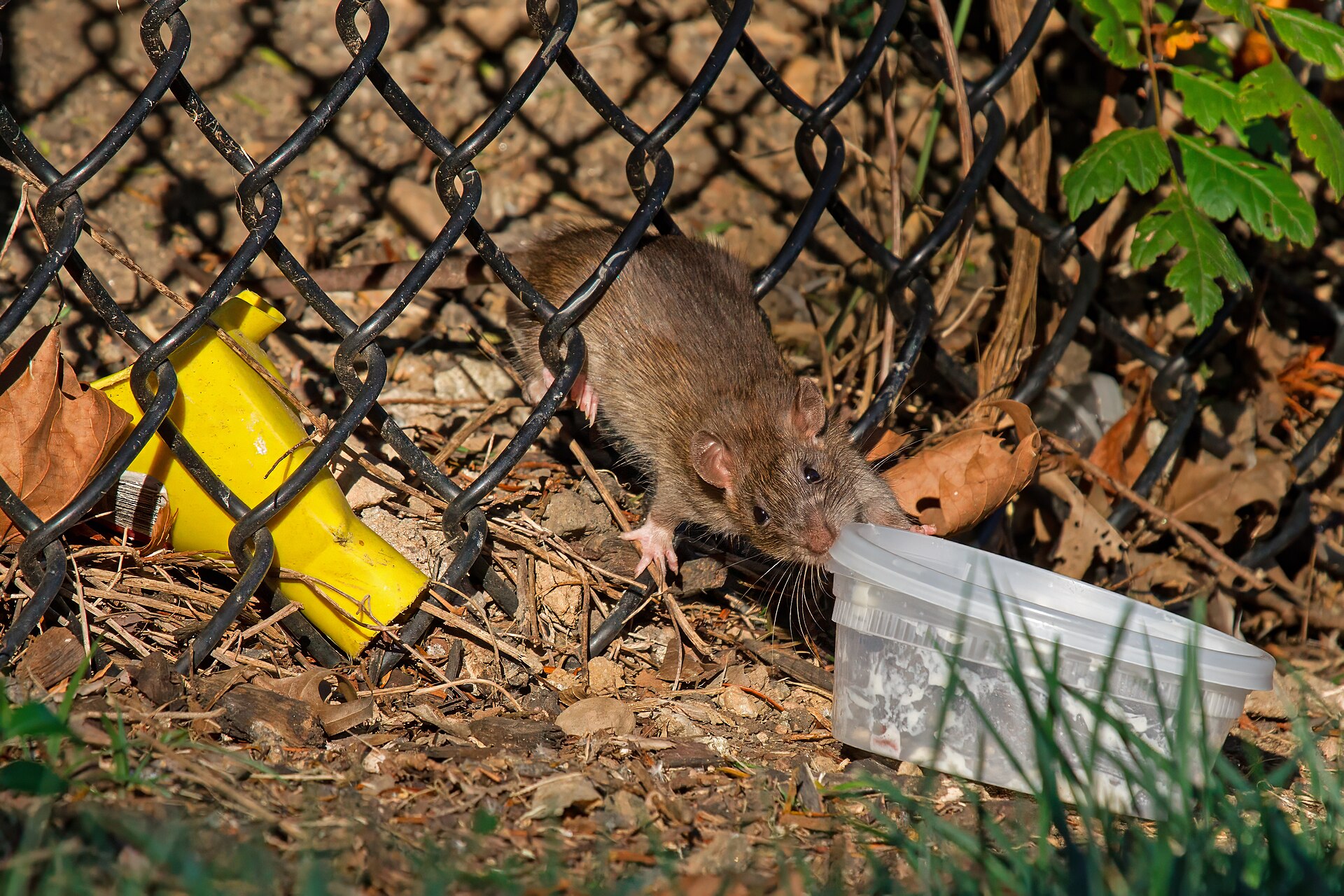
Brown Rat
Rattus norvegicus
Characteristics
Temperament
Highly social, hierarchical, extremely intelligent (comparable to a dog for trainability). Shows empathy, cooperation, "laughter" at 50 kHz when tickled. Excellent pocket pet.
Diet
Generalist omnivore. 30-60 g/day + 30-60 ml water. Food neophobia (tastes a little before consuming). Fancy lines: specific pellets + fruit/vegetables. Avoid chocolate and citrus fruits.
The Brown Rat (Rattus norvegicus), also known as Common Rat, Norway Rat or Sewer Rat, is the largest and most widespread of living rats. Native to north-eastern Asia (Mongolia, northern China), it actively spread to Europe in the 18th century and today is one of the most cosmopolitan species on the planet, present on every continent except Antarctica. It has a fascinating dual identity: on one hand it is considered one of the most damaging urban pests in human history, on the other it is loved as "Fancy Rat", an extremely intelligent and affectionate pet. It is also the second most important scientific model in the world after the mouse, fundamental for neurosciences, behavioural psychology and pharmacology.
Classification and category
The Brown Rat belongs to the order Rodentia, family Muridae, subfamily Murinae, genus Rattus. The genus comprises over 60 species of rats, but R. norvegicus is the quintessential cosmopolitan species together with the congeneric R. rattus (Black Rat or Roof Rat). It is distinguished from the latter by larger size, tail relatively shorter than body, and a preference for ground-level environments (while the Black Rat is more arboreal). Body length is 18-25 cm, to which is added a tail of 15-20 cm. Average weight of wild adult specimens is 200-500 g, but well-fed urban specimens can exceed 600 g. Laboratory lines (e.g. Wistar, Sprague-Dawley, Long-Evans) and fancy breeds can reach 800-900 g. Males are slightly larger than females.
Habitat and distribution
The original habitat of the Brown Rat were the steppes and river zones of north-eastern Asia. Global spread began in the 18th century: documented in Western Europe from about 1730, it reached England in 1730, the USA in 1775, and then spread to all continents following maritime trade routes. The name "norvegicus" is actually misleading: the species is not native to Norway, but when it was scientifically described by John Berkenhout in 1769, it was (mistakenly) thought to have arrived in England from Norwegian ships.
Today it is present on every continent except Antarctica, with populations estimated in billions of individuals (in many large cities estimates are 1 rat per human). Preferred habitats are ground-level anthropic environments: sewers, basements, warehouses, port docks, landfills, urban parks, agricultural farms. Far from humans it lives in burrows dug in the ground along the banks of rivers and lakes. Conservation status is listed as Least Concern (LC) by the IUCN; on the contrary, in many countries it is the subject of active pest control programmes. The species is considered among the 100 most invasive on the planet: it has caused the extinction of multiple endemic birds on oceanic islands (Galápagos, Hawaii, New Zealand, Antilles). There are also three main "domesticated" populations: laboratory rats (selected from 1828), fancy rats as pets (from about 1850), feed rats for raptors/reptiles.
Diet
The Brown Rat is a generalist omnivore with extremely flexible diet. Preferences: cereals, seeds, fruit, vegetables, meat, fish, eggs, insects. It is capable of exploiting any source of calories available, from urban waste to agricultural products, from animal carcasses to food stores in houses and warehouses. Daily requirement is 30-60 g of food (about 10% of body weight), and it needs 30-60 ml of water. Unlike the house mouse, the rat needs to drink: it does not survive without free water for more than 4-5 days.
It possesses a digestive system specialised for coprophagy: it produces two types of faeces (caecal, rich in B vitamins produced by gut bacteria, and final), it ingests the former directly from the anus to recover nutrients. The rat is famous for "food neophobia": faced with a new food, it initially tastes minimal amounts and waits hours before consuming more — an evolutionary mechanism that protects it from poisoning and makes pest control with toxic baits difficult. Domestic fancy lines are adapted omnivores: diet based on specific rat pellets supplemented with small quantities of fruit, fresh vegetables, various seeds. Water always available in drip bottles. Foods to absolutely avoid: chocolate, citrus fruits (for males: cause kidney stones), green broccoli, onions, alcohol.
Physical features
The Brown Rat has a robust, elongated and stocky body, well distinguishable from the slimmer Black Rat. The muzzle is rounded, with large sensory whiskers. The eyes are small and black, the ears short, rounded, scantly haired. The tail, semi-naked (with thin rings of scales), is shorter than the body (diagnostic feature vs Black Rat, in which it exceeds the body) and is dark above, light below. The fur of wild specimens is grey-brown on the back, with darker guard hairs, lighter belly. In fancy specimens there are over 30 colour varieties (agouti, black, blue, mink, husky, siamese, dumbo) and coat types (standard, rex, satin, hairless/nude, manx without tail).
The incisors are orange with continuous growth (about 14 cm per year), capable of gnawing very hard materials: concrete, aluminium, lead, electrical cables, even thin iron wire. Bite force can reach 7 kg/cm² (disproportionate for the size). The forepaws are very dexterous, capable of manipulating objects like small hands. The rat is an excellent swimmer: it can swim 3 km continuously, hold its breath up to 3 minutes, survive falling into the toilet (and climb back up through the siphons). It runs at 10-13 km/h, jumps vertically 70-80 cm. It possesses rudimentary echolocation, dichromatic vision (green-blue), highly developed olfaction (DNA with 1,500 olfactory genes, against humans' 350).
Behaviour and curiosities
The Brown Rat is a highly social, intelligent, emotional animal. It lives in hierarchical colonies of 30-150 individuals, with a dominant male (boss), females allied for collective care of pups (alloparenting), young and subordinate males. Communication is complex: it includes urinary pheromones (signal sex, rank, stress), ultrasonic vocalisations (20-50 kHz), and — sensational 1999 discovery by Dr Jaak Panksepp — rats produce "laughter" at 50 kHz when tickled, suggesting emotional capacities similar to those of higher mammals. Rats show empathy (free trapped fellows without reward), cooperation, even sense of fairness.
Fertility is extraordinary: the female can give birth to up to 5-7 litters per year, with 6-12 young per litter. Gestation is 22 days, weaning at 21 days, sexual maturity at 5-6 weeks. A pair in ideal conditions can generate thousands of descendants in one year. Wild longevity is short (1-2 years, high predation and disease), in captivity 2-3.5 years. Fancy domestic lines were born around 1840-1850 when famous "Black Jack" Beach in London organised contests between ratter dogs and rats: the "prettiest" rats (unusual colour variants) were saved and sold as pets. Charles Darwin was among the first fancy rat enthusiasts. Today they are considered one of the best "pocket pets": extremely intelligent (comparable to a dog for trainability), affectionate, sociable, hygienic. In the USA the National Fancy Rat Club has been organising shows since 1976. On the scientific side, over 25 million rats are used in research every year; Wistar (since 1906) and Sprague-Dawley (since 1925) lines are among the most used models for neurosciences (Skinner, Pavlov), pharmacology, oncology. The "rat effect" in psychology (Robert Rosenthal, 1963) demonstrated how the experimenter's expectation influences the performance of animals.
Pros
- Intelligenza eccezionale, addestrabilità da cane
- Affettuoso e sociale come pet (fancy rat)
- Igienico (si lava costantemente)
- Secondo modello scientifico più importante al mondo
Cons
- In natura: una delle 100 specie più invasive del pianeta
- Veicolo di zoonosi (leptospirosi, hantavirus, salmonellosi)
- Longevità breve (2-3 anni) anche in cattività
- Fertilità esplosiva, va sterilizzato o tenuto monosessuale