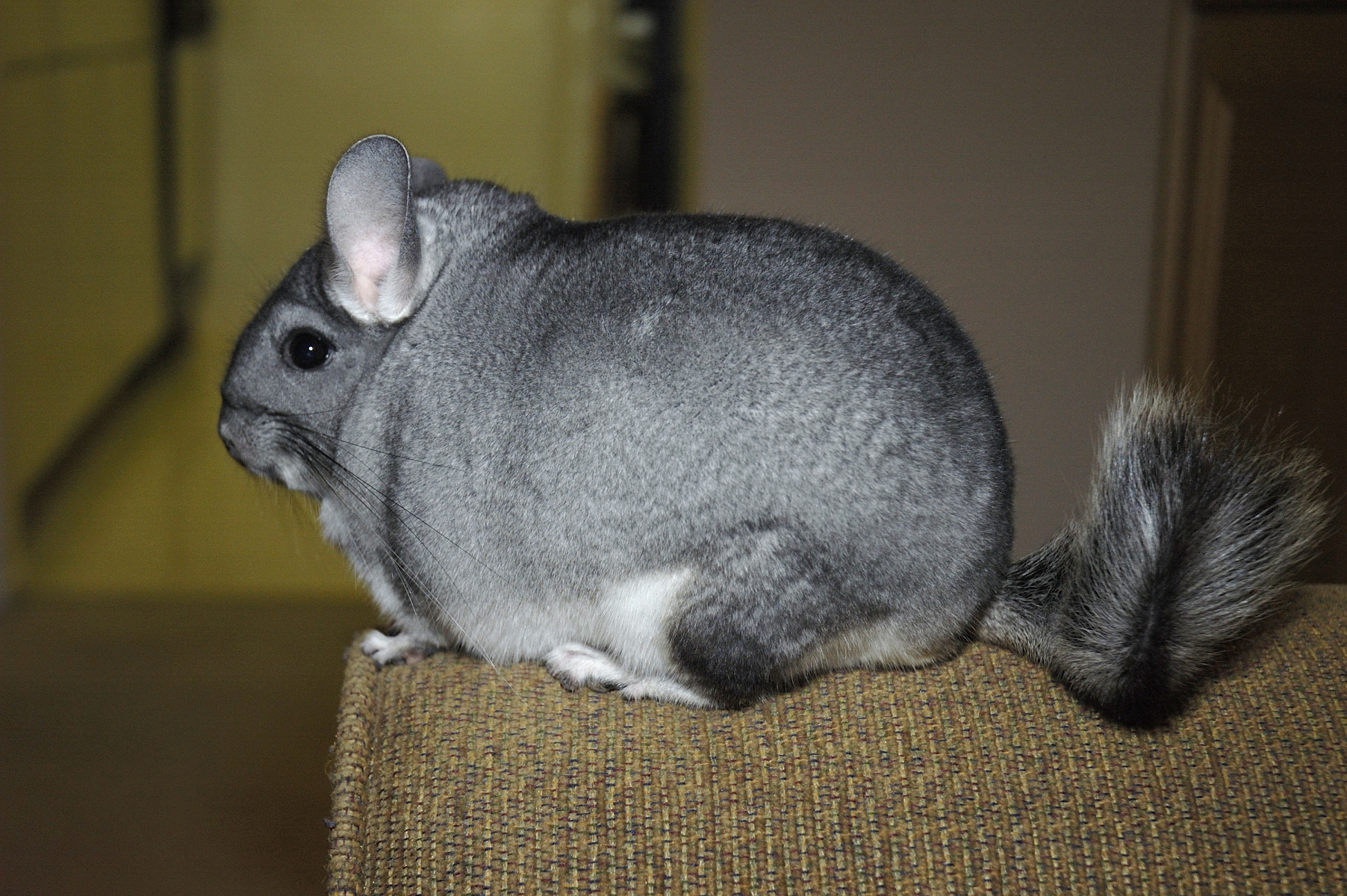
Long-tailed Chinchilla
Chinchilla lanigera
Characteristics
Temperament
Social, nocturnal/crepuscular. Only bathes in pumice dust (no water!). Defence "fur slip": can drop tufts of fur if grabbed. Jumps up to 1.8 m.
Diet
Strict herbivore: high-quality hay (base), chinchilla-specific pellets, dried herbs. Avoid fruit, oilseeds, corn, sugars (risk of lethal dysbiosis).
The Long-tailed Chinchilla (Chinchilla lanigera) is a small high-altitude rodent native to the Chilean Andes. Famous for its incredibly dense fur — up to 20,000 hairs per square centimetre, the densest in the animal kingdom — it was driven to the brink of extinction between the 19th and 20th centuries by indiscriminate hunting and today survives in the wild only thanks to targeted conservation programmes. It is also one of the most beloved small mammals kept as a pet.
Classification and category
The chinchilla belongs to the order Rodentia, family Chinchillidae, which also includes the plains and mountain viscachas. The two living species are Chinchilla lanigera (long-tailed chinchilla, the more common in captivity) and Chinchilla chinchilla (Andean or "Bolivian" chinchilla, larger). It is a small rodent: body length is 22-38 cm, plus a bushy tail of 10-15 cm. Average adult weight is 400-800 g, with females larger than males — an unusual trait among rodents.
Habitat and distribution
The chinchilla's natural habitat consists of rocky, arid and high-altitude zones of the Andes, between 3,000 and 5,000 metres, particularly in the Atacama and Coquimbo regions of north-central Chile. It lives in colonies among rocky crevices, on south-facing slopes (cooler) covered with cushions of xerophytic vegetation and succulents.
Its historical range covered Chile, Bolivia, Peru and Argentina; today the wild species survives only in two small nuclei in Chile, with a total population estimated at a few thousand individuals. Conservation status is listed as Endangered (EN) by the IUCN since 2008, and the species is included in CITES Appendix I, which prohibits international commercial trade. Between the 19th and the beginning of the 20th century, more than 21 million specimens are estimated to have been killed for the fur trade, considered the most precious in the world. Virtually all individuals currently present in homes come from captive breeding.
Diet
The chinchilla is strictly herbivorous. In the wild it feeds on dry grasses, seeds, bark, shrub leaves and succulents — all plants adapted to a dry and poor environment. The diet is naturally very fibrous and low in fat.
In captivity, the dietary basis must be high-quality hay (grass hay, alfalfa used in moderation), always available and of premium quality. It is supplemented with chinchilla-specific pellets (never with rabbit or guinea-pig mixes, which are too fatty) and occasionally small amounts of dried herbs. Fruit, oilseeds, corn and sugary cereals must be avoided: the chinchilla's digestive system is extremely sensitive and cannot handle excess sugars and fats, with potentially lethal consequences (bloating, dysbiosis). Water must always be fresh and available, preferably in a sipper bottle.
Physical features
The chinchilla has a stocky body, a large head with shiny black eyes, wide rounded ears and very long whiskers. Hind legs are more developed than the front ones, giving it a hopping gait suited to rocky environments: an adult chinchilla can jump up to 1.8 metres high. The tail is bushy and prehensile, used for balance during jumps.
The fur is its most extraordinary feature: each follicle produces not a single hair as in other mammals, but up to 60-80 hairs, reaching a density of about 20,000 hairs per square centimetre (by comparison: humans have about 300 on the scalp). This trait is an adaptation to the intense cold of the Andes, but it makes the fur so dense that parasites cannot penetrate it. A practical consequence is that the chinchilla cannot get wet: the fur retains water and mould forms in a matter of hours. Cleaning happens through volcanic sand baths (fine pumice powder), which absorbs excess sebum.
Behaviour and curiosities
The chinchilla is a social, nocturnal and crepuscular animal: in the wild it lives in colonies of 14-100 individuals led by a dominant female. It is active at dawn and dusk and sleeps in rocky crevices during the central hours of the day. Its vocal repertoire is rich: gurgles, sharp whistles, contented "purrs", alarm calls. In captivity it also communicates with its owner, recognising them by voice.
A characteristic defence of the species is fur slip: if grabbed roughly by the fur, it can leave a tuft of hair in the hand of the aggressor (predator or careless human), allowing it to escape. Regrowth takes weeks. Lifespan is remarkable among rodents: 10-15 years in captivity, with documented records of over 20 years. Sexual maturity is reached at 8-12 months; gestation is unusually long (111 days) and the young are born fully developed, already with fur and open eyes, able to walk and jump within hours of birth.
Pros
- Longeva (10-15 anni, fino a 20+)
- Silenziosa, ipoallergenica (poco pelo libero)
- Intelligente, riconosce la voce del proprietario
- Non ha odore caratteristico
Cons
- Specie protetta (CITES Appendice I): solo cuccioli da allevamenti dichiarati
- Dieta molto rigida, errori possono essere letali
- Non si bagna mai, bagno di sabbia indispensabile
- Temperatura ambiente max 23-24 °C (rischio colpo di calore)