Capybara
Hydrochoerus hydrochaeris
Characteristics
Temperament
Extremely social and peaceful. Lives in groups and tolerates other species. Excellent semi-aquatic swimmer.
Diet
Strict herbivore: grass, aquatic plants, reeds, soft bark, fruit. An adult consumes 3-4 kg of vegetation per day.
The Capybara (Hydrochoerus hydrochaeris) is the largest rodent in the world, native to the wetlands of South America. Famous for its peaceful nature and extraordinary ability to socialise with other species, it has become an internet icon in recent years thanks to its relaxed attitude and benign expression.
Classification and category
The Capybara belongs to the order Rodentia, family Caviidae, subfamily Hydrochoerinae. It is closely related to the guinea pig (genus Cavia) and to the lesser capybara, Hydrochoerus isthmius. It is a medium-large mammal, averaging 100-130 cm in length and weighing between 35 and 65 kg; females are usually slightly larger than males.
Habitat and distribution
The natural habitat of the Capybara consists of wetlands, swamps, flooded savannas, riparian rainforests and the banks of rivers, lakes and canals. The species requires constant access to water, where it spends much of the day to thermoregulate and escape predators.
Its range covers most of tropical South America, from Venezuela and Colombia through the Orinoco and Amazon basins down to northern Argentina, including Brazil, Paraguay, Uruguay, Bolivia, Peru and Ecuador. Its most iconic presence is in the Brazilian Pantanal and the Venezuelan Llanos. The conservation status is listed as Least Concern (LC) by the IUCN: the species is abundant and adaptable, although locally hunted for meat and hide.
Diet
The Capybara is strictly herbivorous. Its diet consists mainly of grasses, aquatic plants, reeds, soft bark, fallen fruit and, occasionally, cereal and vegetable crops. An adult can consume 3-4 kg of vegetation per day. Like many rodents, it practices morning coprophagy: it ingests its own night-time faeces to better assimilate the proteins produced by caecal fermentation.
Physical features
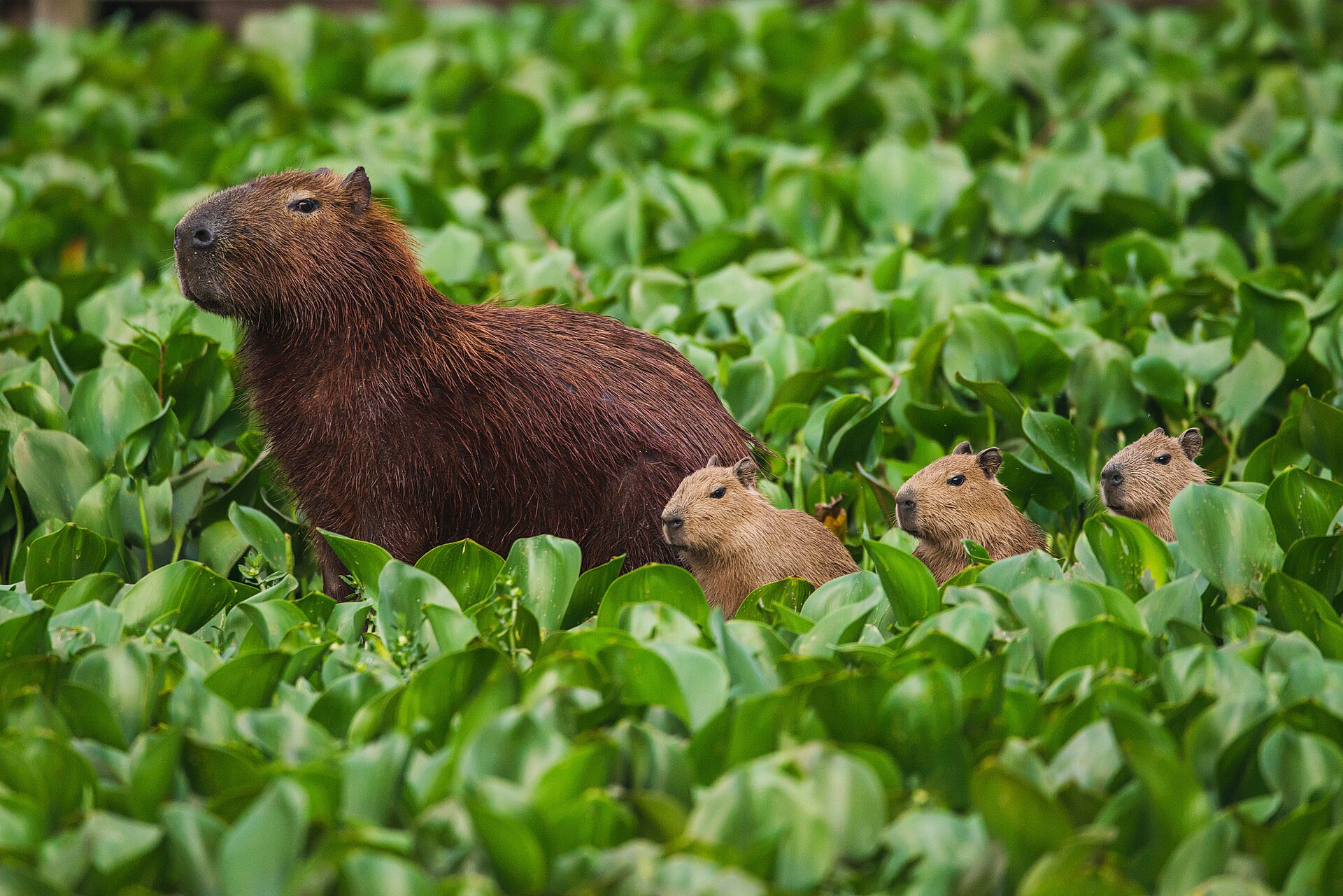
The Capybara has a stocky, robust body with an arched back, short legs and a large head with a broad muzzle. The coat is coarse, reddish-brown on the upper parts and lighter on the belly. The ears, eyes and nostrils are positioned high on the head — a typical adaptation in semi-aquatic animals that allows the body to remain almost completely submerged while still breathing and observing the surroundings. The feet have partial webbing between the toes, an aid for swimming. The Capybara has no visible tail.
Behaviour and curiosities
The Capybara is a deeply social animal: it lives in groups of 10 to over 30 individuals, led by a dominant male. The social structure is complex and based on cooperation, with sentinels that emit alarm calls when they spot predators such as caimans, jaguars, anacondas and harpy eagles.
It is an excellent swimmer and can stay underwater for up to five minutes. Its tolerance towards other species is legendary: in South America it is often seen with birds perching on its back, monkeys, turtles and even small wild cats. For this reason, it is sometimes nicknamed "the friendliest animal in the world". Lifespan is 8-10 years in the wild and up to 12 in captivity.
Pros
- Indole pacifica e socievole
- Nuotatore eccellente
- Carattere tollerante verso altre specie
- Facile da osservare in natura
Cons
- Specie selvatica, non adatta come pet domestico
- Richiede grandi spazi e accesso costante all'acqua
- Vita relativamente breve
- Regolamentato in molti paesi