Grass Snake
Natrix natrix
Characteristics
Temperament
A diurnal, aquatic, shy wild snake of a markedly peaceful disposition, entirely harmless. Faced with a human it flees, preferably by diving into water. If cornered it almost never bites, but stages theatrical defences: it plays dead (flipping belly-up) and emits a foul smell from its cloaca, as well as hissing and faking strikes with its mouth closed. It is NOT an animal to handle for fun: it is protected, useful wildlife, a predator of amphibians, to be observed and respected near wetlands, and never to be confused with a viper.
Diet
A non-venomous aquatic predator, with a diet based above all on amphibians: frogs, toads, tree frogs, newts and their tadpoles, as well as fish caught in the water and, occasionally, small mammals, lizards and nestlings. It hunts by swimming and patrolling ponds, ditches and banks, and, having no venom and not practising constriction, it seizes prey with its jaws and swallows it alive and whole. Its close dependence on amphibians makes it an important predator of wetlands and a good indicator of their health: the decline of frogs and toads directly affects it.
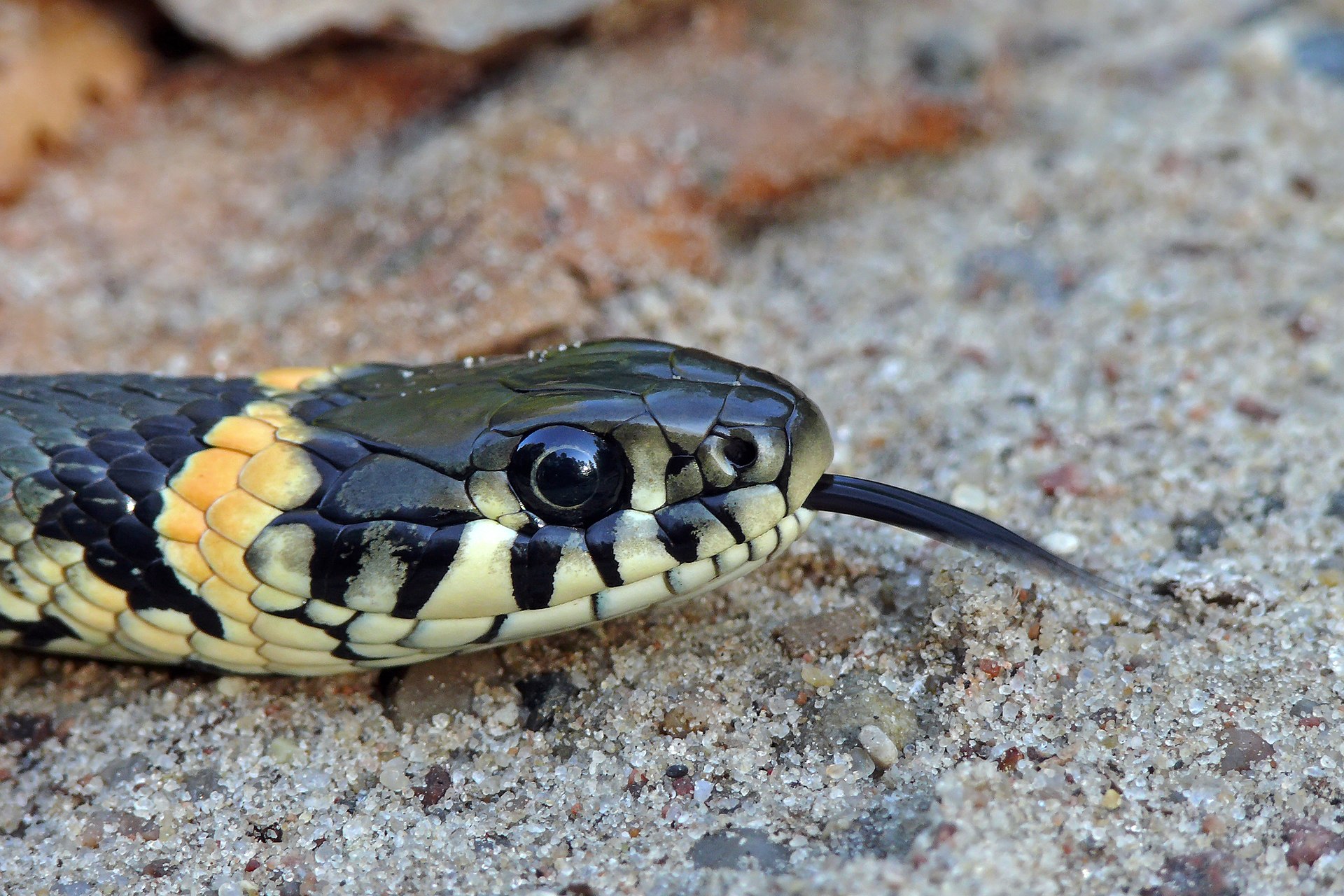
The Grass Snake (Natrix natrix), also known as the ringed snake or water snake, is one of the most common, harmless and fascinating snakes in Europe: an aquatic colubrid of mild character and theatrical defences. Famous for:
- The "collar": a characteristic yellow (or whitish) patch edged with black behind the head, hence the name
- Harmlessness: it is not venomous and poses no danger to humans
- Life in the water: an excellent swimmer, tied to ponds, ditches and wetlands
- The "death feint": when threatened it flips belly-up, mouth open and tongue out, playing dead
- Large size: one of the longest snakes in Europe, able to exceed a metre and a half
- A frog-hunter's diet: it feeds mainly on amphibians, swallowed alive
IUCN status: Least Concern (LC), common and widespread. In the portal it rounds off the Snakes group at this round's milestone: alongside the Aesculapian Snake and the Western Whip Snake (the other harmless native colubrids) and the Asp Viper (the venomous one), the Grass Snake completes the picture of "the snakes you actually meet in Italy", adding the one most tied to water.
Classification and category
Order Squamata (the scaled reptiles), suborder of the snakes (Serpentes), family Colubridae (broadly), in the group of the water snakes (genus Natrix). In the portal it is placed among the Snakes. It is important to tell it apart from other snakes: compared with the Aesculapian Snake and the Western Whip Snake (also harmless colubrids), the Grass Snake is more tied to water and is recognized by the characteristic pale collar behind the head; unlike the viper (venomous), it has a round pupil, a head little distinct from the neck and a more slender body, whereas the viper has a vertical pupil, a triangular head and a stocky body; it should also be distinguished from the dice snake and the viperine snake, other European water snakes with a different pattern. Etymology: the genus name "Natrix" is Latin for "water snake" (from the root of "natare", to swim); the Italian name "natrice" and the popular "biscia" come from this same water-and-swimming origin. Parameters: Length generally 70-150 cm, with females that can exceed 2 m (females are markedly larger than males). Build slender but sturdy. Appearance a typical colubrid, with slightly keeled dorsal scales. Longevity: remarkable, it can live a long time, with specimens reaching and exceeding 15-20 years. Reproduction: it is oviparous; the female lays numerous eggs (even 10-30 and more) in warm, moist substrates such as heaps of decaying vegetation, manure or compost, where the heat aids incubation.
Habitat and distribution
The Grass Snake is a snake widely distributed across the western Palearctic: much of Europe (including Italy) and western Asia, as far as North Africa. Preferred habitats — almost always near water: ponds, marshes, lakes, slow rivers, ditches and canals; damp meadows, water meadows, banks and wetlands of all kinds; and gardens, vegetable plots and countryside with water and compost heaps (where it often lays its eggs). It is a diurnal, thermophilic snake strongly tied to aquatic environments, where it hunts and takes refuge. It is an excellent swimmer and can dive for a long time. It loves to bask in the sun on the banks, but at the slightest alarm it dives into the water and vanishes. In winter it goes into dormancy in burrows, piles and crevices. Its dependence on wetlands makes it sensitive to their degradation and drying out. IUCN: Least Concern. It is common and widespread, but locally it suffers from the loss of wetlands, water pollution, the decline of amphibians (its prey) and direct killing by humans, often out of fear or because mistaken for a viper. It is a protected species.
Diet
The Grass Snake is an aquatic predator with a diet based above all on amphibians. It eats: amphibians (frogs, toads, tree frogs, newts and their tadpoles, the absolute basis of its diet); fish, caught in the water; and occasionally small mammals, lizards and nestlings. Hunting techniques: hunting in water and on the banks (it swims and patrols wet environments in search of amphibians); capture without venom or constriction (it seizes prey with its jaws and swallows it alive and whole, without killing it first); and ambush and active search (it alternates motionless waiting with exploring pools and reedbeds). Crucially, its close dependence on amphibians ties the Grass Snake's fate to that of frogs and toads. The decline of amphibians, due to the loss of wetlands and pollution, therefore also affects this snake, which is one of their main natural predators and a good "indicator" of the health of freshwater environments.
Physical features
A snake with a slender body and a mild appearance. Colouring and collar: a base colour of olive-green, greyish or brown, often with small dark spots on the flanks; the "collar": a characteristic yellow or whitish band, edged with black, just behind the head (more evident in juveniles and in many populations); a pale belly with black-and-white checkering. The body and head: a long, slender but sturdy body, that of a good swimmer; an oval head, little distinct from the neck, of mild appearance; large eyes with a round pupil, typical of diurnal, harmless colubrids. Performance: excellent swimming and the ability to dive for a long time; agile movements in water and on land; and a theatrical defensive repertoire (see curiosities), as an alternative to the bite, which it almost never uses.
Behaviour and curiosities
The Grass Snake is a diurnal, shy snake of peaceful disposition. Faced with a human, its first reaction is flight, ideally into water. It is a solitary animal, active in the warm season, that spends much time basking in the sun near water, ready to vanish at the slightest disturbance.
The "death feint": the Grass Snake's most spectacular defence is so-called thanatosis, that is "playing dead"; when it feels in serious danger and cannot flee, the grass snake suddenly flips belly-up, opens its mouth, lets its tongue hang out and stays motionless, convincingly simulating a corpse; many predators, preferring live prey, lose interest in an apparently dead animal, and the grass snake can thus save its life. The smelly weapon: besides the death feint, the grass snake has another very effective defence: when grabbed, it emits from its cloaca a foul-smelling substance, mixed with feces, capable of discouraging most attackers (humans included!); it can also inflate its body, hiss and make mock strikes with its mouth closed, "pretending" to bite without actually doing so. The snake that (almost) never bites: despite its sometimes considerable appearance and size, the Grass Snake is one of the most peaceful snakes; it far prefers flight, the death feint and the repellent smell to the bite, which it uses very little; when it does, however, it is entirely venomless and harmless; it is thus a snake that stages a great defensive "theatre" precisely to avoid having to defend itself for real. The water snake: the Grass Snake is one of the most aquatic European snakes; it swims with great agility, both at the surface and by diving, and often hunts directly in the water, chasing frogs and fish; for this reason, and because of the genus name (Natrix, "swimmer"), it is popularly called the "water snake"; it is a snake that rarely strays too far from ponds, ditches or banks. The "compost clutch": the Grass Snake needs heat to develop its eggs, and has found a perfect ally in humans: heaps of compost, manure and decaying grass clippings, which generate heat as they rot; it is very common for the grass snake to lay its eggs in these warm piles in gardens and vegetable plots, so much so that gardeners often discover them when turning the compost: a small, unexpected and entirely harmless "gift". "Not a viper": like the whip snake and the Aesculapian snake, the Grass Snake too is often killed because mistaken for a viper; yet telling it apart is simple: it has a round pupil (not vertical), a head little distinct from the neck (not triangular), a more slender body and, above all, the characteristic pale collar behind the head; moreover it is closely tied to water, where the viper does not usually live; recognizing it helps not to fear and not to needlessly kill a harmless and very useful snake.
Pros
- Del tutto innocua per l'uomo: non velenosa, preferisce fuggire o "fingersi morta"
- Utile predatrice delle zone umide (rane, rospi, pesci); buon indicatore ecologico
- Comune e diffusa; IUCN Least Concern
- Affascinante repertorio difensivo (tanatosi, odore repellente), unico tra i serpenti nostrani
Cons
- NON è un animale da compagnia: è fauna selvatica protetta
- Spesso uccisa per paura o perché scambiata per una vipera
- Dipende dalle zone umide e dagli anfibi: soffre il degrado dell'acqua e il calo delle rane
- Se maneggiata, emette un odore nauseabondo e può sporcare di feci (difesa innocua ma sgradevole)