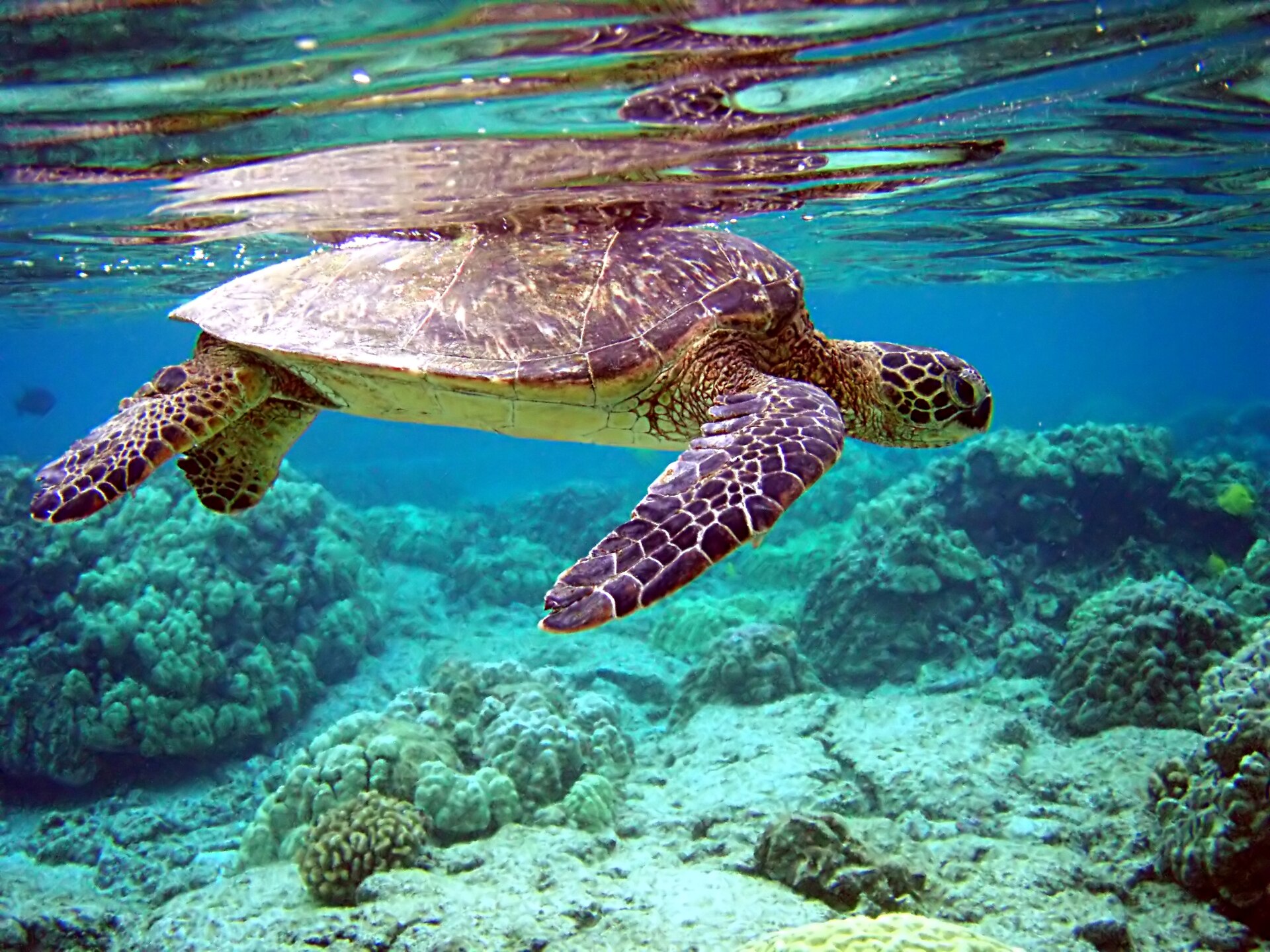
Green Sea Turtle
Chelonia mydas
Characteristics
Temperament
Solitary, migratory, faithful to birth site ("natal homing"). Obligate herbivore as adult. Can stay in apnea up to 5 hours. Keystone species of submarine meadows.
Diet
Omnivore as juvenile (plankton, jellyfish, crustaceans); STRICT herbivore as adult: Posidonia, green algae, occasionally sponges. Up to 2 kg of vegetation per day.
The Green Sea Turtle (Chelonia mydas) is a large oceanic turtle widespread in the tropical and subtropical seas of the world. It is the only one of the seven living sea turtle species to be completely herbivorous as an adult, and owes its name not to the colour of the carapace (generally brownish-olive) but to the greenish colour of its subcutaneous fat, tinted by the algae and marine plants on which it feeds. Today it is classified as Endangered by the IUCN, a victim of accidental fishing, plastic pollution and loss of nesting sites.
Classification and category
The Green Sea Turtle belongs to the order Testudines, suborder Cryptodira, family Cheloniidae. It is the only species of the genus Chelonia, distinct from other sea turtles (loggerhead, hawksbill, olive ridley, Kemp's ridley, flatback and leatherback) for its head scales and herbivorous diet. It is one of the largest sea turtles: the carapace generally measures 80-120 cm in length, with documented peaks up to 150 cm. Average adult weight is 110-200 kg, but record specimens have been recorded over 320 kg. Females are slightly smaller than males.
Habitat and distribution
The natural habitat of the Green Sea Turtle consists of tropical and subtropical oceans, submarine seagrass meadows of Posidonia and marine phanerogams, coastal lagoons and sandy shores where nesting occurs. The distribution is pantropical and covers all oceans: Atlantic (Caribbean, Brazil, West Africa), Indian (Madagascar, Maldives, Seychelles, Western Australia), Pacific (Hawaii, Galápagos, Indonesia, Eastern Australia). In the Mediterranean it is present with a breeding population confined to the coasts of Turkey, Cyprus, Syria, Lebanon and Israel.
Conservation status is listed as Endangered (EN) by the IUCN. The species is included in CITES Appendix I and protected by numerous international conventions (Bonn, Bern, Barcelona). The main threats are bycatch (accidental capture in fishing), loss of nesting beaches due to coastal development, plastic pollution (turtles mistake bags for jellyfish), fibropapillomatosis (viral tumour disease linked to pollution) and climate change (which influences the sex ratio at hatching).
Diet
The Green Sea Turtle is unique among sea turtles: obligate herbivore as an adult, but opportunistic omnivore in its early years of life. Juveniles, during the oceanic "lost years" of the first 5-10 years, live on the high seas feeding on plankton, jellyfish, small crustaceans and gelatinous organisms.
Once they reach a size of 25-35 cm of carapace, they settle in coastal grazing areas and change diet, becoming strict herbivores: they graze on Posidonia oceanica, Cymodocea, Zostera, green and red algae, and occasionally eat sponges and ascidians. They can consume up to 2 kg of vegetation per day. Their ecological role is crucial: green turtles are the main "lawnmowers" of submarine seagrass meadows, keeping them healthy and productive — their decline has led to the degradation of vast marine pastures in the Caribbean and eastern Mediterranean.
Physical features
The Green Sea Turtle has a hydrodynamic body, perfectly adapted to marine life. The carapace is oval, slightly domed, brownish-olive with darker streaks; the nuchal scute is wide. The plastron is yellowish and relatively flat. The head is small relative to the body, with a single pair of prefrontal scales (a diagnostic feature of the species); the beak is serrated on the edges, an adaptation for "cutting" seagrass.
The legs are transformed into flippers: the front ones, long and powerful, act as propellers during swimming; the rear ones, shorter, serve as rudders. They cannot retract head and limbs into the carapace, unlike land tortoises. They can remain in apnea for up to 5 hours during rest thanks to an exceptionally slow metabolism. The characteristic colour of the fat (from which the name "green") is due to the chlorophyll and carotenoids of the ingested algae — the meat, considered fine, has historically been the object of intense hunting that decimated populations.
Behaviour and curiosities
The Green Sea Turtle is a migratory and nesting-site-faithful species: each female returns cyclically (every 2-4 years) to the same beach where she was born to lay her eggs, even after migrating thousands of kilometres. The phenomenon of natal homing is still today one of the mysteries of animal biology: they are thought to use the Earth's magnetic field as a compass, imprinting as hatchlings the magnetic signature of their original site.
The female generally lays 100-200 eggs in a 50-70 cm deep hole dug in the sand at night, above the high-tide line. Incubation lasts 50-70 days and the sex of the hatchlings is determined by incubation temperature (TSD): higher temperatures produce females, lower temperatures males. Global warming is already dramatically altering these ratios, with populations in some areas composed 99% of females. Hatchlings rush en masse towards the sea as soon as they emerge, guided by the brightness of the ocean horizon; only one in a thousand will reach adulthood. Longevity is exceptional: 70-100 years in the wild, with documented specimens exceeding 120 years.
Pros
- Specie iconica e simbolica
- Longeva (70-100+ anni)
- Ruolo ecologico chiave
- Visibile in molte aree protette nel mondo
Cons
- Specie selvatica MARINA, NON è un animale da compagnia
- Endangered IUCN
- Bycatch, plastica, perdita spiagge: minacce critiche
- Clima altera rapporto sessi alla schiusa