Hyacinth macaw
Anodorhynchus hyacinthinus
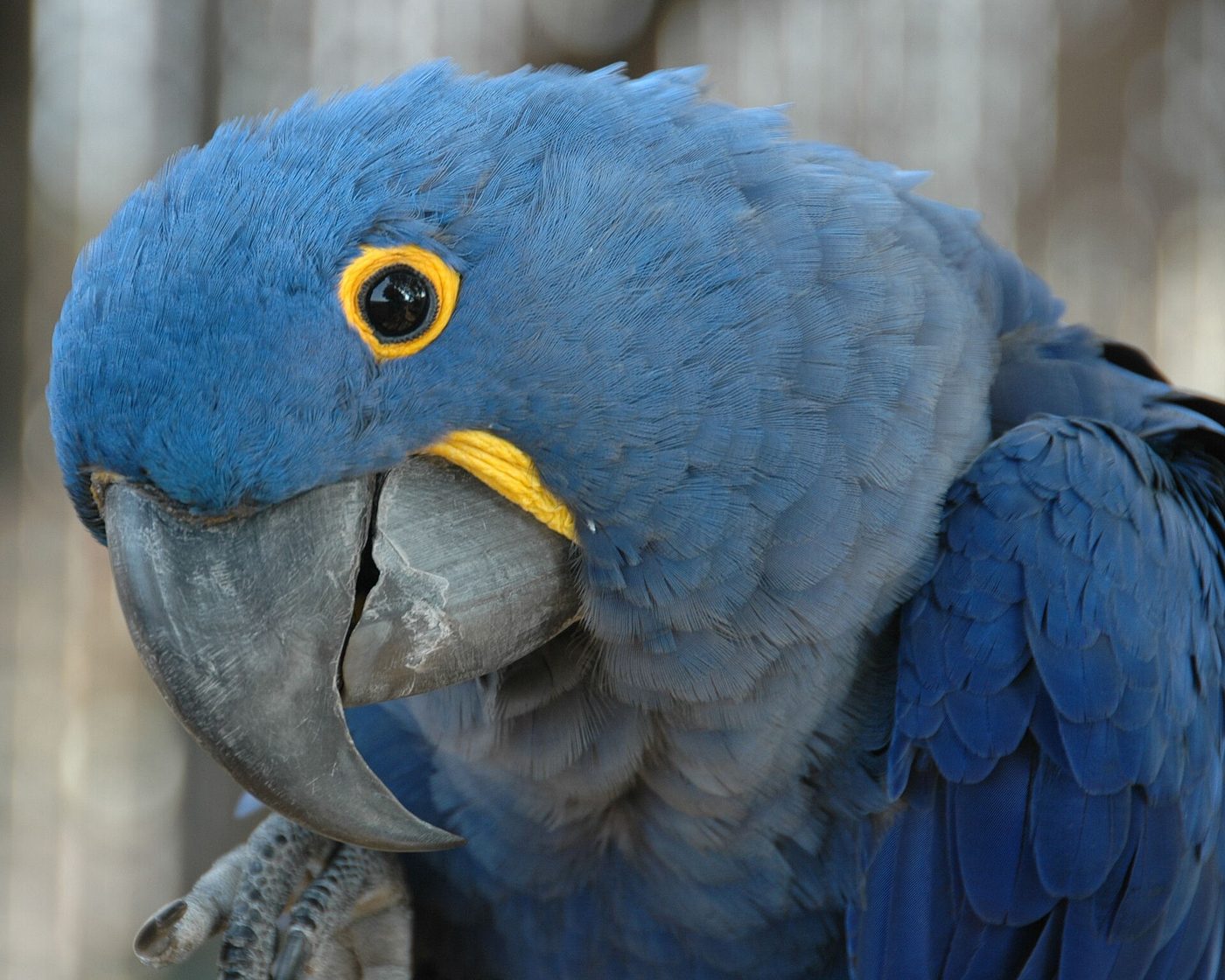
Cobalt blue from head to tail, the hyacinth macaw is the largest flying parrot in the world, a gentle giant of the South American forests with an immensely powerful bill.
Characteristics
Temperament
Docile and sociable despite its size and fearsome bill. It lives in pairs or small groups, forms lasting bonds and is intelligent and communicative.
Diet
Seed-eater: mainly very hard-shelled palm nuts, opened with its powerful bill, as well as fruit, seeds and shoots.
The largest flying parrot
The hyacinth macaw is the largest flying parrot on the planet: from the tip of the bill to the end of its long tail it can measure over a metre. Its plumage is an intense, uniform cobalt blue, lit up by a striking ring of bare, bright yellow skin around the eyes and a yellow patch at the base of the lower mandible. The bill, huge and curved, is black and extraordinarily powerful. It is native to the forests, wooded savannas and palm groves of central South America.
A bill to open the hardest nuts
The hyacinth macaw's bill is one of the most powerful in the bird kingdom, able to crush the hardest palm nuts, which make up an important part of its diet. With surprising force it can break shells that no other forest animal could open, thus gaining access to an exclusive food source. It also feeds on fruit, seeds and shoots.
A gentle giant
Despite its imposing size and fearsome bill, the hyacinth macaw generally has a docile and sociable character. It lives in pairs or small groups, communicating with loud, booming calls. Like all macaws, it forms lasting pair bonds and is very attached to its partner. Its intelligence and beauty have, unfortunately, made it a target of the illegal exotic animal trade.
A dependence on trees
The hyacinth macaw nests almost exclusively in the cavities of large trees, particularly of certain palm species. This dependence on mature trees and on specific plants makes it especially vulnerable to habitat loss: the destruction of forests removes both its nesting sites and its food sources.
Conservation
The hyacinth macaw is classified as a vulnerable species. In the past it was heavily decimated by capture for the pet trade and by habitat destruction. Thanks to intensive protection and reintroduction programmes some populations have recovered, but the species remains at risk and depends on the conservation of South American forests and palm groves.