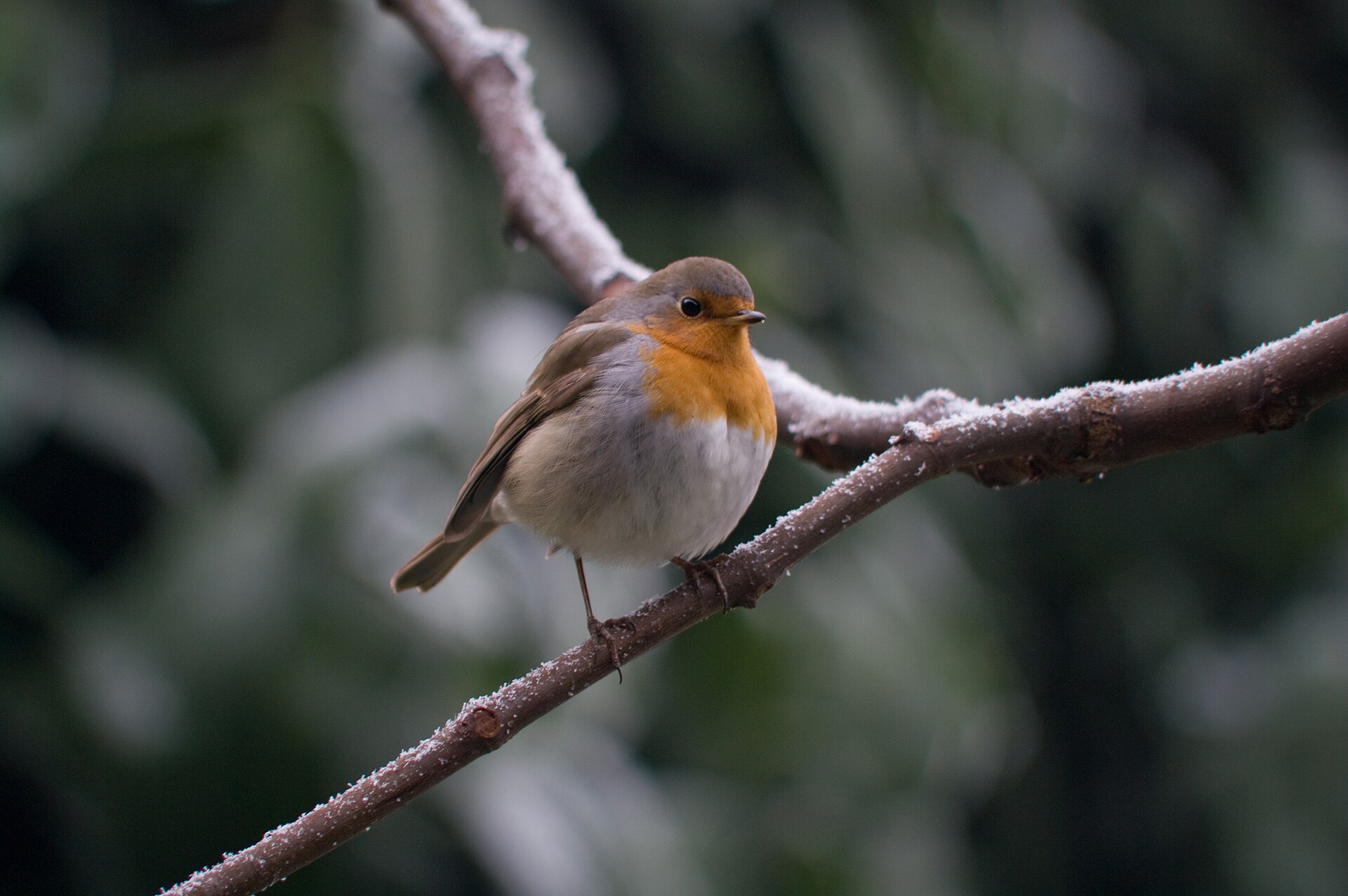
European Robin
Erithacus rubecula
Characteristics
Temperament
A small, lively, diurnal and strongly territorial wild passerine. Despite its charming looks and proverbial tameness towards people (especially in Britain, where it follows the gardener), it is a solitary, pugnacious bird that resolutely defends its territory even in winter. It sings almost all year round, even at night. It is NOT a cage or pet bird: it is wild birdlife to be observed and safeguarded in its environment; it can be helped with winter feeders, hedges and undergrowth.
Diet
Mainly insectivorous, with a flexible, seasonal diet: insects, larvae, earthworms, spiders and other small invertebrates in spring and summer; berries, fruits and seeds in autumn and winter. It hunts by ambush from a low perch and takes advantage of soil turned over by the gardener (or, in the wild, by wild boar) to find exposed prey. In winter it readily visits feeders, where it likes fats, small seeds and mealworms.
The European Robin (Erithacus rubecula) is one of the most loved, familiar and recognizable small passerines in Europe: a fixture of woods, parks and gardens, and a true icon of the winter season. Famous for:
- The orange breast: its rusty-orange face and breast make it unmistakable
- Its confidence with people: it approaches the gardener to snatch worms from the turned-over soil
- The pugnacious temperament: behind the charming looks, it is a highly territorial, aggressive bird
- The near-continuous song: it sings through most of the year, even in winter and even at night
- The link with Christmas: in Britain it is the quintessential symbol of the winter holidays
- The portal's first "garden bird": it opens the category of songbird passerines
IUCN status: Least Concern (LC). It enters the portal as the first representative of the passerines, the huge order of "perching birds" to which more than half of all bird species in the world belong — here alongside the passerines already present, such as swallows and corvids.
Classification and category
Order Passeriformes (the passerines, the "perching" or songbirds), family Muscicapidae (the Old World flycatchers). It was once classified among the Turdidae, the family of thrushes and blackbirds, which it resembles in look and habits. The European species is Erithacus rubecula. In the portal it opens the new category of passerines. It is useful to tell it apart from similar or confusingly named birds: the American "robin" (Turdus migratorius) is NOT a robin but a much larger thrush — British colonists called it "robin" for its reddish breast, but it is another species; the redstart also has reddish tones, but mainly on tail and belly, and is more slender; young robins have no orange breast at all: they are brown and densely spotted, developing the red only as they grow. Etymology: the genus name "Erithacus" comes from Ancient Greek, used for a small solitary bird; "rubecula" refers to the red colour of the breast; the Italian "pettirosso" and the old English "redbreast" describe the same trait. Parameters: Length about 12.5-14 cm. Weight about 16-22 g. Wingspan about 20-22 cm. Longevity: in the wild the average life is short, often one or two years due to high juvenile mortality, but some individuals can exceed 8 years. Reproduction: it nests in cavities and recesses, sometimes in unusual places (pots, boxes, abandoned tools).
Habitat and distribution
A typically Eurasian bird: its range covers much of Europe, east to western Siberia, and south to North Africa; northern and eastern populations are migratory, those of southern and western Europe (including Italy) largely resident. Preferred habitats — places with trees, shrubs and undergrowth: broadleaf and mixed woods and forests with dense undergrowth; gardens, parks and hedgerows, also in towns and built-up areas; and woodland edges, clearings and cultivated areas with trees and bushes. The Robin's behaviour towards people varies greatly by area: in Britain it is famous for its tameness, even following the gardener and perching close by to take advantage of the turned-over soil; in continental Europe it tends to be shyer and more woodland-bound. In winter it is a welcome presence in gardens, where it readily visits feeders. IUCN: Least Concern. It is one of the most common and widespread species of its range, of no conservation concern, though locally affected by the loss of hedgerows and undergrowth.
Diet
The Robin is mainly insectivorous, but with a flexible diet that changes with the seasons. It feeds on: insects and larvae (the basis of the diet, especially in spring and summer); earthworms, spiders and other small invertebrates; and berries, fruits and seeds (important in autumn and winter, when insects are scarce). Feeding habits: ambush hunting (it perches on a low vantage point and scans the ground, then drops quickly to seize the prey); "following the digger" (in gardens it exploits the soil turned over by the gardener — or, in the wild, by wild boar — to find exposed worms and larvae); and the use of feeders (in winter it visits feeders, where it likes fats, small seeds and mealworms). Crucially, the Robin is a clever opportunist. The habit of following large animals (and people) to feed on what the turned-over soil brings to the surface is considered one of the reasons for its proverbial tameness, at least in areas where it is not hunted.
Physical features
A small, plump-looking and endearing bird, but unmistakable for its colour. The breast and face — the distinguishing trait: breast, throat and forehead a warm rusty-orange, extending to the face; a grey-bluish border separating the orange from the brown of the back and the white of the belly. The body and plumage: olive-brown upperparts, whitish belly; a rounded body, often "puffed up" in the cold, giving it the look of a little ball; large dark eyes, useful for activity in low light; and slim legs and a fine, insectivore's bill. Peculiarities: males and females are identical in appearance — there is no visible dimorphism; the young are completely different — brown and spotted, with no trace of orange, so as not to trigger the adults' territorial aggression.
Behaviour and curiosities
The Robin is a solitary, strongly territorial bird, active by day. Despite the tender appearance, it has one of the most pugnacious characters among garden birds, and a far-from-peaceful social life.
The little warrior: behind the charming little face, the Robin is notoriously aggressive in defending its territory; males (and in winter also females, which defend their own territory) resolutely attack intruders of the same species, displaying the orange breast as a threat signal; clashes can be violent and, in rare cases, even fatal: a non-negligible part of adult robin mortality is due precisely to territorial fights. The breast as a "flag": the orange breast is not just decorative but a true signal; in disputes the Robin shows it off by puffing it up and orienting it towards the rival; it has been shown that a mere tuft of red feathers can trigger a male's attack: it is the colour, more than the shape of the bird, that sets off the aggression; this is why the young, lacking red, are tolerated in others' territories. The winter and night singer: unlike many birds, the Robin sings almost all year round, because it defends its territory even in winter; its wistful, warbling song is one of the few to cheer gardens in the cold months; it also often sings at night, especially in towns near streetlights: for this it is sometimes mistaken for the nightingale, another great nocturnal singer. The Christmas bird: in Britain the Robin is closely associated with Christmas and appears on a great many greeting cards; the tradition began in the 19th century: Victorian postmen, who delivered Christmas wishes, wore red uniforms and were nicknamed "robins"; so the little red-breasted bird came to symbolise the holidays; the Robin has also been voted the national bird of the United Kingdom. Nests in strange places: the Robin nests in sheltered cavities and recesses, but is famous for sometimes choosing unusual, curious spots: old boots, teapots, watering cans, the pockets of hanging jackets, shed shelves; this imagination in choosing the nest site adds to its bond with human environments and to many gardeners' curious stories. The robin's "compass": the Robin, like many migratory birds, can orient itself using the Earth's magnetic field; famous studies on magnetoreception in birds were carried out precisely on this species, showing how magnetic orientation is linked to vision and light; a small garden bird has thus become a protagonist of scientific research on animal navigation.
Pros
- Piccolo uccello amatissimo e inconfondibile, simbolo dei giardini e dell'inverno
- Confidente con l'uomo: facile da osservare e da attirare con le mangiatoie
- Canta quasi tutto l'anno, anche d'inverno e di notte
- IUCN Least Concern: comune e diffuso in gran parte d'Europa
Cons
- NON è un uccello da gabbia: è avifauna selvatica protetta
- Sorprendentemente aggressivo e territoriale verso i propri simili
- Vita media breve in natura, con alta mortalità giovanile
- Risente localmente della perdita di siepi, sottobosco e aree verdi