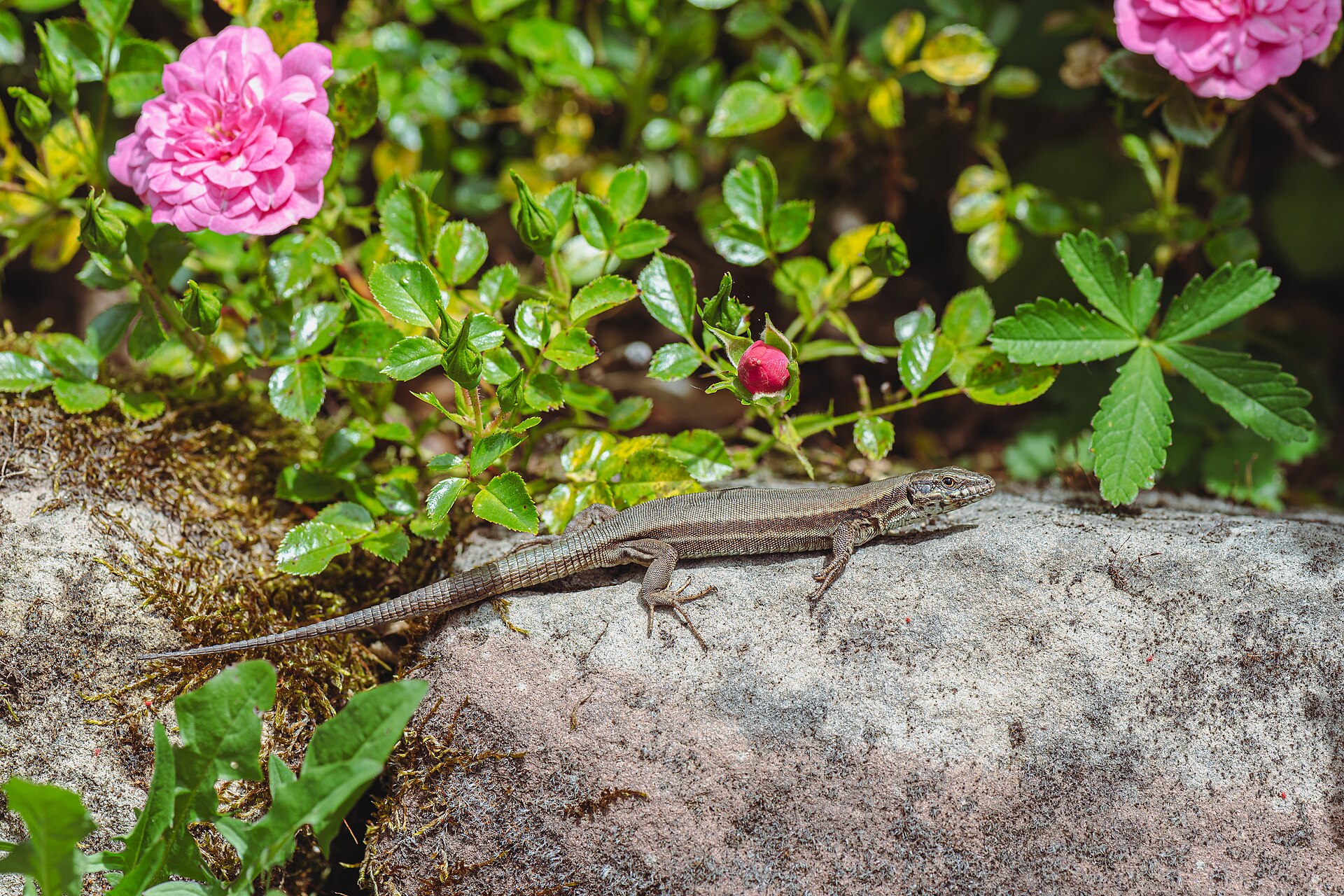
Common Wall Lizard
Podarcis muralis
Characteristics
Temperament
A small wild saurian, diurnal, extremely agile and heliothermic, closely tied to the sun and vertical surfaces (walls, rocks, ruins). It is shy and very fast: it warms up in the sun on walls and stones and flees into a crack at the slightest alarm, able if necessary to shed its tail to escape predators (autotomy). Markedly synanthropic, it readily coexists with humans. It is NOT a pet: it is protected native wildlife, to be observed and respected in its environment, where it plays a useful role by feeding on insects and serving in turn as prey for many predators.
Diet
Insectivorous: it feeds mainly on insects (flies, small beetles, ants, grasshoppers), spiders and other small invertebrates, sometimes supplementing with small fruits or sugary substances. It hunts "by sight", spotting prey with its eyes and chasing it with lightning dashes on the sunlit surfaces where insects and spiders abound. It is more active and effective when, warmed by the sun, it reaches its optimal body temperature. By feeding on large quantities of invertebrates it plays a useful role in their control in gardens and urban environments.
The Common Wall Lizard (Podarcis muralis) is probably the most familiar reptile for anyone living in Italy and much of Europe: the small lizard that darts across sunlit walls, climbs nimbly over rocks and dives into a crack at the slightest movement. Famous for:
- Life "on walls": it loves drystone walls, ruins, rocks, steps and sunlit surfaces
- Extraordinary agility: it runs and climbs with lightning dashes
- The very long tail, often longer than the body
- Great variability: colours and patterns change a lot from population to population
- Tail autotomy: it can shed it to escape predators
- The bond with humans: one of the most "urban" and familiar wild species
IUCN status: Least Concern (LC). It enters the portal among the lizards, alongside the green lizard, the viviparous lizard and other saurians: with them it shares the family, but it stands apart as the small, tireless "home" lizard, perhaps the most observed wild reptile in all of Europe.
Classification and category
Order Squamata, family Lacertidae (the true Old World lizards), genus Podarcis (the Mediterranean "wall" lizards). The species is Podarcis muralis. In the portal it is placed among the lizards. It is important to tell it apart from very similar species with which it often shares the same environments: the Italian wall lizard (Podarcis siculus) — another Podarcis very common in Italy, often more robust and with greener tones; the two species can coexist and be confused; the green lizard (Lacerta bilineata), also in the portal — much larger and a bright green, of an entirely different size; the viviparous lizard (Zootoca vivipara), in the portal — tied to cooler, damper environments, with a different biology (it gives birth to live young). Because of its extreme variability and its resemblance to other Podarcis, certain identification can require care: the combination of small size + "wall" habits + flattened body + very long tail is nonetheless typical of the wall lizard. Etymology: the genus name Podarcis comes from Greek and refers to the agile feet; "muralis" ("of walls") perfectly describes the preferred habitat. Parameters: Total length roughly 15-20 cm, including the tail. Body slender and flattened, about 6-7 cm (head-body). Tail very long, often more than the body. Longevity: a few years in the wild. Reproduction: it is oviparous, laying small eggs in sheltered cracks and recesses.
Habitat and distribution
The Common Wall Lizard is very widespread across much of Europe: its range covers much of central and southern Europe, including Italy, with introductions also outside its range (for example in Britain and North America). Preferred habitats — sunlit vertical surfaces and rocky or man-made environments: drystone walls, ruins, rubble and old buildings; rocks, screes, embankments and walls; and gardens, vineyards, railway ballast and path edges. The wall lizard is a markedly synanthropic species: it readily coexists with humans and uses walls, buildings and other structures as if they were natural rock faces. It is diurnal and heliothermic: it warms up in the sun on exposed surfaces to become active, and quickly takes refuge in cracks when it is too hot or at the slightest danger. In the colder climates of its range it enters a phase of inactivity (dormancy) during winter. IUCN status: Least Concern (LC). It is one of the most common and adaptable lizards in Europe, able to thrive even in the heart of urban environments. Its abundance and its tameness make it the easiest wild reptile to observe for most people.
Diet
The Common Wall Lizard is essentially insectivorous. It feeds on: insects (flies, small beetles, ants, grasshoppers and others); spiders and other small invertebrates; and occasionally small fruits or sugary substances. Hunting habits: "sight" hunting (it spots prey with its eyes and chases it with very rapid dashes); ambush on walls (it patrols the sunlit surfaces where insects and spiders are abundant); and sun-linked activity (it is more active and fast when, warmed by the sun, it reaches its optimal body temperature). Crucially, by feeding on large quantities of insects and other small invertebrates, the Common Wall Lizard plays a useful role in controlling these animals in gardens, vegetable plots and urban environments, and is in turn an important prey for birds, snakes and other predators.
Physical features
A small, agile, slender saurian, with a "flattened" appearance suited to slipping into cracks. The body and tail — the distinguishing traits: a slender, flattened body, ideal for sliding into the cracks of walls; a very long, thin tail, often longer than the body, used for balance; agile limbs with long toes and claws suited to climbing. The highly variable coat: very variable colours (from brown to grey to greenish, depending on the population); a pattern often reticulated or mottled on the back; the flanks may show spots and, in males, bluish flecks; a whitish belly, sometimes with reddish or orange tones. A special adaptation: tail autotomy (in case of danger it can voluntarily shed the tail, which keeps moving to distract the predator while the lizard flees; the tail then regrows, though different from the original).
Behaviour and curiosities
The Common Wall Lizard is a diurnal, agile, sun-bound animal, with a life entirely governed by temperature and light. Its familiar presence on walls and rocks makes it one of the best-known and most-loved reptiles, often the first "encounter" with the reptile world for many children.
The tail that comes off: like many lizards, the wall lizard is capable of autotomy: if seized by the tail by a predator (or a hand), it can voluntarily shed it along special breakage planes; the severed tail keeps writhing for a few moments, distracting the predator and giving the lizard time to flee; the tail then regrows, though usually shorter and slightly different in appearance. The "thermoregulating" species: the wall lizard is heliothermic, that is, it regulates its body temperature through external heat sources; this is why it is so often seen motionless in the sun on walls: it is "charging up" with heat to be active and fast; when too hot it moves to shade or a crack, alternating sun and shelter with great precision through the day. The colour variability: although it does not change colour like a chameleon, the Common Wall Lizard is extraordinarily variable from one population to another, with browner, greyer or greener individuals, and different dorsal patterns; this variability, together with the resemblance to the Italian wall lizard, sometimes makes certain identification difficult even for enthusiasts. The "city" reptile: few wild species coexist with humans as closely as the wall lizard; house walls, gardens, steps, ruins and railway ballast are for it perfect artificial "rock faces"; this is why it is one of the species that lets even city-dwellers observe a true wild animal up close. The coloniser of new territories: thanks to its adaptability, the Common Wall Lizard has also been successfully introduced outside its natural range; in some North American cities, for example, there are populations descended from a few specimens released decades ago, locally nicknamed with curious names: an example of its surprising ability to thrive in new environments. The garden "thermometer": for those with a garden or plot, the appearance of the first lizards in the sun on walls is one of the most classic signs of the arrival of the warm season, and their activity closely follows its rhythm: numerous and fast on warm, sunny days, absent and hidden on cold or rainy ones.
Pros
- Il rettile selvatico più comune e familiare d'Europa: facilissimo da osservare
- Utile in giardini e orti: si nutre di insetti e altri piccoli invertebrati
- Straordinariamente adattabile, prospera anche in pieno ambiente urbano
- IUCN Least Concern: comune e diffusa in gran parte d'Europa
Cons
- NON è un animale da compagnia: è fauna selvatica autoctona protetta
- Molto variabile e simile ad altre Podarcis: identificazione non sempre facile
- Predata da molti animali; alta mortalità, vita media breve
- Risente localmente della perdita di muretti a secco, siepi e ambienti adatti