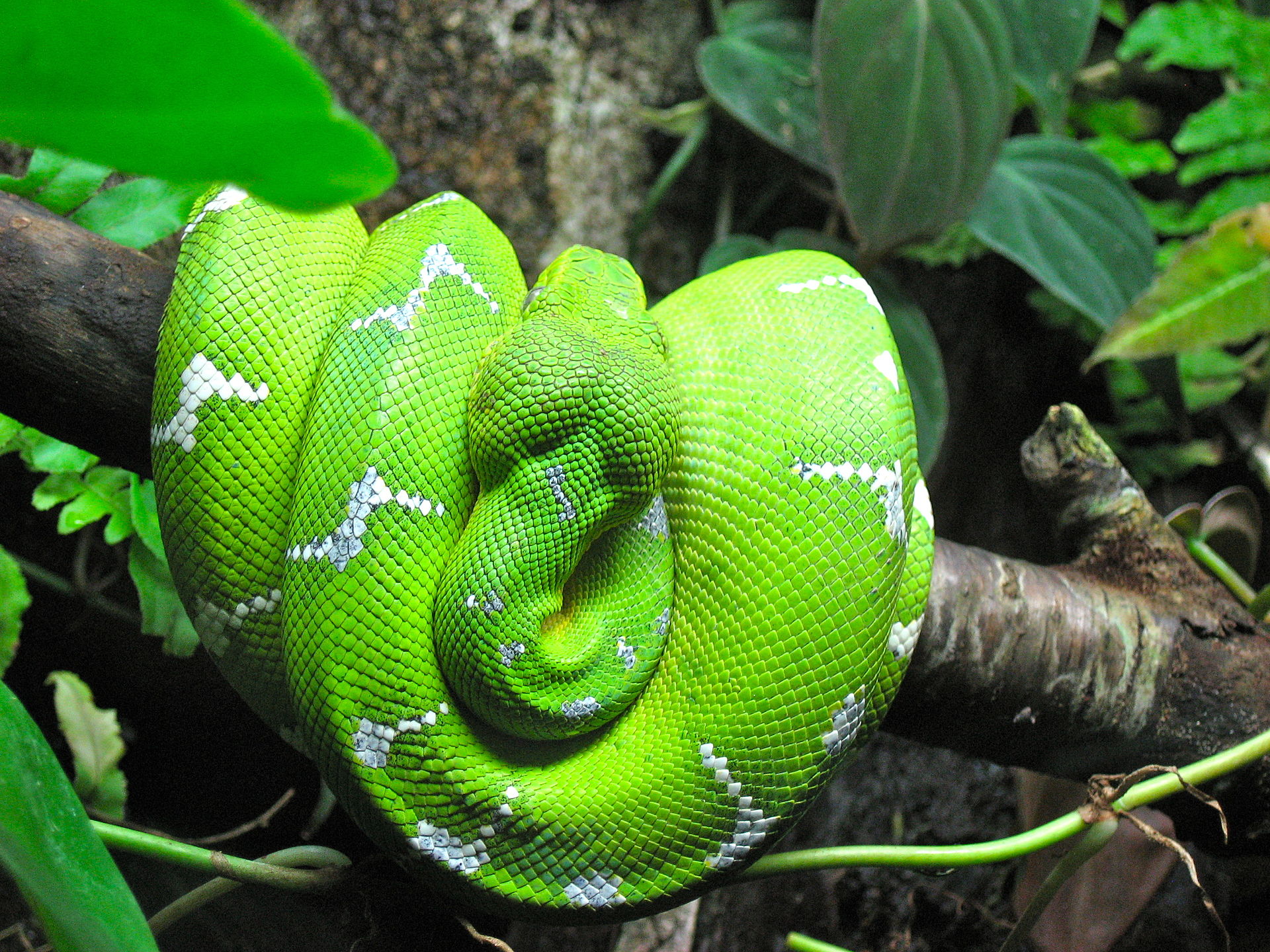
Emerald Tree Boa
Corallus caninus
Characteristics
Temperament
Nocturnal, solitary, arboreal and quiet: it makes stillness and green camouflage its main weapons. By day it rests coiled in neat loops on a horizontal branch; by night it hunts by ambush. Non-venomous, it kills by constriction, but if bothered it can bite hard, inflicting wounds with its long teeth. Not a beginner's animal nor one to handle casually: a wild arboreal boa dependent on the Amazon forest.
Diet
A non-venomous ambush predator that kills by constriction. It feeds mainly on small mammals (arboreal rodents) and birds caught among the branches, and occasionally on lizards. It anchors its prehensile tail to a branch and holds the front of its body in a hook, ready to strike downward; heat-sensing labial pits let it locate warm-blooded prey in the dark. Its very long front teeth serve to hold prey, especially feathered birds, before wrapping them in its coils.
The Emerald Tree Boa (Corallus caninus) is one of the most spectacular arboreal snakes of the Amazon rainforest. Famous for:
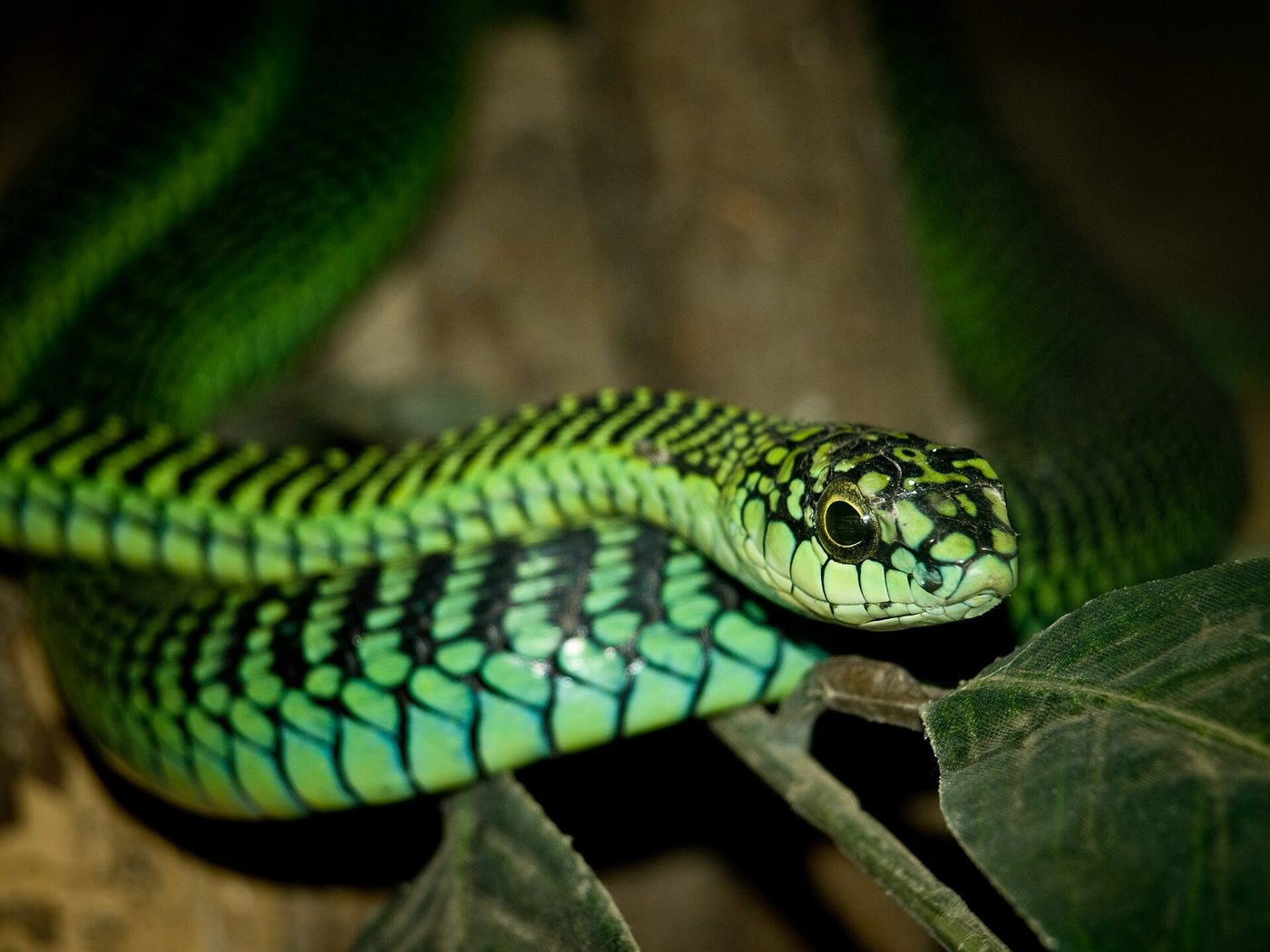
- Brilliant emerald green: a vivid green livery crossed by white spots and zigzags ("lightning bolts") along the back, with a yellow belly
- An unmistakable resting pose: it drapes itself in neat, symmetrical coils around a horizontal branch, with its head resting in the centre
- Very long front teeth: among the longest (proportionally) of any non-venomous snake, ideal for holding feathered prey
- Heat-sensing pits: deep pits along the lips that detect the warmth of warm-blooded prey, even in the dark
- A colour change when young: the babies are born reddish or orange and turn green as they grow
- Its likeness to the green python: almost identical to the Australian green tree python, despite not being related
IUCN status: Least Concern (LC) (listed in CITES Appendix II). Nocturnal, arboreal and non-venomous, it is the ambush predator of the Amazon canopy: it ideally completes the forest's "upper storey" alongside other branch dwellers already in this portal — the cat the Margay, the porcupine the Coendou and the nocturnal bird the Common Potoo.
Classification and category
Order Squamata, suborder Serpentes, family Boidae (the boas) — the same as the Boa Constrictor and the Anaconda. It is therefore a non-venomous constricting boa, but specialized for arboreal life. A fascinating comparison is with the green tree python (Morelia viridis) of Australia and New Guinea: the two species are almost identical in appearance (green, arboreal, the same coiled pose on the branch) and habits, yet they live on different continents and are not close relatives — the emerald tree boa is an American boa, the green python an Australasian python. It is one of the most celebrated cases of convergent evolution among reptiles: two separate lineages finding the same solution for the same way of life. Etymology: "Corallus" recalls coral; "caninus" ("canine") refers to the long, fang-like front teeth, reminiscent of a dog's canines. A related species of the upper Amazon, once confused with this one, is now often distinguished as Corallus batesii. Parameters: Length 1.5-2 m (exceptionally to ~2.2 m). Weight typically ~1-1.5 kg. Build robust but laterally compressed, ideal for draping over branches. Longevity about 15-20 years, sometimes more in captivity. It is ovoviviparous — it lays no eggs but gives birth to fully formed young (usually several, up to about twenty), born reddish or orange.
Habitat and distribution
The Emerald Tree Boa is tied to the rainforests of the Amazon basin, in northern South America: the Amazon basin and neighbouring regions — northern Brazil, Venezuela, Colombia, the Guianas, and parts of Peru, Ecuador and Bolivia. Preferred habitats: lowland tropical rainforest (its prime habitat, full of branches to live on); and humid forests and treed zones along watercourses. It is an almost exclusively arboreal species: it spends its life among the branches, where it hunts, rests and breeds, coming down to the ground very rarely. It is nocturnal and solitary. By day it rests coiled in neat loops on a horizontal branch, motionless and well camouflaged among the green foliage; by night it becomes active to hunt. IUCN: Least Concern. Still widespread in the vast Amazon forests; the main threats are deforestation and collection for the exotic-pet trade (it is regulated under CITES, Appendix II).
Diet
A non-venomous ambush predator that kills by constriction: small mammals (especially arboreal rodents, the staple); birds (caught among the branches; the very long front teeth help hold them despite feathers); and lizards and other small vertebrates (occasionally, especially when young). Hunting strategies: the "J" ambush (it anchors its prehensile tail to a branch and lets the front of its body hang in an S or hook shape, ready to strike downward); the thermal "radar" (the heat-sensing labial pits detect the body warmth of a passing mammal or bird in the dark, letting it strike accurately even without seeing it well); and constriction (once it has seized the prey with its teeth, it wraps around it and suffocates it with its coils before swallowing it whole). Crucially, its oversized front teeth (hence the name caninus) are not for injecting venom — the emerald tree boa has none — but for sinking firmly into prey and holding it, especially feather-covered birds, during the decisive first moments of the strike.
Physical features
A stunning, unmistakable snake, perfectly designed for life in the trees. Livery: brilliant emerald green on the back and flanks; irregular white or cream spots and bars along the back, often joined into a "lightning-bolt" zigzag; a yellow belly; the young are born brick-red or orange and gradually turn green over the first months or years of life. Adaptations: a laterally compressed body (it drapes stably over branches); a strong prehensile tail (anchoring the snake during ambush and movement); a large head well distinct from the neck, with large eyes; very long front teeth (among the most developed, proportionally, of non-venomous snakes); and heat-sensing labial pits (deep and numerous, to "see" warmth). Performance: camouflage (the green makes it nearly invisible among foliage); an exceptional grip on branches thanks to body and tail; a lightning downward strike from the hook position; and a thermal sense (it hunts effectively even in complete darkness).
Behaviour and curiosities
A nocturnal, solitary, quiet animal that makes stillness and camouflage its main weapons. It spends much of the day coiled on its branch, perfectly blended with the vegetation, stirring only after dusk. Although non-venomous, if bothered it can bite hard, and its long teeth inflict painful wounds: in the wild it is best left undisturbed.
The perfect coils: the emerald tree boa's resting pose is one of the most iconic images of Amazonian wildlife. The snake winds into neat, almost symmetrical coils, one above another, around a horizontal branch, with its head resting in the centre. This arrangement is not just elegant: it spreads the weight, ensures stability and keeps it ready to strike downward at passing prey. The "dog" teeth: the scientific name caninus comes from its extraordinarily long front teeth, reminiscent of canine fangs; proportionally they are among the longest teeth of any non-venomous snake, used not for venom (which it lacks) but to sink deep into prey and prevent escape, especially birds, whose feathers make them harder to hold. The "infrared radar": like many boas and pythons, the emerald tree boa has heat-receptor pits along its lips; these organs sense tiny temperature differences, letting it "see" the thermal shape of a warm-blooded mouse or bird in the total dark of the Amazon night, so that, combined with its ambush position, it can strike accurately even without good vision. The Australian twin: the emerald tree boa and the green tree python (Morelia viridis) are one of the most spectacular examples of convergent evolution among vertebrates; though belonging to two different families (American boas and Australasian pythons) and living an ocean apart, they have independently evolved the same green colour, the same coiled pose, the same hunting style and even the same juvenile colour change — proof of how similar environments (rainforest canopies) "shape" similar animals. The red babies: one surprise of this species is that the newborns are not green at all; they are born a vivid brick-red or orange, sometimes with yellowish tones, and only as they grow, over months or a few years, take on the emerald green of adults — an age-related (ontogenetic) colour change shared, once again, with the Australian green python. Live birth: unlike many egg-laying snakes, the emerald tree boa is ovoviviparous: the eggs develop and hatch inside the mother's body, which gives birth to fully formed, independent young — a useful strategy in a humid, arboreal environment where finding a safe egg site would be difficult.
Pros
- Serpente arboricolo spettacolare, icona della biodiversità amazzonica
- IUCN Least Concern: ancora diffusa nelle grandi foreste
- Non velenosa; controlla roditori e piccoli vertebrati delle chiome
- Caso da manuale di evoluzione convergente (col pitone verde)
Cons
- Non è un animale per principianti: morso doloroso con denti lunghi
- Dipende dalle foreste pluviali: minacciata da deforestazione
- Raccolta per il commercio di esotici (regolata dalla CITES)
- Non velenosa ma può essere difensiva se disturbata