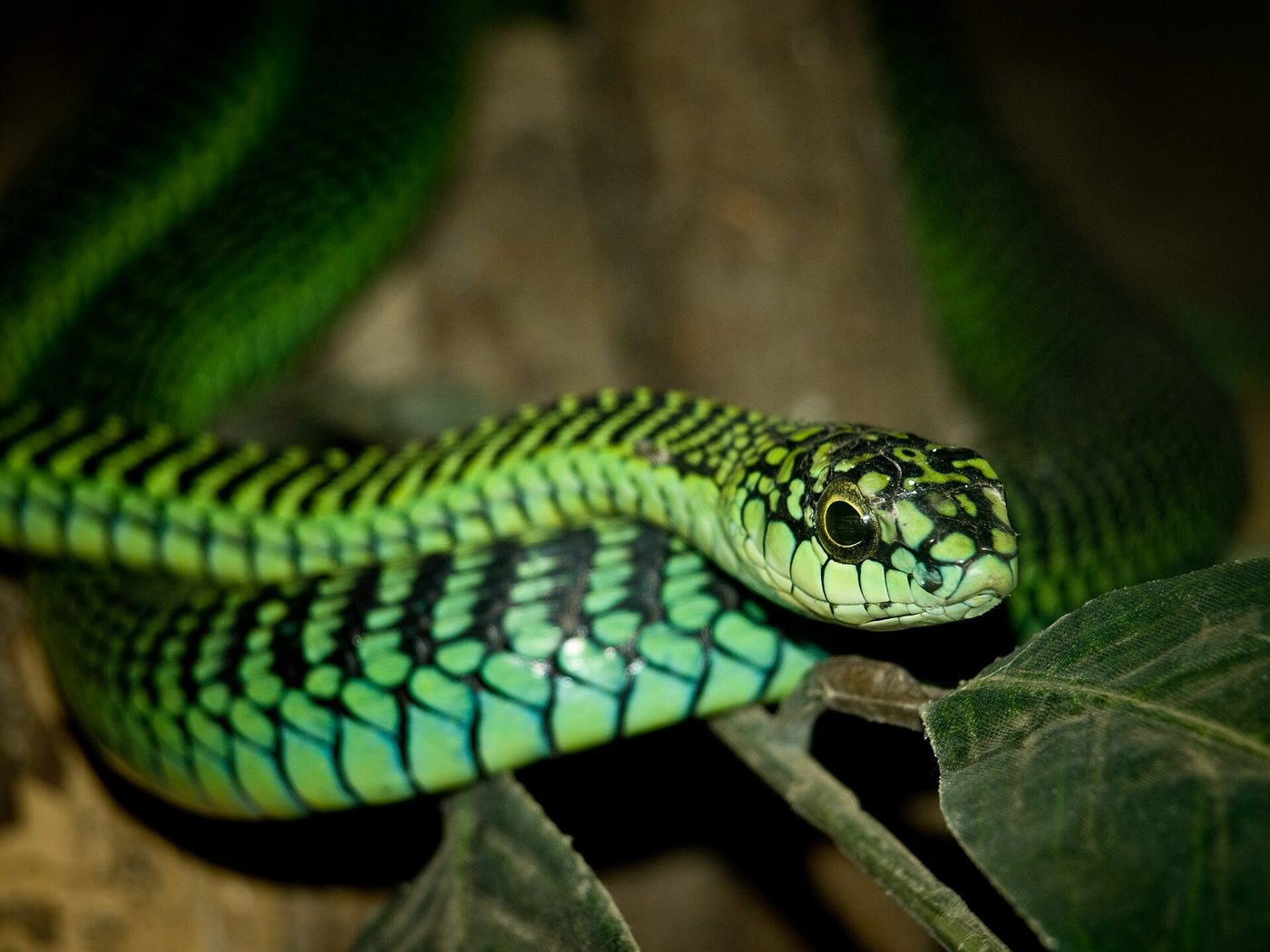
Boomslang
Dispholidus typus
A large tree snake of sub-Saharan Africa, the boomslang has huge eyes and a very potent venom: it is the most dangerous of the colubrids.
Characteristics
Temperament
Diurnal, arboreal, shy but dangerous
Diet
Carnivore: chameleons, lizards, birds, eggs
The 'tree snake'
The boomslang is a large, slender snake up to a metre and a half long, whose Afrikaans name means precisely "tree snake". It is perfectly adapted to life among the branches: a streamlined body, cryptic colours and, above all, exceptionally large eyes that give it very sharp vision. Its colouring varies greatly by region and sex: males are often bright green, while females tend towards brown.
Habitat and distribution
It lives across much of sub-Saharan Africa, from wooded savannas to scrubland, wherever there are trees and bushes to move through. It is diurnal and spends most of its time among the vegetation, where it hunts and camouflages itself.
Behaviour and venom
It feeds mainly on chameleons, lizards, birds and eggs, which it locates with its excellent vision by slowly moving its head. It is the most venomous of the colubrids: its venom acts on blood clotting and, although the fangs are set at the back of the mouth, a bite can be fatal to humans. Fortunately it is a shy snake that prefers to flee, and bites only if handled or cornered. When threatened it can inflate its neck to look bigger.
Curiosities
The famous herpetologist Karl Patterson Schmidt died in 1957 from the bite of a boomslang, and his notes on the symptoms, taken to the end, contributed to the understanding of this species' venom.
Conservation
The IUCN lists the species as Least Concern: it has a very wide range and stable populations. As with many snakes, its main interaction with people is being killed out of fear.
Pros
- Huge eyes and very sharp vision
- Extraordinary adaptation to life in trees
- Wide range, not threatened
Cons
- Very potent venom: potentially fatal bite
- Must never be handled
- Often killed by people out of fear