Photo: The Lilac Breasted Roller · CC BY 2.0
Oilbird
Steatornis caripensis
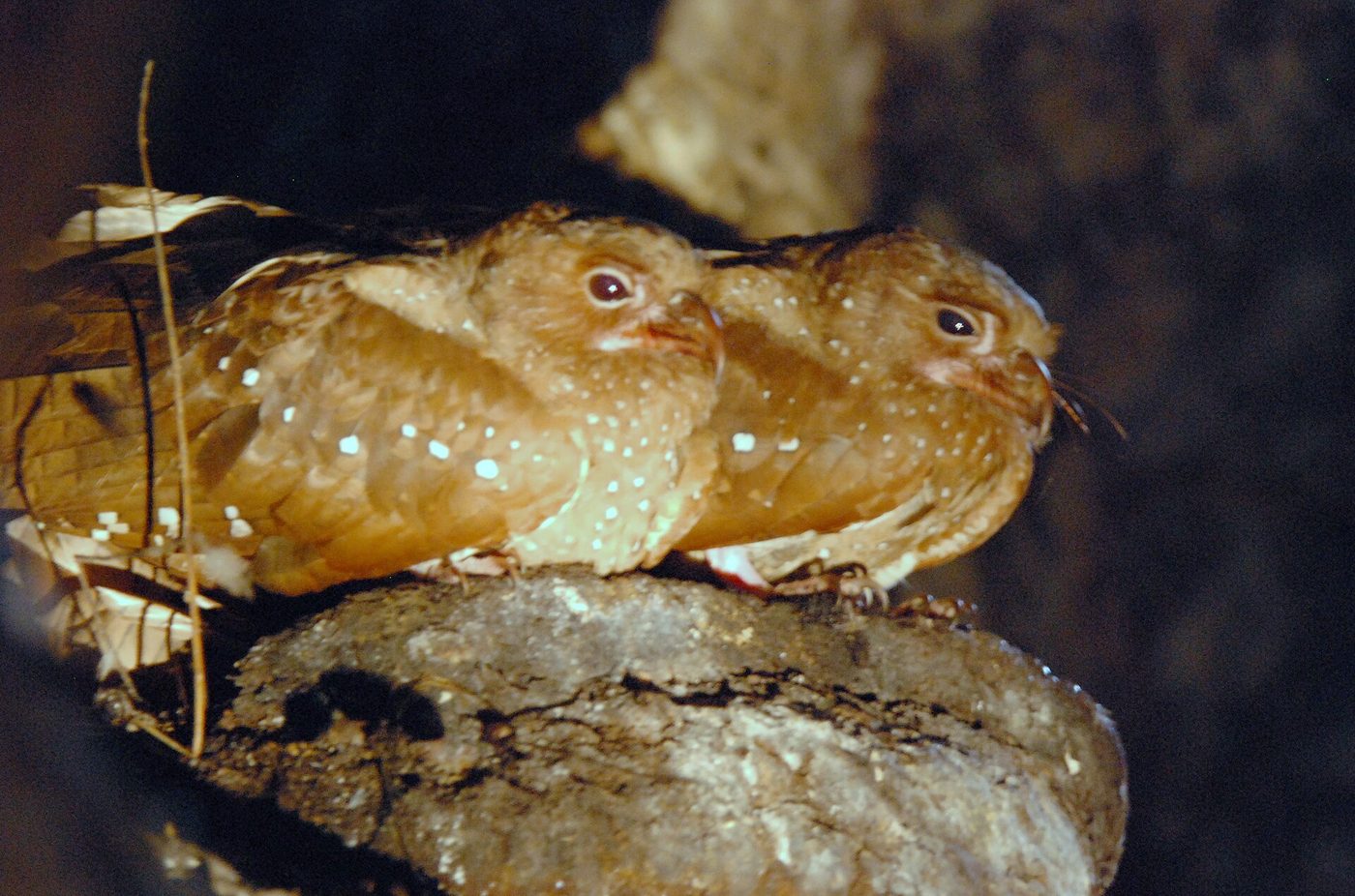
A bird unique in the world, the oilbird is the only nocturnal flying fruit-eating bird and finds its way in the darkness of caves by echolocation, like bats.
Characteristics
Temperament
Nocturnal, colonial, frugivore
Diet
Frugivore: fruit of oil palms and tropical laurels
An extraordinary bird
The oilbird is a completely unique bird, the only living representative of its family. It has a reddish-brown plumage scattered with white spots edged with black, long, broad wings, and a sturdy, hooked bill. Its large eyes are adapted to seeing in conditions of very little light. But the feature that makes it truly exceptional is another: it is the only nocturnal flying fruit-eating bird, and one of the very few birds in the world able to find their way by echolocation.
Habitat and distribution
It lives in the northern regions of South America and on the island of Trinidad. It nests in large colonies inside caves, often in total darkness, where it builds its nests on ledges and projections of the rock walls. By day it rests in the depths of the caverns, and at night it comes out to look for food in the surrounding forests.
Finding its way in the dark
To move in the absolute darkness of the caves, the oilbird emits a series of rapid, high-pitched 'clicks', of a frequency audible even to humans. By listening to the echo of these sounds reflected from the walls, it manages to orient itself and avoid obstacles, exactly as bats do: it is one of the very few bird species to possess this ability. Outside, on the other hand, it relies on sight and smell to find food.
Feeding and conservation
It feeds exclusively on fruit, particularly that of oil palms and some tropical laurels, which it gathers in flight while hovering in the air. By regurgitating or dispersing the seeds, it plays an important role in the spread of many forest plants. It is classified as a species of least concern. Its name derives from the very fat chicks, once harvested to obtain oil from them.
Pros
- The only nocturnal flying fruit-eating bird
- Finds its way by echolocation, like bats
- Valuable seed disperser
- Unthreatened populations
Cons
- Depends on caves to nest
- Sensitive to disturbance of its colonies
- In the past harvested for the chicks' oil