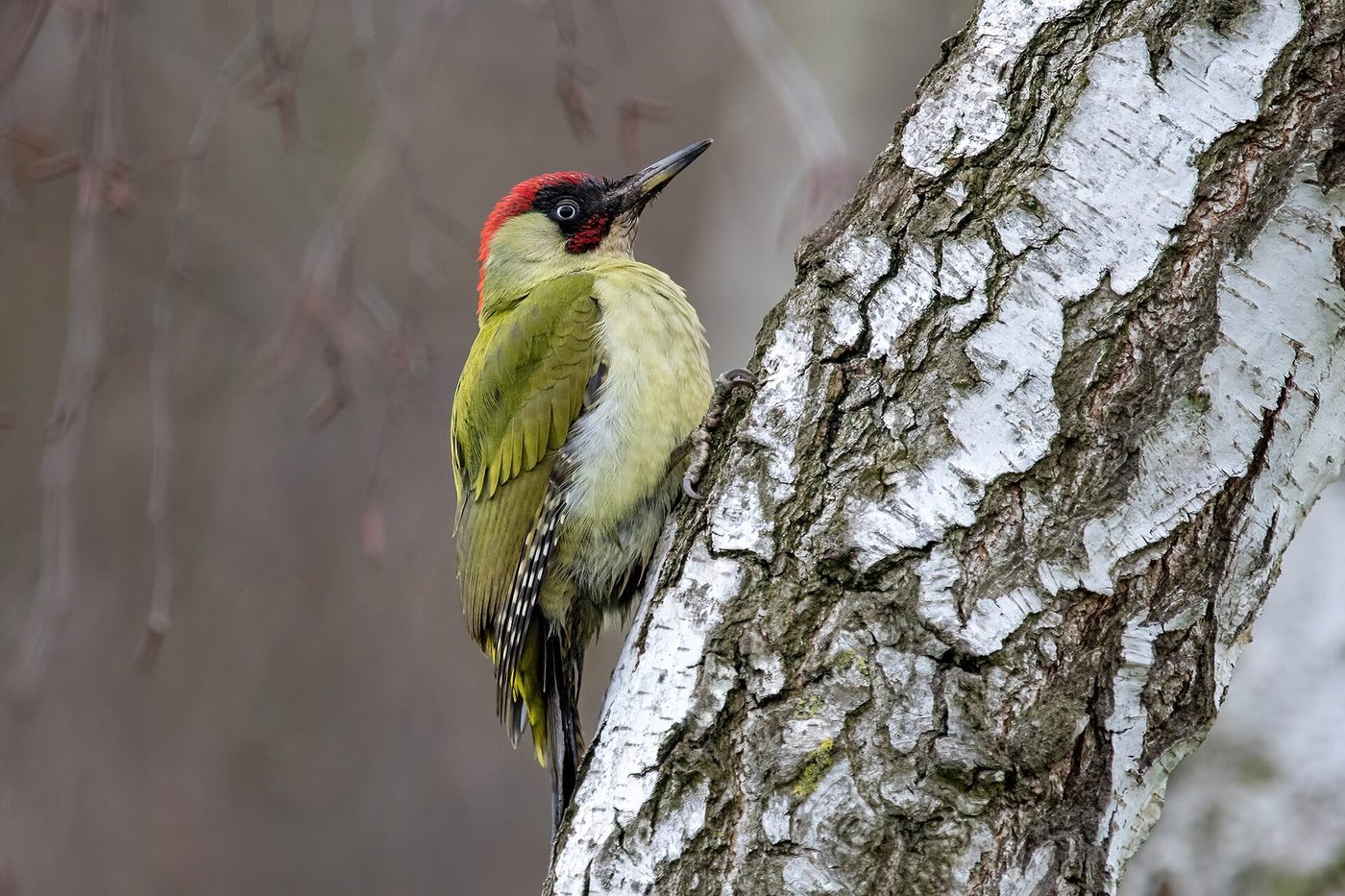
Photo: Alexis Lours · CC BY 4.0
European green woodpecker
Picus viridis
The green woodpecker is a large green woodpecker with a red crown, famous for its loud laughing call and its habit of feeding on ants on the ground.
Characteristics
Temperament
Resident, shy, often on the ground
Diet
Mainly ants and their larvae
Description
The green woodpecker is one of the largest European woodpeckers. It has an olive-green back, a paler belly, a yellowish rump and a striking bright red crown. On its face it bears a black 'mask' and a moustache stripe: red-centred in the male, all black in the female. Its bill is stout and its tongue extraordinarily long and sticky.
Habitat and distribution
It is widespread across much of Europe and western Asia. It favours varied, semi-open landscapes: open woodland, woodland edges, orchards, parks and wooded gardens with broad grassland nearby. It is a resident bird, tied to its territory all year.
Behaviour
Unlike other woodpeckers, it drums little on wood and spends much of its time on the ground, where it seeks its favourite food: ants. With its long sticky tongue it probes anthills and catches ants and larvae by the thousand. Its call, a loud, cadenced laugh, earned it the English nickname 'yaffle'.
Did you know?
The green woodpecker's tongue can extend well beyond the tip of the bill and is a formidable tool for reaching ants in their galleries. In very snowy winters, when the ground is covered, it can struggle to find food.
Conservation
It is classed as least concern. It depends on grassland and pastures rich in anthills and on old trees for nesting; agricultural intensification and the use of insecticides can threaten its populations.
(Note: the mass value given by Wikidata, 8.9 kg, is clearly wrong: the green woodpecker actually weighs about 150–250 grams.)
Pros
- Useful predator of surplus ants
- Striking plumage and unmistakable call
- Present all year, even in parks
Cons
- Depends on grassland rich in anthills
- Vulnerable to very snowy winters
- Threatened by the use of insecticides