Photo: thibaudaronson · CC BY-SA 4.0
Marvelous spatuletail
Loddigesia mirabilis
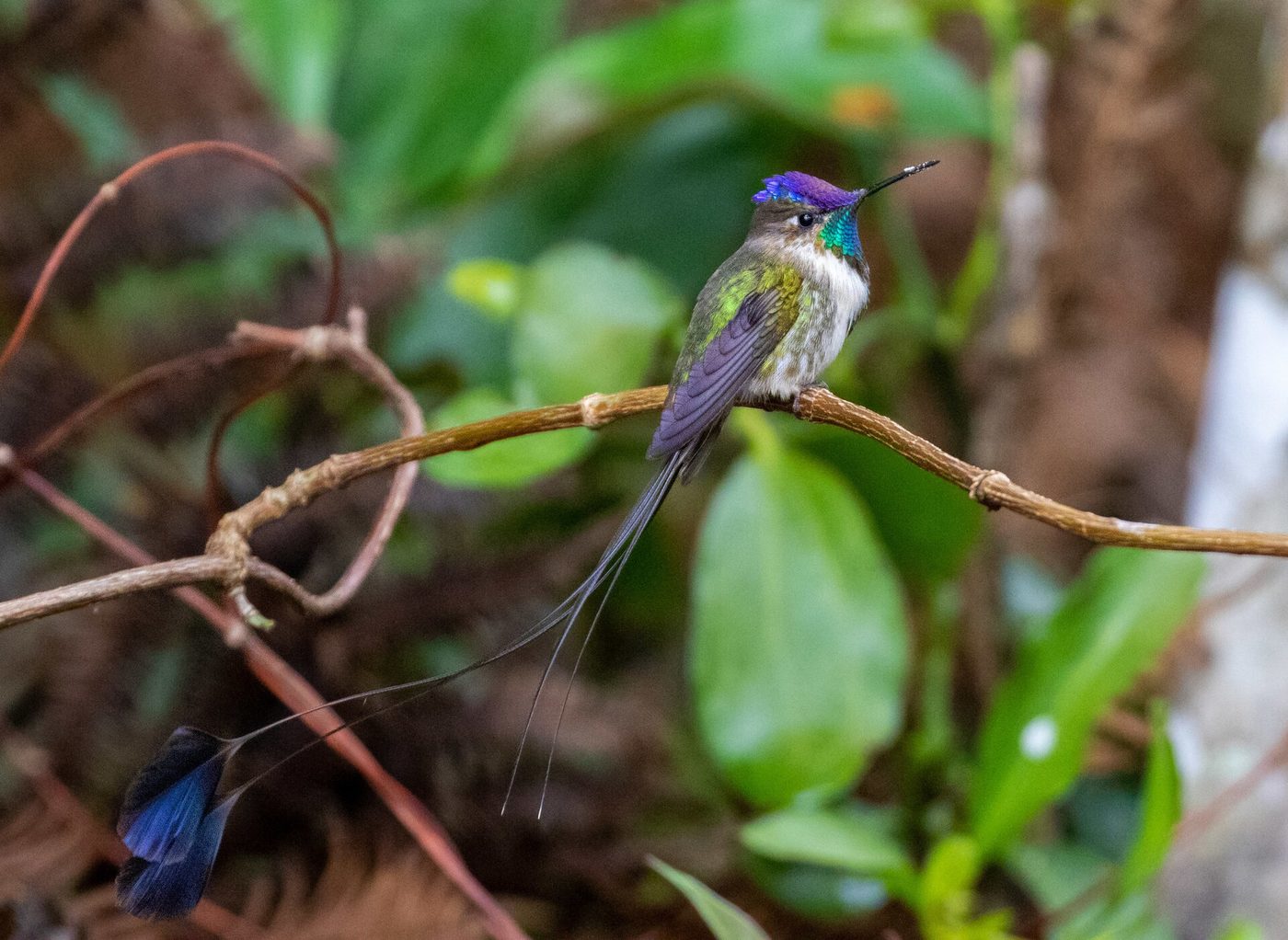
A tiny hummingbird endemic to northern Peru, the marvelous spatuletail flaunts just two tail feathers ending in large, iridescent racket-shaped spatules.
Characteristics
Temperament
Active, territorial, acrobatic in flight
Diet
Nectarivore: flower nectar, small insects
A hummingbird with a one-of-a-kind tail
The marvelous spatuletail is one of the world's most extraordinary hummingbirds. The male has just four tail feathers, but two of them are hugely elongated, cross over each other and end in broad iridescent blue-violet "rackets" or spatules. No other bird sports such a structure. Its plumage combines brilliant greens, a turquoise throat and a striking violet crest on the head. It is a minute bird in which the ornamental tail can exceed the length of the body.
Habitat and distribution
The species is endemic to a small area of northern Peru, in the Amazonas region, along the eastern slopes of the Andes. It lives at the edge of montane forest and in thorny scrub at elevations of roughly 2,000 to 3,000 metres, where it feeds on the nectar of flowers such as the lily of the Incas and various local shrubs.
Courtship
The male uses its tail rackets in a spectacular courtship dance: he swings and vibrates them in front of the female, moving them independently like little flags while hovering in mid-air. The effort is so intense that the male tires quickly and must rest between displays. It is a textbook example of sexual selection, in which an extreme ornament evolves because females prefer it.
Curiosities
Like all hummingbirds, it beats its wings dozens of times per second and can hold a stationary hover. Its rarity and beauty have made it a flagship for birdwatching in Peru, and its image is used to promote the protection of Andean forests.
Conservation
The IUCN treats the species as Near Threatened (Endangered in some assessments): its minute range and habitat destruction for agriculture make it fragile. Local reforestation projects and the planting of nectar-bearing plants help support its populations.
Pros
- Racket tail unique in the entire bird kingdom
- Spectacular acrobatic courtship display
- Flagship for birdwatching and Andean conservation
Cons
- Minute range, highly localised species
- Near Threatened due to habitat loss
- Hard to observe in the wild