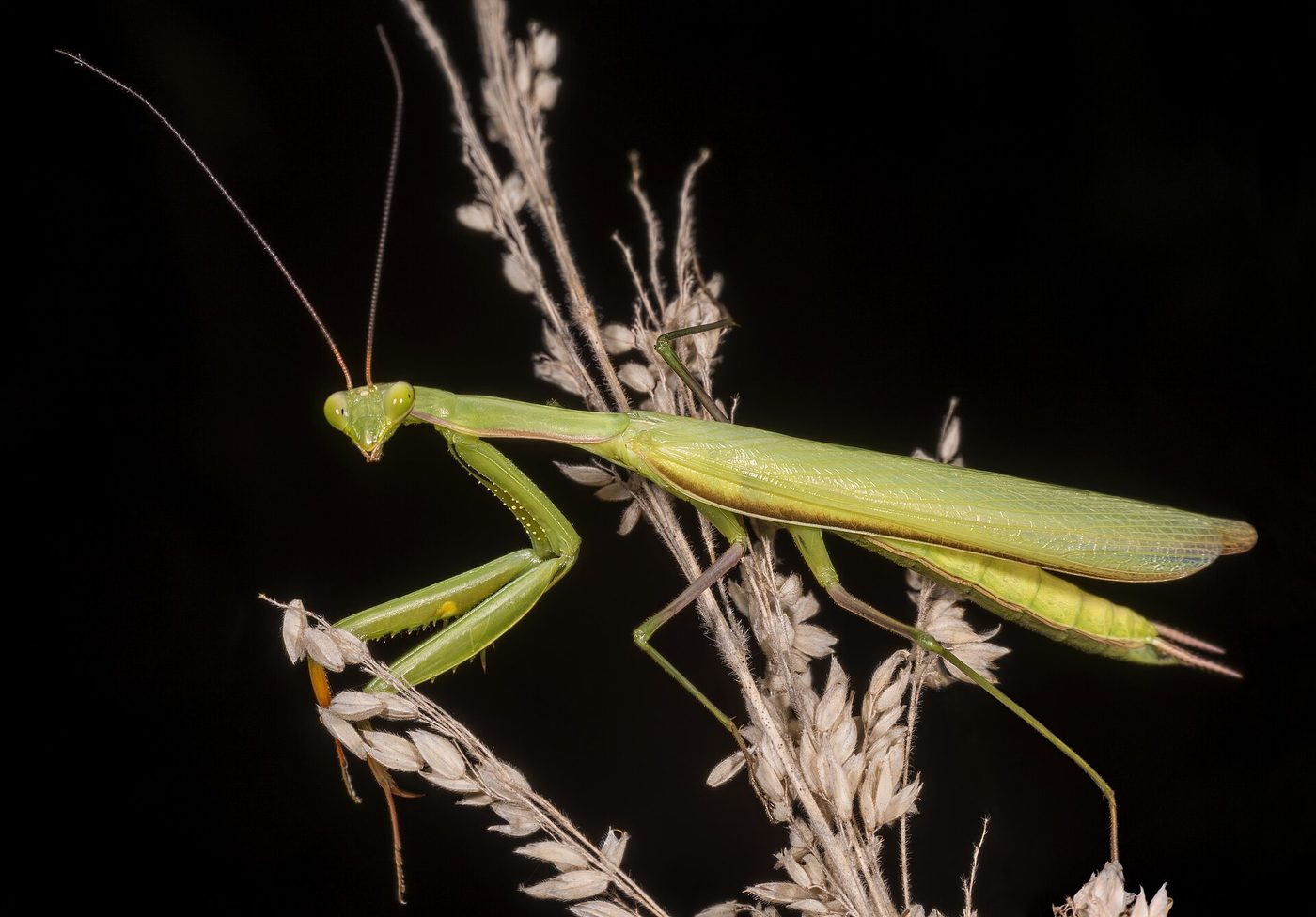
Photo: Didier Descouens · CC BY-SA 4.0
European mantis
Mantis religiosa
Motionless among the leaves with its legs folded as if in prayer, the European mantis is a relentless ambush hunter, a master of camouflage and patience.
Characteristics
Temperament
A solitary ambush predator, motionless and patient. Cryptic and territorial; when threatened it adopts an intimidating posture, spreading its wings and raising its legs.
Diet
Predator: flies, grasshoppers, butterflies and other insects, caught by ambush with the raptorial legs.
The praying hunter
The European mantis owes its name to the characteristic position of its forelegs, folded in front of the head as if in prayer. In fact those legs, called raptorial, are deadly weapons: fitted with rows of spines, they snap out in a fraction of a second to seize prey and hold it in a grip from which escape is almost impossible. The body is slender, green or brown to blend into the vegetation, and the triangular head is extraordinarily mobile: the mantis is the only insect able to turn its head to look behind itself.
An ambush predator
The mantis does not chase its prey: it waits for it. It stays motionless for long periods, perfectly camouflaged, until an insect passes within reach. Then it strikes with lightning speed. Large compound eyes and the mobile head give it excellent vision and the ability to judge distances precisely. It feeds on flies, grasshoppers, butterflies and other insects, and the largest individuals can catch prey of considerable size.
Camouflage and defence
Camouflage is the mantis's main weapon, both to hunt and to defend itself from predators. When threatened, however, it can adopt an intimidating posture, raising its forelegs and spreading its wings to appear larger and more dangerous. It is an effective bluff against many attackers.
Reproduction and a myth to dispel
The mantis is associated with the fame of sexual cannibalism: the female devouring the male after, or during, mating. It is a real behaviour but not as frequent as believed, and observed mostly in captivity or under conditions of stress and hunger. In the wild many matings end without the male being eaten. The female then lays her eggs in a characteristic ootheca, a spongy mass that hardens and protects the eggs through the winter.
Conservation
The European mantis is common and unthreatened. It is a useful predator that helps control insect populations, and its presence is a sign of environments rich in life. Preserving meadows, waste ground and hedges, avoiding pesticides, helps this fascinating hunter and the whole ecosystem.