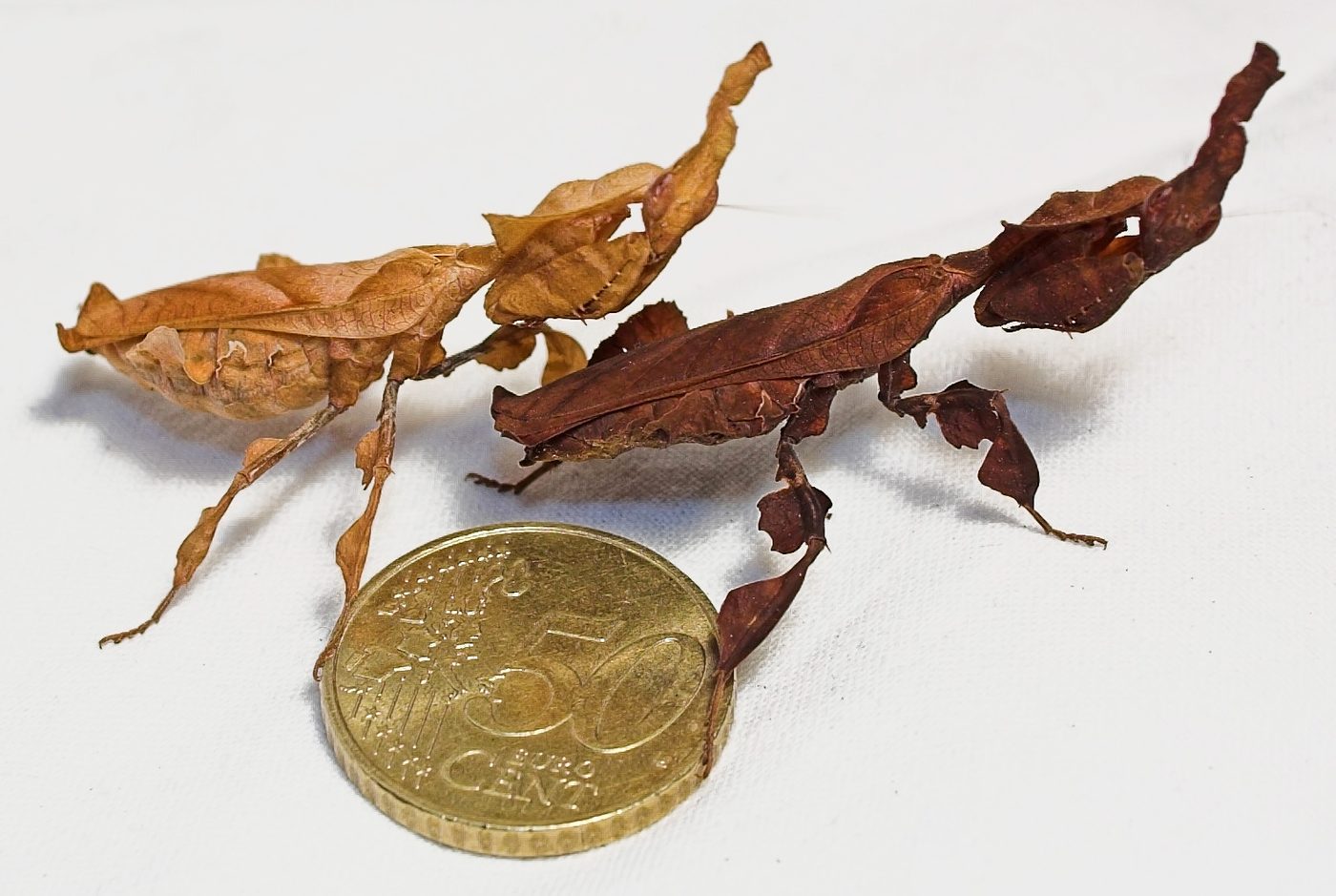
Photo: Mydriatic · CC BY-SA 4.0
Ghost mantis
Phyllocrania paradoxa
The ghost mantis is a small African mantis shaped like a dry leaf, one of the most perfect examples of plant mimicry among insects.
Characteristics
Temperament
A motionless ambush predator; tolerates its own kind, rarely cannibalistic.
Diet
Insectivorous: fruit flies and small insects.
A mantis dressed as a dead leaf
The ghost mantis (Phyllocrania paradoxa) is a small mantis of the family Hymenopodidae, famous for a body that perfectly mimics a dead, withered leaf. Its head bears a distinctive pointed projection like a curled leaf, while its limbs and abdomen are adorned with jagged lobes and flaps that break up its outline. Its colour ranges from brown to grey, with shades that adapt to the surroundings. Motionless among the leaf litter or on a twig, it is virtually indistinguishable from a real fallen leaf.
Habitat and range
It is native to Africa, particularly the southern regions of the continent and Madagascar, where it lives among low vegetation and dry leaf litter.
Behaviour and diet
It is an ambush predator: it waits motionless, camouflaged, and catches small insects — fruit flies and other suitably sized insects — with a lightning strike of its raptorial forelegs. Its camouflage serves both to hide from predators and to surprise prey.
Did you know?
It is one of the most popular mantises in the terrarium hobby, prized for its unusual look and because, unusually for a mantis, it tolerates the presence of other individuals relatively well, with a lower tendency to cannibalism. This makes it one of the few mantises that can be kept in groups.
Conservation
It has no major species-specific IUCN assessment and is considered common across its range. As with many insects, its conservation depends on the health of African natural habitats.
Pros
- Perfect dead-leaf camouflage
- Low cannibalism: can be kept in groups
- Easy and fascinating in a terrarium
Cons
- Very small and delicate
- Needs live prey of suitable size
- Depends on African habitats in the wild