Photo: Megan McCarty · CC BY 3.0
Luna moth
Actias luna
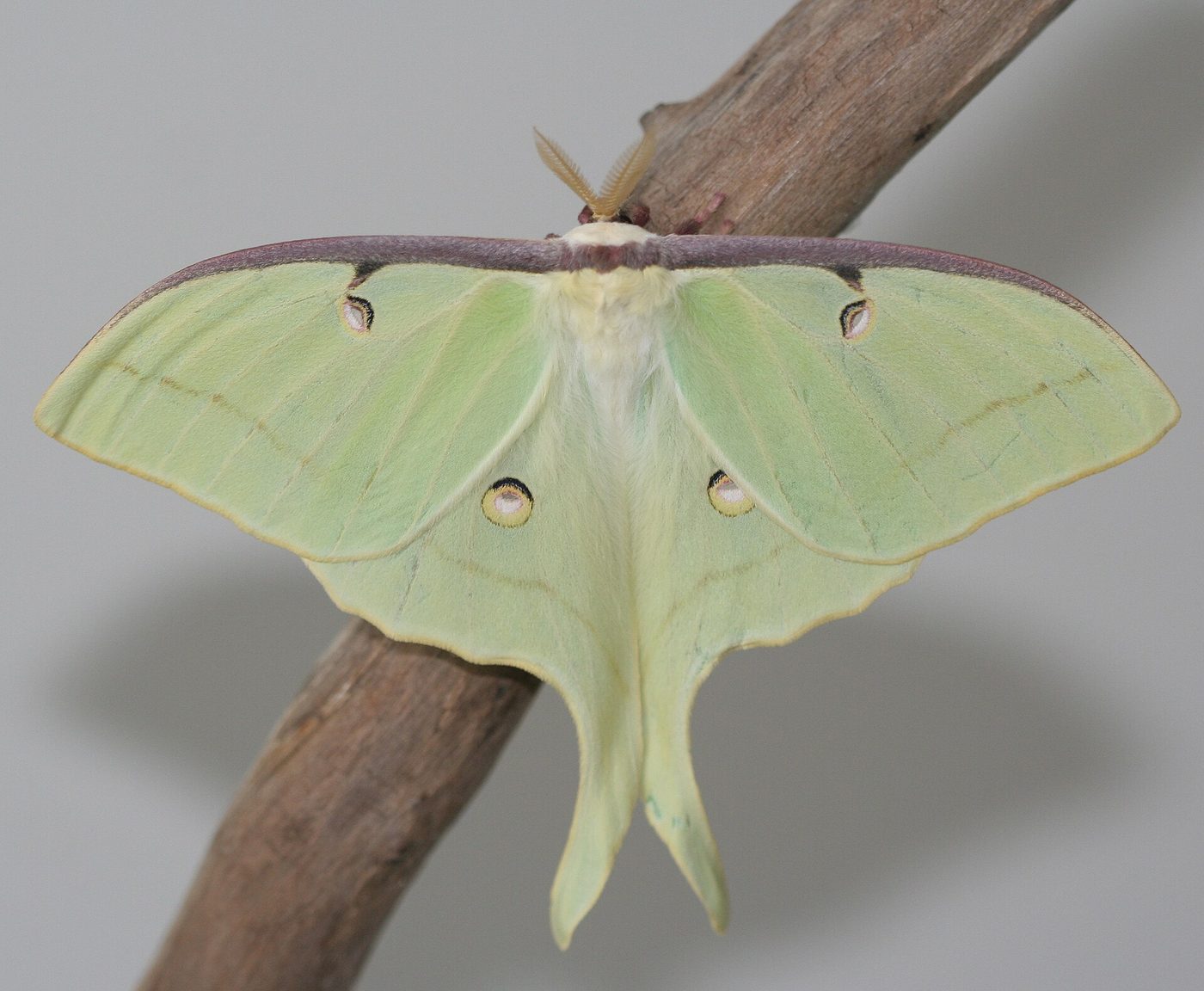
Large and delicate, a soft lime green with long tails and prominent eyespots, the luna moth is one of the most spectacular and fascinating moths of North America.
Characteristics
Temperament
Nocturnal, delicate, attracted to light
Diet
As a caterpillar feeds on leaves; the adult does not feed
A moth of moonlit colours
The luna moth is a large, unmistakable nocturnal moth belonging to the family of the saturniids, the group of the giant silk moths. Its broad wings are a delicate lime green, almost pastel, edged with pink or purple along the front margin. On each wing stands out an eyespot, a rounded mark resembling an eye. The hindwings extend into two long, thin, winding tails, giving it an elegant, almost fairytale appearance. Its wingspan can reach around ten centimetres.
Habitat and distribution
It is widespread across much of North America, where it inhabits woods and forests, preferring wooded, well-drained areas. It is a nocturnal moth: by day it rests motionless among the leaves, camouflaged by its green colour, while at night it becomes active and is strongly attracted to sources of light.
A fascinating life cycle
The adult's life is very short: the luna moth, once it emerges from the cocoon, has no functional mouthparts and cannot feed. It therefore lives only about a week, with the sole purpose of reproducing. All the energy it needs is accumulated during the caterpillar stage, a large and voracious green caterpillar that feeds on the leaves of various trees, such as walnut, birch and others. After pupating in a silk cocoon, the moth emerges transformed.
Curiosities
The long tails of the hindwings are not merely decorative: they are thought to serve to confuse the sonar of bats, one of the moth's main nocturnal predators, diverting the attack away from the body. For its ethereal beauty, the luna moth is much loved and popular: it has even appeared on stamps and book covers.
Pros
- Elegant, unmistakable appearance
- Delicate lime green with long tails
- Harmless and fascinating moth
- Tails confuse bats
Cons
- Very short adult life, about a week
- The adult cannot feed
- Sensitive to light pollution