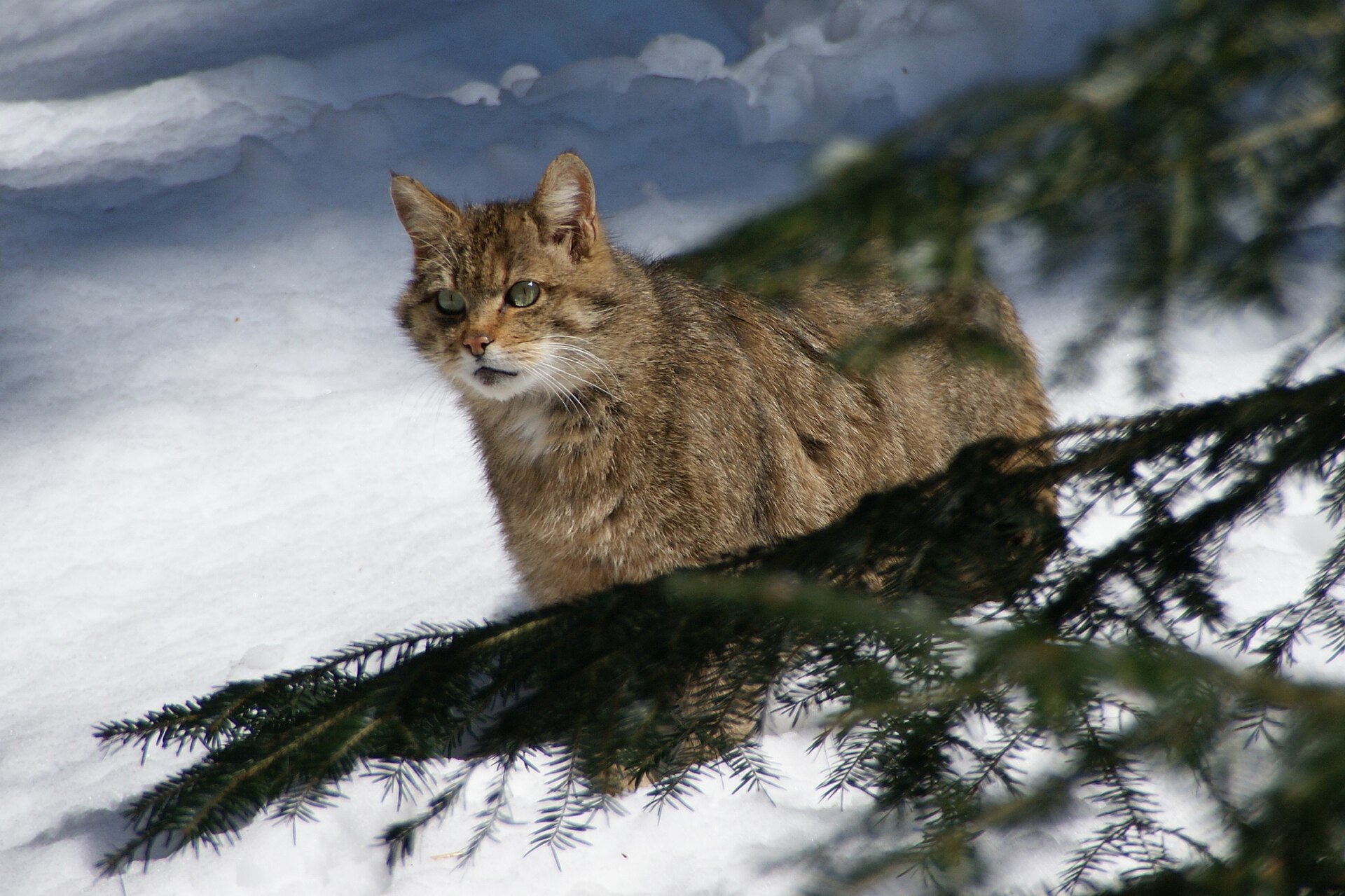
European Wildcat
Felis silvestris
Characteristics
Temperament
Solitary, territorial and deeply shy. A nocturnal and crepuscular hunter specialized on rodents, it lives hidden in the woods and avoids people. It marks its territory with urine and scratches; the female raises the kittens alone. Although it resembles a domestic cat, its nature is entirely wild and it cannot be tamed, even if hand-raised. Not a pet: a native wild cat whose genetic purity is threatened by hybridization with domestic cats.
Diet
A carnivore specialized on small rodents. The absolute staple: voles and mice (often over 80% of prey). It also eats rabbits and young hares where available, birds caught on the ground or in bushes, and occasionally reptiles, amphibians and insects. It hunts by stalk-and-wait with a final pounce, mainly at dawn and dusk when rodents are active. By hunting voles and mice it plays an important rodent-control role in the woods.
The European Wildcat (Felis silvestris) is the wild cat native to the forests of Europe, Italy included. Famous for:
- Its "wild tabby" look: it recalls a striped domestic cat but is sturdier, and is told apart by precise details
- An unmistakable tail: bushy and cylindrical, with sharp dark rings and a rounded black tip
- The true cat of our woods: present in Italy, especially the Apennines and Sicily, and across much of Europe
- An untameable nature: shy and wild, it cannot be tamed even if hand-raised
- "Not the house cat's grandfather": the domestic cat's ancestor is the African wildcat, a different though related species
- The threat of hybridization: the main risk to the species is interbreeding with domestic and feral cats
IUCN status: Least Concern (LC) as a species, but many local populations are fragile because of hybridization and habitat loss. The challenge of its conservation — protecting the genetic "purity" of a cat that so resembles the house cat — closely echoes that of other wild canids in this portal, such as the Dingo and the Golden Jackal.
Classification and category
Order Carnivora, family Felidae, genus Felis — the same as the domestic cat and the small wild cats of the Old World. It is closely related to the African wildcat (Felis lybica), the species from which, about 10,000 years ago in the Middle East, the domestic cat (Felis catus) descends; and to the domestic cat itself, with which it can interbreed and produce fertile hybrids. An important misconception to clear up: the house cat does NOT descend from the European wildcat, but from its African cousin. The European wildcat is therefore a "wild relative" of our cat, not its direct ancestor. It includes several populations; the British one (the Scottish wildcat, nicknamed the "Highland tiger") is famous and severely threatened. Etymology: "Felis" is Latin for "cat"; "silvestris" means "of the woods, wild", for its forest habitat. Parameters: Body 50-65 cm. Tail 25-35 cm (bushy, ringed, black-tipped). Weight 3.5-8 kg (males larger; on average a little heavier and sturdier than a domestic cat). Longevity about 7-10 years in the wild, up to about 15 in captivity. Solitary; mating in late winter; gestation ~63-68 days; litters of 2-4 kittens, raised by the female alone in a hidden den (tree hollows, abandoned burrows, rock crevices).
Habitat and distribution
The European Wildcat is tied mainly to the continent's forest environments: across much of Europe (the Iberian Peninsula, France, Central and Eastern Europe, the Balkans, Italy) to Anatolia and the Caucasus; in Italy it occurs especially along the central-southern Apennines and in Sicily, with populations in some Alpine areas. Preferred habitats: mature deciduous and mixed forests (its prime habitat, with dense undergrowth and natural dens); woodland, Mediterranean scrub and mosaics of forest and clearings; and hilly and montane zones, up to medium altitudes. It tends to avoid open areas, heavily snow-covered zones and very human-dominated settings. It is solitary, territorial and mainly nocturnal and crepuscular: it marks its territory with urine and secretions, and males hold large ranges overlapping those of several females. Its shyness makes it hard to observe — so much so that many sightings are actually feral domestic cats. IUCN: Least Concern as a species. Locally, however, it is threatened by hybridization with domestic cats, forest loss and fragmentation, road mortality, and diseases carried by stray cats.
Diet
A carnivorous hunter specialized on small rodents: small rodents (voles and mice are the absolute staple, often over 80% of prey); rabbits and young hares (where available); birds (caught on the ground or in bushes); and reptiles, amphibians and insects (as a supplement, especially in some seasons). Hunting strategies: stalk-and-wait (like all small cats, it creeps in silently or waits motionless near prey burrows, then strikes with a final pounce); crepuscular and nocturnal hunting (most active at dawn and dusk, when rodents are active); and rodent control (by hunting mainly voles and mice, it plays an important regulating role in the woods). Crucially, its strong dependence on small rodents ties it to the health of forest ecosystems and their edges, where vole populations are abundant.
Physical features
The European Wildcat resembles a striped domestic cat but is larger, sturdier and more "rustic"; recognizing it takes attention to detail. Coat: grey-brown with a soft tabby pattern, never with sharp spots or blotches; a dark dorsal stripe that runs along the back but stops at the base of the tail; thick, warm fur, longer in winter. The distinguishing traits versus the domestic cat (crucial for identification): a bushy, cylindrical ("club-like") tail with 3-5 sharp dark rings and a rounded black tip (not tapered); a stockier build and sturdier legs; a faint, regular tabby pattern, without the bright colours or blotched patterns of domestic cats; and an overall more "stocky" and wild look. Performance: a silent stalk and powerful pounce, like a small cat; climbing (it scales trees nimbly for shelter); acute senses (excellent sight, hearing and smell); and extreme wariness — its main defence against humans.
Behaviour and curiosities
A solitary, territorial, deeply shy animal. It defends its territory by marking it with urine and scratches, avoids contact with people and leads a hidden life in the thick of the woods, making it one of the hardest Italian and European mammals to observe in the wild.
"Not a gone-wild house cat": this is the most common misconception. The European wildcat is a wild species in its own right, not a domestic cat returned to the wild; even taken as a kitten and hand-raised, it keeps a wild nature and never truly tames, remaining wary, independent and hard to handle, unlike a true domestic cat. The tail that makes the difference: telling a wildcat from a domestic tabby is not trivial, but the tail is the best clue — the wildcat's is bushy and cylindrical like a club, with well-separated dark rings and a rounded black tip, while the domestic cat's tends to be thinner and tapered; the dorsal stripe stopping at the base of the tail is another good sign. The wrong ancestor: contrary to belief, our house cat does NOT descend from the European wildcat; genetic research has established that all domestic cats descend from the African wildcat (Felis lybica), tamed in the Middle East about 10,000 years ago with the birth of farming (cats kept rodents away from grain stores), so the European wildcat is a wild cousin, not a grandfather. The hybridization paradox: the greatest threat to this cat is not a predator but its very resemblance to the house cat — by interbreeding with domestic and stray cats it produces fertile hybrids, and over time the genetic "purity" of wild populations is diluted, exactly the same problem that threatens the Dingo in Australia and complicates the conservation of the Golden Jackal. The "Highland tiger": the British population, the Scottish wildcat, is nicknamed the "Highland tiger" and is one of Europe's most threatened, reduced to very few genetically pure individuals precisely because of hybridization, with conservation and reintroduction programmes under way to save it — a symbol of this elusive cat's fragility. The woodland mouser: though it resembles the house cat, the European wildcat plays a valuable ecological role in the woods, controlling vole and mouse populations that make up almost its entire diet — in a sense, the natural "rodent guardian" of Europe's forests.
Pros
- Felino selvatico nativo d'Europa e d'Italia, simbolo dei boschi sani
- IUCN Least Concern come specie
- Controlla naturalmente arvicole e topi nelle foreste
- Grande valore per la biodiversità europea e la conservazione locale
Cons
- Non è un animale domestico: indole selvatica, non addomesticabile
- Minacciato dall'ibridazione con i gatti domestici e randagi
- Sensibile a deforestazione, frammentazione e investimenti stradali
- Spesso confuso con gatti soriani o gatti inselvatichiti