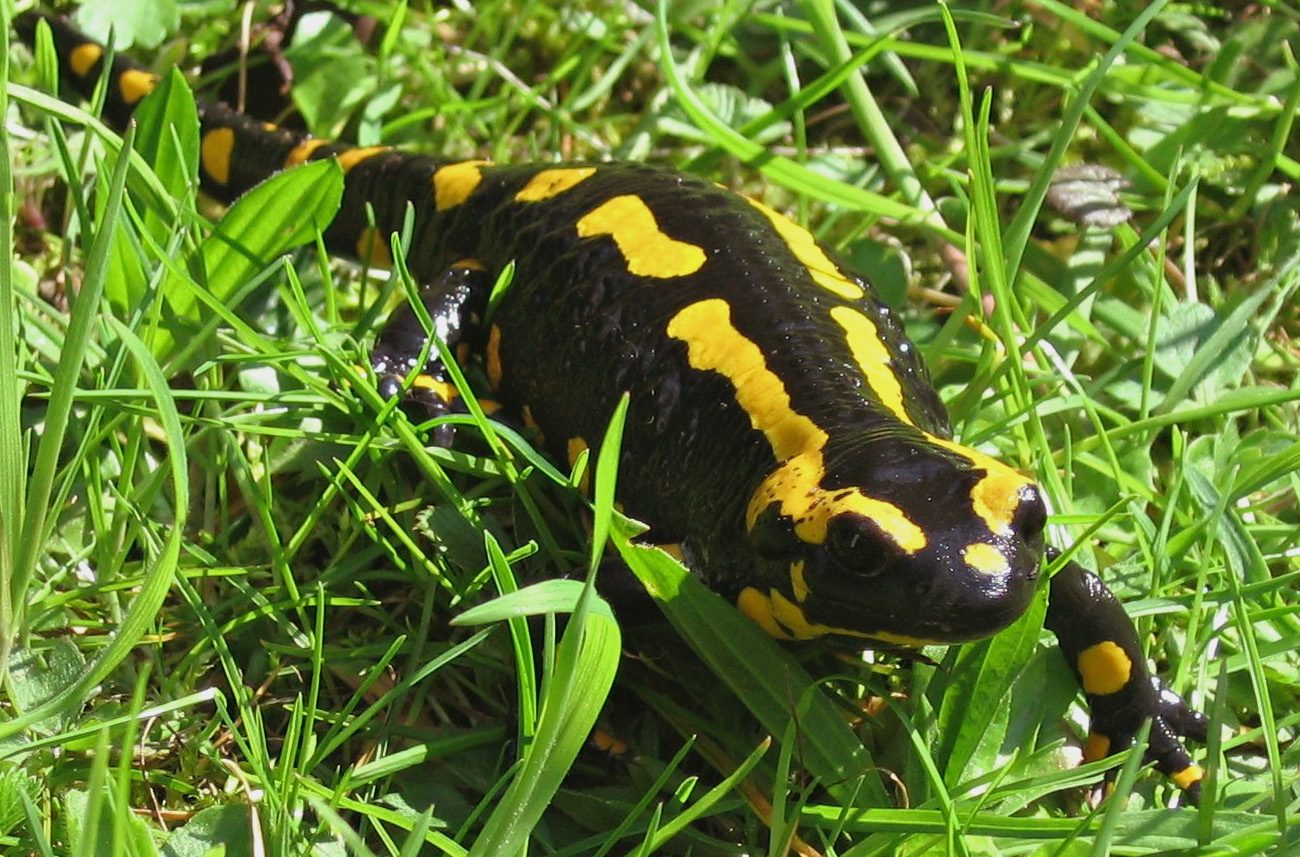
Photo: Michael Linnenbach · CC BY-SA 3.0
Fire salamander
Salamandra salamandra
Black and yellow like a warning sign, the fire salamander is an amphibian of damp woods that does not fear being seen: its colours are a warning.
Characteristics
Temperament
Nocturnal, slow and shy, active chiefly after rain. It does not flee by jumping: its defence is its warning colours and the toxic secretions of its skin.
Diet
Carnivore: earthworms, snails, insects and other small invertebrates, hunted in the night-time damp.
An amphibian of alarm colours
The fire salamander is one of Europe's most recognisable amphibians, with its glossy black livery crossed by patches and bands of vivid yellow, sometimes tending to orange. This striking colouring does not serve to hide but, on the contrary, to be noticed: it is a warning signal, a way of telling predators that the animal is toxic. Its skin indeed secretes irritating and poisonous substances that protect it from attack.
The body is stocky, the tail cylindrical, the legs short; unlike frogs it does not jump but walks slowly with a swaying gait.
Where it lives
The fire salamander is tied to damp broadleaf woods, particularly hill and mountain forests crossed by streams and springs of clear water. It loves shady, cool places, with abundant leaf litter, rotting logs and stones under which to take refuge. It occurs across much of central and southern Europe.
Habits and breeding
It is a nocturnal and crepuscular animal that leaves its refuges chiefly after rain, when humidity is highest. It feeds on earthworms, snails, insects and other small invertebrates. Its breeding is unusual: unlike most amphibians, which lay eggs, the fire salamander is mostly viviparous or ovoviviparous, and the female releases already-developed, gilled larvae into the water, where they complete their metamorphosis.
Curiosities
The link between this animal and fire is ancient: the very name salamander evokes legends according to which it could live among flames. The belief probably arose because salamanders, sheltering in logs, fled when these were burned, thus seeming born of fire.
Conservation
The fire salamander is listed as least concern, but it depends closely on the quality of woods and waters. The pollution of streams, the destruction of damp forest habitats and, in recent times, the spread of a pathogenic fungus that attacks salamanders pose serious threats to many populations.