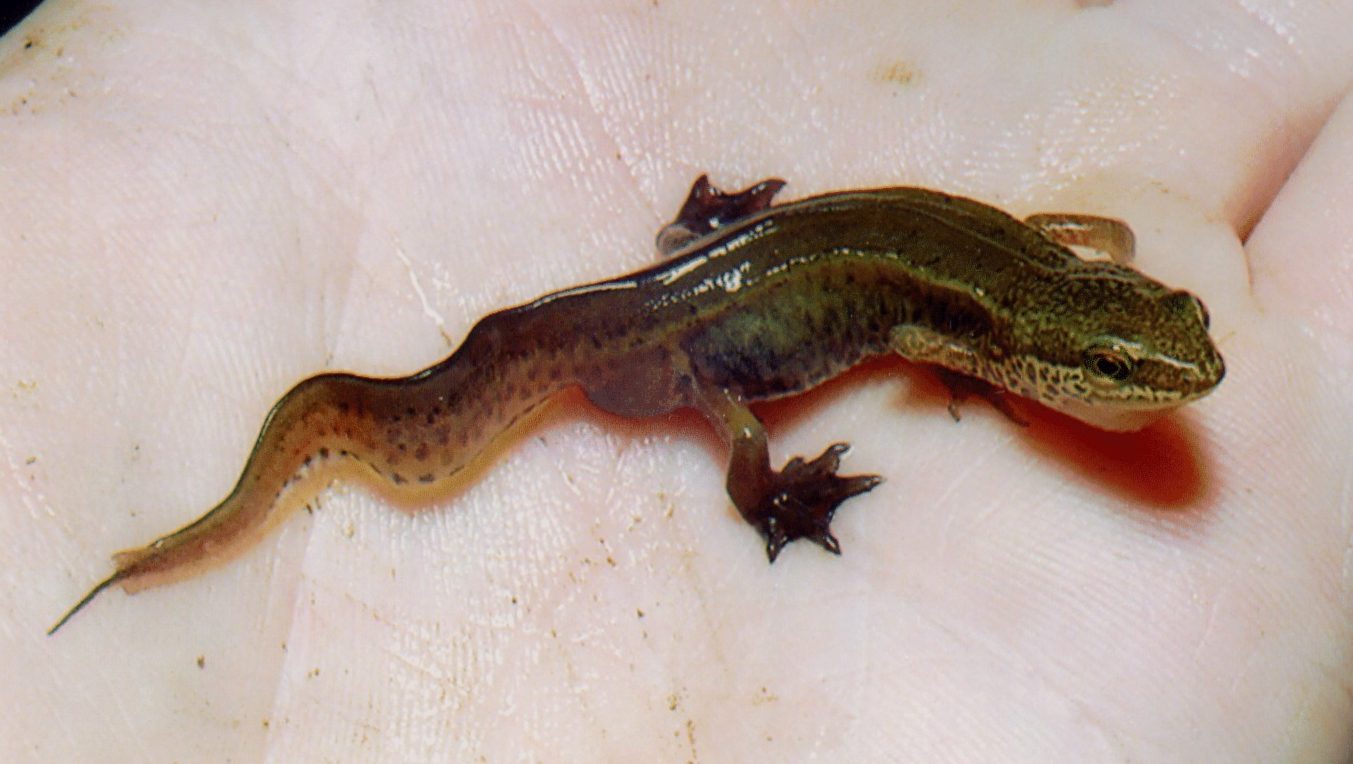
Photo: Christian Fischer · CC BY-SA 3.0
Palmate newt
Lissotriton helveticus
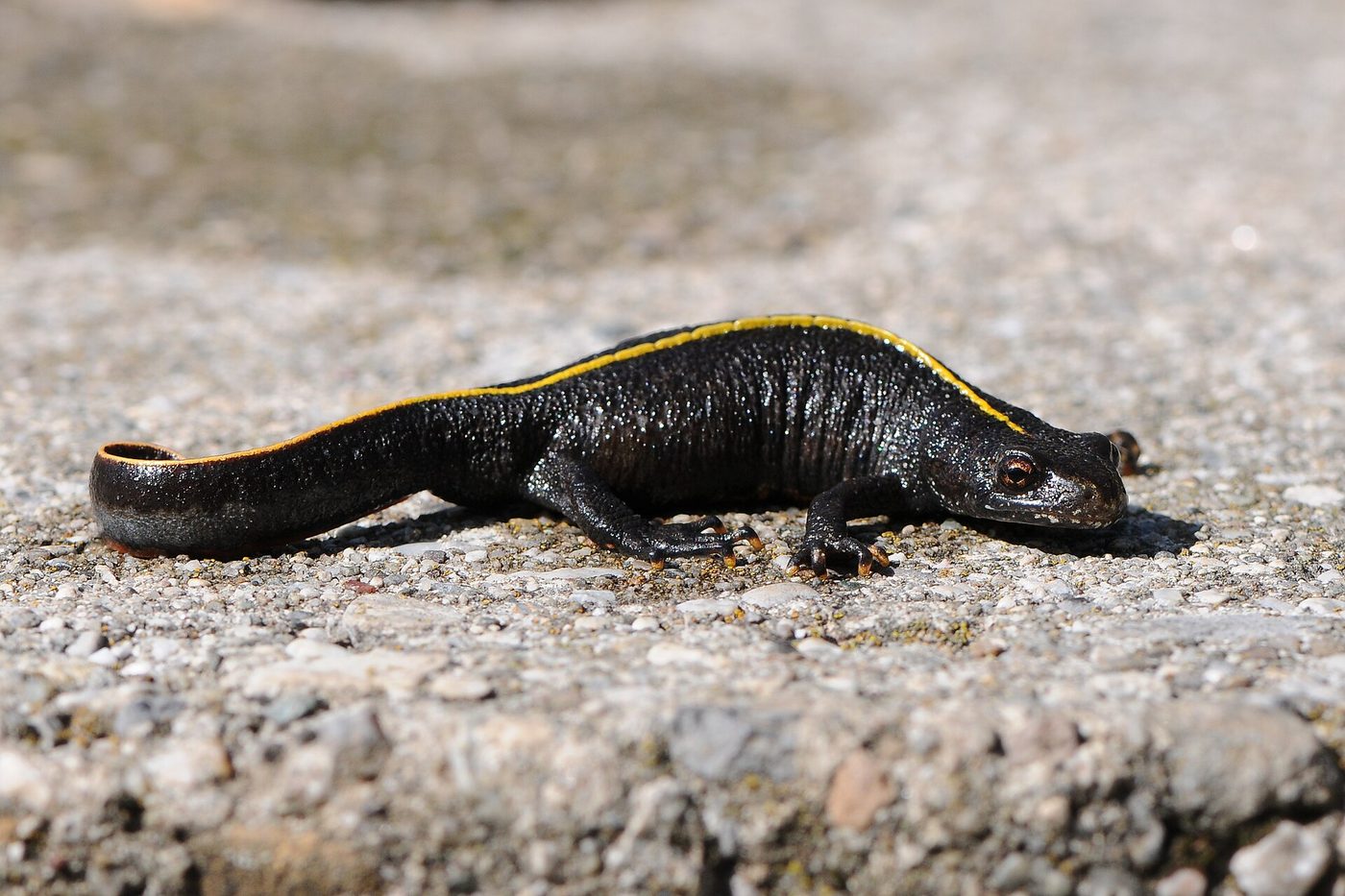
The palmate newt is a small aquatic amphibian of western Europe, whose breeding male develops webbed hind feet and a filament on the tail.
Characteristics
Temperament
Amphibious, nocturnal, shy
Diet
Small aquatic and terrestrial invertebrates
Description
The palmate newt is one of the smallest European newts, 5-9.5 centimetres long. It has a slender body, olive or brown with a few dark spots, and a yellow-orange belly with an unspotted throat, a trait that distinguishes it from the similar smooth newt. A dark stripe runs along the head and through the eyes. The breeding male develops distinctly webbed hind feet, a low smooth crest on the back and a characteristic filament at the tip of the tail.
Habitat and distribution
It occurs in western Europe, from Great Britain to the northern Iberian Peninsula. It frequents ponds, pools, ditches and small bodies of water, often in cool woodland, heath and hill habitats. It tolerates even slightly acidic, nutrient-poor waters where other newts struggle.
Behaviour and reproduction
Outside the breeding season it leads a terrestrial life, hidden in damp places. In spring it returns to water to breed: the male courts the female with a dance, displaying its tail and webbed feet. The eggs are laid singly and folded into the leaves of aquatic plants. It feeds on small invertebrates.
Did you know?
The male's webbed hind feet, which give the newt its name, and the fine tail filament are temporary adaptations that appear only in the breeding season and serve in courtship and swimming.
Conservation
It is classed as least concern, but depends on small wetlands to breed. The loss of these habitats and the introduction of predatory fish into ponds can locally threaten its populations.
Pros
- Tolerates even acidic, nutrient-poor waters
- Indicator of healthy small wetlands
- Long-lived, can reach ten years
Cons
- Depends on ponds and pools to breed
- Vulnerable to introduced predatory fish
- Shy and hard to observe