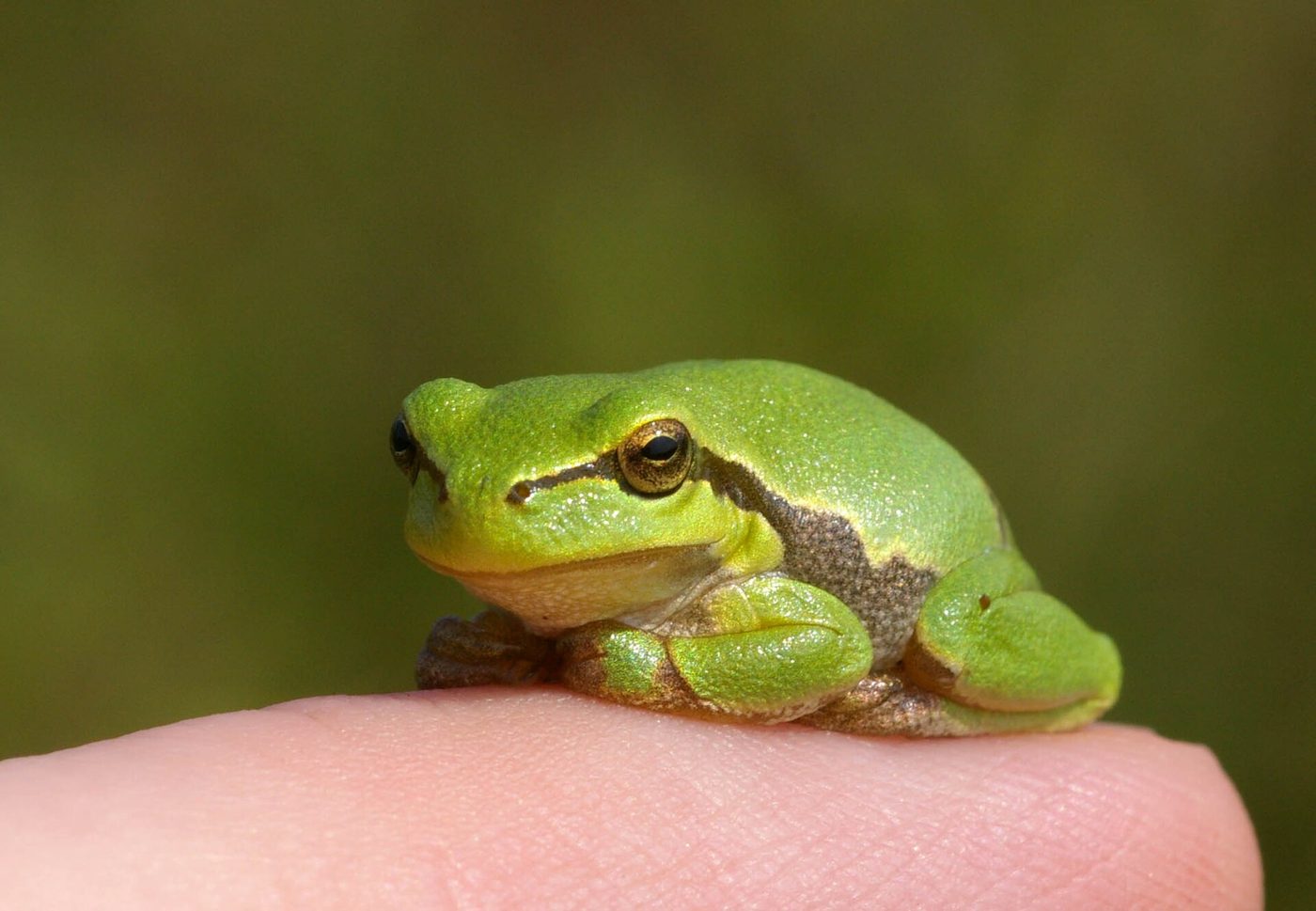
Photo: Christian Fischer · CC BY-SA 3.0
European tree frog
Hyla arborea
Tiny, brilliant green and fitted with adhesive discs on its toes, the tree frog is Europe's only frog that lives among the trees and sings at the top of its voice on spring evenings.
Characteristics
Temperament
Arboreal, nocturnal and cryptic. It spends the day motionless among the leaves; the males are loud singers on spring evenings near water.
Diet
Insectivore: insects and other small invertebrates, caught with the tongue among the vegetation.
A frog that lives in trees
The tree frog is a small amphibian of unmistakable appearance: it rarely exceeds five centimetres in length and sports smooth skin of a brilliant emerald green, which can nonetheless shift in tone from green to brown according to its surroundings, the temperature and its mood. A thin dark line runs along its flanks, from the snout to the hind legs. Its most extraordinary feature is its fingertips: each toe ends in a small adhesive disc that lets it climb leaves, branches and even smooth surfaces.
It is the only European frog to lead a mostly arboreal life, away from water for much of the year.
Where it lives
The tree frog favours settings rich in vegetation and close to water: reed beds, bushes, hedgerows, damp thickets and pond banks. It spends much of its time perched on leaves and branches, where its colour camouflages it perfectly. To breed, though, it needs bodies of still, clean water free of predatory fish.
The call
On spring evenings the males gather near water and strike up a powerful chorus, out of all proportion to their size. The call is made possible by a large vocal sac beneath the throat, which inflates like a balloon and amplifies the sound. A chorus of tree frogs can be heard from a great distance and is one of the most typical sounds of European spring nights.
Breeding and diet
As an adult the tree frog feeds on insects and other small invertebrates, which it catches with its tongue. In spring it returns to water to breed: the females lay their eggs in small clumps, from which tadpoles hatch and live in water until metamorphosis, when they develop legs and can climb back up among the vegetation.
Conservation
The tree frog is listed as least concern, but like all amphibians it is sensitive to the loss of wetlands, water pollution and the use of pesticides. The draining of ponds and ditches and the introduction of fish into small bodies of water are among the threats that reduce its breeding sites.