Photo: Tassilo Rau · CC BY-SA 3.0
Binturong
Arctictis binturong
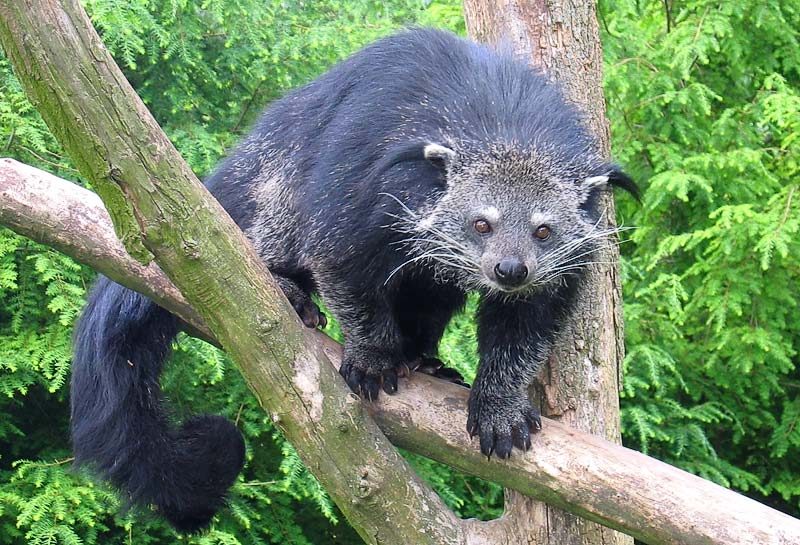
With its black shaggy fur, prehensile tail and curious popcorn smell, the binturong is an arboreal mammal of the Asian forests, nicknamed the 'bearcat'.
Characteristics
Temperament
Nocturnal, arboreal, slow and solitary
Diet
Frugivore and omnivore: mainly fruit, then small animals
The mysterious 'bearcat'
The binturong is a mammal of unusual appearance, so much so that it is nicknamed the 'bearcat' in many languages, for its cat-like face and stocky, shaggy body resembling that of a small bear. In reality it is related neither to cats nor to bears: it belongs to the viverrid family, the same as civets and genets. It has thick black fur, long white whiskers and tufts of hair on its ears. Its most extraordinary feature is its long, muscular, prehensile tail, which it uses as a fifth limb to grip branches.
Habitat and distribution
It lives in the tropical forests of Southeast Asia, from India to Indonesia. It is a strictly arboreal animal: it spends much of its life among the treetops, moving slowly and cautiously thanks to its prehensile tail and flexible limbs. It prefers dense, mature forests, where it finds food and shelter.
Behaviour and diet
The binturong is mainly nocturnal and solitary, but not aggressive. It is above all frugivorous: it feeds largely on fruit, in particular figs, which it gathers among the branches, supplementing them with leaves, shoots, eggs, small animals and insects. By moving about and dispersing seeds in its droppings, it plays a valuable role as a 'gardener of the forest', contributing to the regeneration of vegetation, so much so that it is considered important for the spread of certain plants.
A fragrant curiosity
One of the binturong's most famous features is its smell: it gives off a curious scent reminiscent of freshly made popcorn or warm bread. This aroma is produced by glandular secretions the animal uses to mark its territory and communicate with its own kind, and is perhaps the feature that makes it most endearing to the public.
Conservation
The binturong is classified as a vulnerable species. The main threats are the destruction of tropical forests, caused by logging and plantations, and hunting. Protecting the mature forests of Southeast Asia is essential for the survival of this fascinating and unusual tree-dweller.
Pros
- Prehensile tail used as a fifth limb
- Valuable seed disperser of the forest
- Curious popcorn smell
- Long-lived and fascinating
Cons
- Vulnerable species
- Depends on mature forests
- Threatened by deforestation and hunting