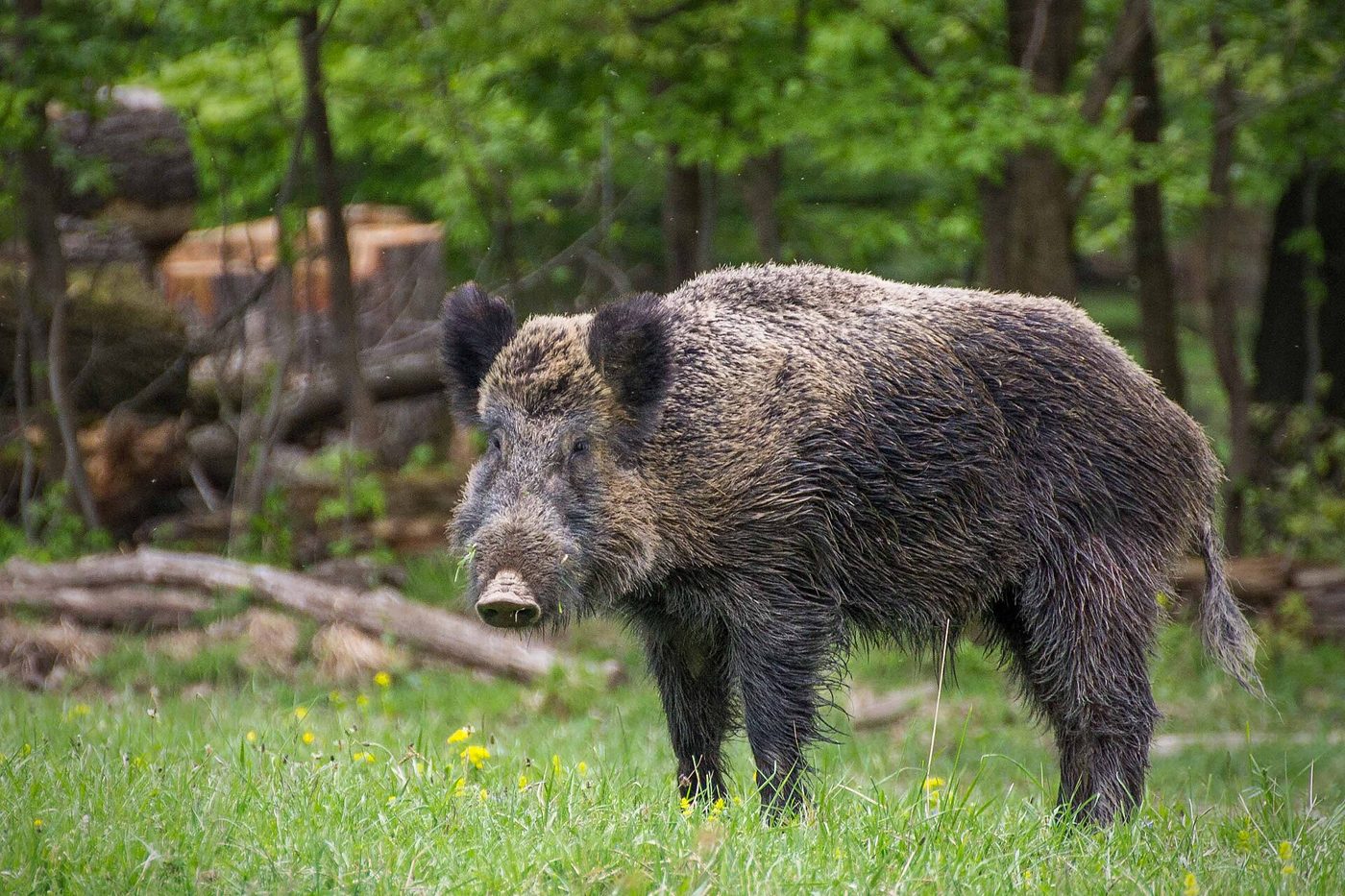
Photo: Valentin Panzirsch · CC BY-SA 3.0 at
Wild boar
Sus scrofa
Sturdy, intelligent and remarkably adaptable, the wild boar is the wild ancestor of the domestic pig and one of Europe's most successful mammals.
Characteristics
Temperament
Intelligent, adaptable and cautious, active mainly by night. It usually avoids people, but a female with young or a cornered animal may react decisively.
Diet
Opportunistic omnivore: roots, tubers, bulbs, acorns, earthworms, mushrooms, fruit, eggs, small animals and carrion.
The ancestor of the pig
The wild boar is the wild forebear of the domestic pig, from which it differs in its more compact build, elongated snout and coat of coarse bristles ranging from grey to dark brown. The head is large and wedge-shaped, suited to digging the ground, and adult males develop curved canines, the so-called tusks, which emerge at the sides of the mouth and grow throughout life. The young, called piglets, are born with a coat of pale stripes that camouflages them in the undergrowth and fades as they grow.
Where it lives
Few mammals have so vast a range: the wild boar occupies much of Europe, Asia and North Africa, and humans have introduced it to other continents. It favours woodland rich in undergrowth, but its adaptability lets it live in wildly different settings, from wetlands to cultivated countryside, pushing ever more often to the edges of cities.
What it eats
The wild boar is an opportunistic omnivore with an enormously broad diet. With its snout it digs the ground in search of roots, tubers, bulbs, acorns and earthworms, but it does not spurn mushrooms, fruit, eggs, small animals and carrion. This flexible diet is one of the keys to its success: it feeds on virtually whatever the environment offers in each season.
Social behaviour
Females and young live in family groups led by an old female, while adult males tend to be solitary, joining the groups only during the mating season. Active mainly by night, the wild boar has a very keen sense of smell and considerable intelligence, which lets it learn quickly and get around obstacles. It can run fast and swims well.
Spread and management
The wild boar is listed as least concern and its populations are growing strongly in many European regions. The problem, if anything, is the opposite of rarity: abundance. Crop damage, road collisions and an ever more frequent presence in urban areas make managing the species a delicate matter, at the centre of a continual balancing of ecological, agricultural and safety needs.