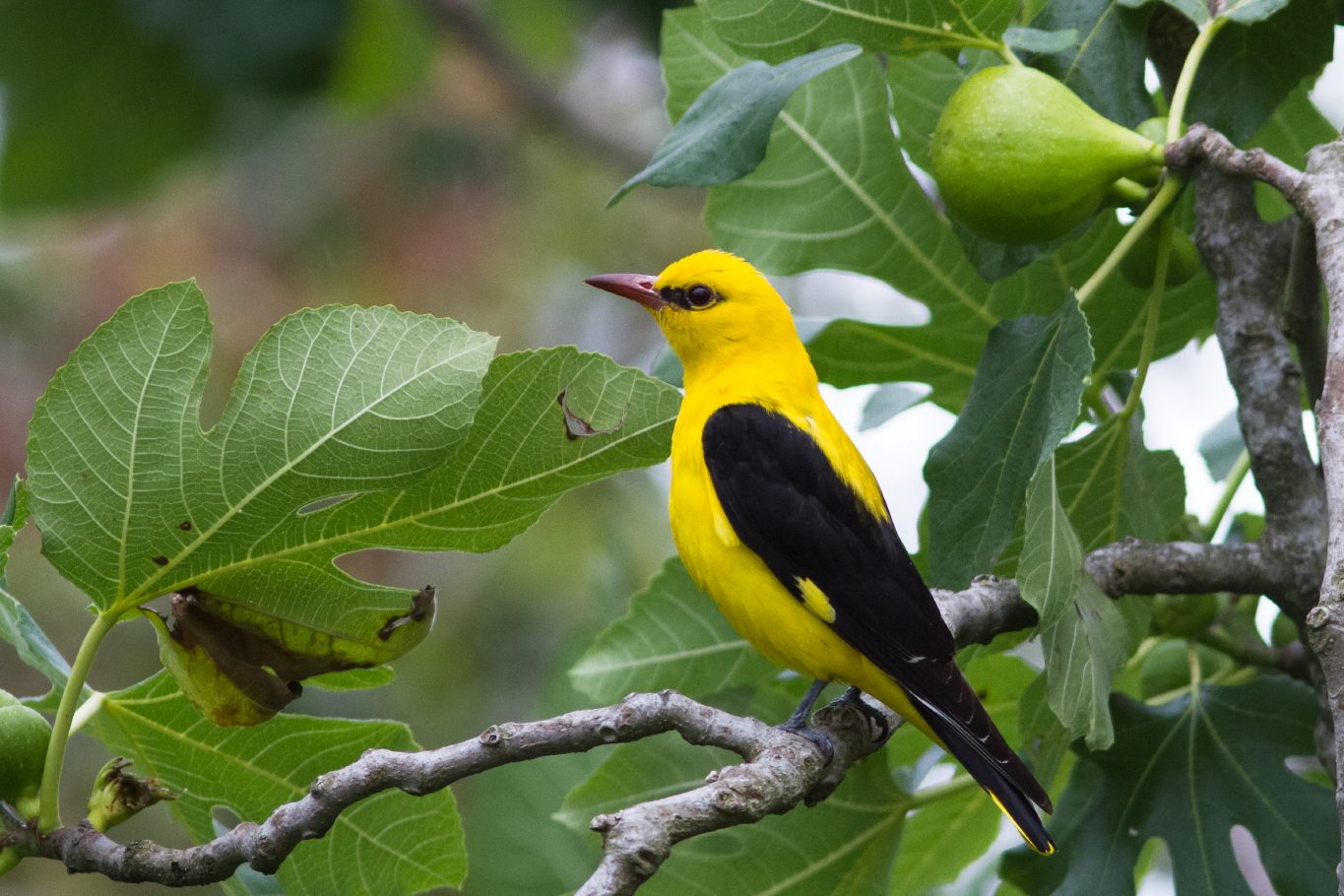
Eurasian golden oriole
Oriolus oriolus
The golden oriole is a migratory bird whose males glow golden-yellow with black wings, far easier to hear than to see among the treetops.
Characteristics
Temperament
Shy, arboreal, with a fluting song
Diet
Insects, caterpillars and ripe fruit in summer
Description
The golden oriole is one of Europe's most colourful birds, yet surprisingly hard to spot. The male has brilliant golden-yellow plumage, set off by the black of its wings and tail and a pinkish bill. The female is far more discreet, in yellowish-green tones with a whitish, streaked belly. Despite the vivid colours, the male blends well among sunlit leaves.
Habitat and distribution
It is a migrant that spends the summer in Europe and much of western Asia, wintering in central and southern Africa. It frequents bright broadleaf woodland, poplar groves, orchards and tree lines along watercourses, staying almost always hidden high in the canopy.
Behaviour
It spends much of its time among the foliage, where it is betrayed above all by its song: a fluting, melodious and unmistakable whistle, often described as a liquid, golden call. It feeds on insects, caterpillars and, in summer and autumn, on ripe fruit such as cherries and figs. It builds a hammock-shaped nest, slung in the fork of a branch.
Did you know?
Its scientific name comes from the Latin aurum, "gold", for the male's plumage. The song has inspired musicians and poets: the composer Olivier Messiaen dedicated a piece to it in his Catalogue of Birds.
Conservation
It is classed as least concern, but depends on mature woodland and riparian habitats. The loss of these habitats and the use of pesticides, which reduce insects, can threaten local populations.
(Note: the mass value given by Wikidata, 7.3 kg, is clearly wrong: the golden oriole actually weighs about 50–80 grams.)
Pros
- Male's plumage among the finest in Europe
- Melodious, unmistakable song
- Useful predator of caterpillars and insects
Cons
- Extremely hard to spot in the canopy
- Depends on mature woodland and riverine habitats
- Sensitive to insect declines