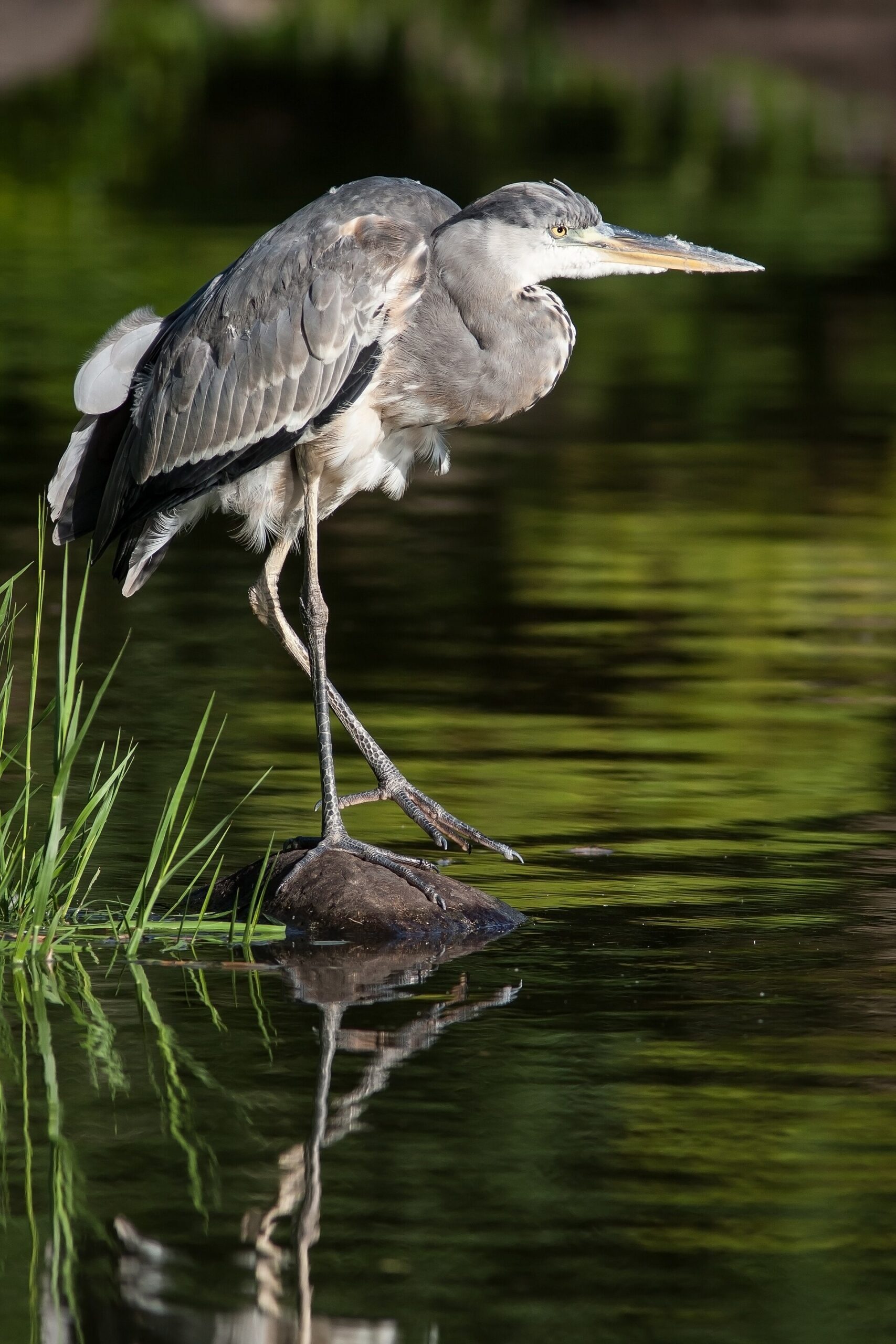
Grey Heron
Ardea cinerea
Characteristics
Temperament
A large wild wader, patient, solitary in hunting and active mainly by day. It is the "stand-and-wait" fisher par excellence: it stays motionless for a long time at the water's edge, then catches its prey with a lightning stab of the bill. Though shy, it has adapted very well to human environments and can become confiding along canals and ponds. It nests in colonies (heronries). It is NOT a pet: it is wild birdlife to be observed and safeguarded in its environment, and a valuable presence and indicator of the health of wetlands.
Diet
An opportunistic carnivore with a fish-dominated but very varied diet: besides fish, it catches amphibians and reptiles (frogs, tadpoles, small snakes), small mammals (especially voles and mice, even in fields), insects, crustaceans and even small birds. It hunts with the "stand-and-wait" technique: it stays motionless for a long time scanning the shallow water, then strikes with a lightning movement of the neck and the long dagger bill, swallowing the prey whole. Sometimes it advances slowly to approach. Patience, stillness and dietary flexibility are the keys to its success.
The Grey Heron (Ardea cinerea) is the most common and widespread of the large European herons: a tall, elegant wading bird, grey-plumaged, embodying the very image of the patient fisher of the wetlands. Famous for:
- "Stand-and-wait" hunting: it stays motionless for a long time, then strikes its prey with a stab of the bill
- The dagger bill: long, sturdy and yellowish, a perfect fishing weapon
- Flight with an "S"-shaped neck: it flies with the neck folded, not outstretched like storks and cranes
- The wader's elegance: a long neck, slender legs, a statuesque bearing
- Adaptability: present in rivers, lakes, marshes and even city canals
- Heronries: it nests in colonies in trees
IUCN status: Least Concern (LC). It enters the portal among the waders, alongside the storks (white and black) and the extraordinary Shoebill: with them it shares the world of wetlands, but it stands apart for its hunting style and for flying with the neck folded, typical of herons.
Classification and category
Family Ardeidae (the herons), genus Ardea. The species is Ardea cinerea. In the portal it is placed among the waders, the large long-legged birds tied to aquatic environments. It is useful to tell it apart from other herons and large waders: the great egret (Ardea alba) and the little egrets — herons of entirely white plumage, quite different from the grey heron's grey; the purple heron (Ardea purpurea) — darker, with reddish tones, and more tied to reedbeds; the storks (also in the portal) — large waders that, however, fly with the neck outstretched, while the heron flies with the neck folded into an "S"; this is one of the surest ways to tell them apart in flight; the American great blue heron (Ardea herodias) — the very similar "twin" species of the New World. Etymology: "Ardea" is the Latin word for "heron"; "cinerea" means "ash-coloured", referring to the grey plumage. Parameters: Height about 84-100 cm. Wingspan about 155-195 cm. Weight roughly 1-2 kg. Longevity: in the wild on average a few years, with high juvenile mortality, but some individuals can exceed 20 years. Reproduction: it nests in colonies (heronries), building large stick nests in trees.
Habitat and distribution
The Grey Heron is one of the most widespread waders of the Old World: its range covers much of Europe, Asia and Africa; northern populations are partly migratory, temperate ones (including Italy) largely resident. Preferred habitats — almost every environment with shallow water and abundant fishing: rivers, lakes, ponds and marshes; wetlands, rice paddies, estuaries and coasts; and canals, ditches and urban ponds, where it is often surprisingly confiding. The Grey Heron is a solitary, territorial hunter in its fishing areas, but colonial in nesting: it gathers in heronries, often large colonies set up in trees, where many pairs build their big stick nests. Its adaptability — the ability to exploit every kind of wetland, including artificial and urban ones — underlies its great success and wide distribution. IUCN status: Least Concern (LC). It is common and healthy across much of its range. In the past it was persecuted (also as a "competitor" at fish farms and ponds), but today it is generally protected and widespread.
Diet
The Grey Heron is an opportunistic carnivore, with a diet dominated by fish but surprisingly varied. It feeds on: fish (the basis of the diet, of various sizes); amphibians and reptiles (frogs, tadpoles, small snakes); small mammals (in particular voles and mice, caught even in fields); and insects, crustaceans and even small birds. The hunting technique: "stand-and-wait" (the heron stays motionless, often on one leg, scanning the water for a long time, then strikes with a lightning movement of neck and bill); slow approach (alternatively it walks with extreme slowness and caution in shallow water, approaching the prey); and the bill-strike (the long dagger bill is thrust to seize or spear the prey, then swallowed whole). Crucially, patience and stillness are its winning weapons. The ability to hunt terrestrial prey such as voles in fields too, besides fish, makes it a very flexible predator, able to exploit different resources depending on the season and environment.
Physical features
A large wader of statuesque bearing, unmistakable for size and colour. The plumage — the distinguishing trait: ash-grey upperparts, whitish underparts; a white head crossed by a black band over the eye, ending in a tuft/crest of black feathers; and a whitish-grey neck with dark streaking on the front. The bill and legs: a long, sturdy, dagger-like bill, yellowish (brighter in the breeding season); long, slender wader's legs; and a long, flexible neck, foldable into an "S". In flight: large grey wings with slow, deep beats; a neck folded into an "S" (not outstretched) and legs trailing behind: the surest way to tell it from storks and cranes in flight; and an imposing, prehistoric-looking silhouette.
Behaviour and curiosities
The Grey Heron is a patient bird, solitary in hunting and active mainly by day (but sometimes also at dusk). Its image — motionless and statuesque at the water's edge — is one of the most classic and recognizable of European wetlands.
The fisher of patience: the Grey Heron is the very symbol of waiting; it can stay motionless for very long minutes, staring at the shallow water, before darting with a lightning stab of the bill; this "stand-and-wait" strategy is extremely effective and lets it catch prey unaware of its presence. The "S"-shaped neck: unlike storks and cranes, which fly with the neck fully outstretched, the heron flies with the neck folded back into an "S", the head almost resting on the shoulders; it is a detail that, together with the trailing legs, allows it to be recognized at a glance even from afar. The heronries: although a solitary hunter, the Grey Heron nests in colonies called heronries; on large trees one can count dozens of bulky nests, built with sticks and occupied year after year; heronries are lively, noisy places, often shared with other heron species. The mouse hunter: although we imagine it mainly fishing, the Grey Heron is a versatile predator; it by no means scorns terrestrial prey, and can be seen hunting voles and mice in fields and meadows, far from the water; this dietary flexibility is one of the secrets of its success. Coexistence with humans: the Grey Heron has adapted very well to human-modified environments; it is found along city canals, in parks, at ornamental ponds and fish farms, where it can become surprisingly confiding; its very frequenting of fishing ponds once made it disliked by some, but today it is appreciated as an elegant inhabitant of wetlands. The "feather powder": like other herons, the Grey Heron has special feathers called "powder down" that crumble into a kind of fine powder; the bird uses it, together with a foot equipped with a "comb"-like claw, to clean its plumage of slime and fish residue, keeping it tidy and efficient.
Pros
- Grande e bellissimo trampoliere, elegante e facile da osservare nelle zone umide
- Molto adattabile: presente anche in canali, parchi e laghetti cittadini
- Predatore versatile e utile (mangia anche topi e arvicole)
- IUCN Least Concern: comune e diffuso in Europa, Asia e Africa
Cons
- NON è un animale da compagnia: è avifauna selvatica protetta
- Può predare i pesci di laghetti e allevamenti, entrando in conflitto con l'uomo
- Risente del degrado e della perdita delle zone umide
- Vita media breve in natura, con alta mortalità giovanile