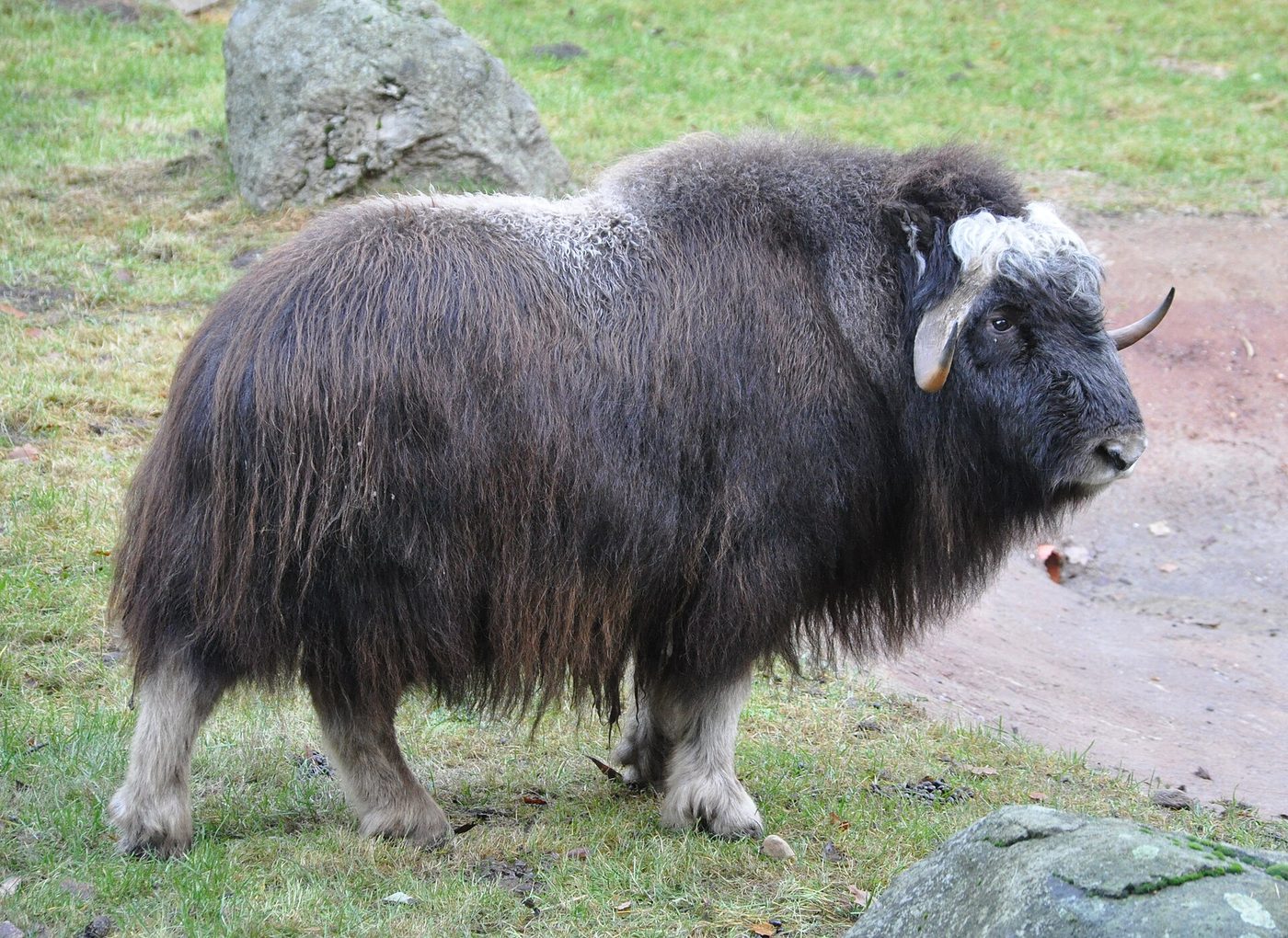
Photo: Quartl · CC BY-SA 3.0
Muskox
Ovibos moschatus
The muskox is a massive Arctic herbivore wrapped in a thick coat that nearly reaches the ground, built to withstand the harshest winters.
Characteristics
Temperament
Gregarious, sturdy, defensive as a group
Diet
Herbivorous: grasses, mosses, lichens and tundra shrubs
A woolly giant of the tundra
The muskox is a large, heavily built Arctic mammal with high shoulders and curved horns that, in males, meet across the forehead to form a sturdy bony boss. Its most striking feature is its coat: a thick fur that hangs almost to the ground, made of long outer guard hairs and an extremely fine woolly underlayer called qiviut, among the warmest natural fibres in the world. Despite its name, it is not related to oxen: it belongs to the goat-antelope subfamily, closer to goats and sheep.
Habitat and range
It lives on the cold Arctic tundra of Canada and Greenland and has been successfully reintroduced to Alaska, Siberia, Norway and Sweden. It survives where temperatures fall far below freezing, feeding on grasses, mosses, lichens and shrubs it reaches by digging through snow with its hooves.
Behaviour
It lives in herds and has a famous defensive strategy: faced with a predator such as a wolf, the adults form a circle with their horns pointing outward, protecting the young in the centre. Its name comes from the musky odour emitted by males during the rut, which serves to attract females.
Notable facts
Qiviut, the muskox's underwool, is gathered during the spring moult and spun into prized yarns, warmer and lighter than sheep's wool. The scientific name Ovibos combines the Latin words for "sheep" and "ox".
Conservation
The species is listed as Least Concern, with a total population estimated at around 130,000. A survivor of the last ice age, it remains sensitive to the climate change altering the fragile Arctic ecosystem.
Pros
- Extraordinary adaptation to extreme cold
- Qiviut underwool among the warmest fibres on Earth
- Stable, unthreatened population
Cons
- Sensitive to Arctic climate change
- Rutting males can be aggressive