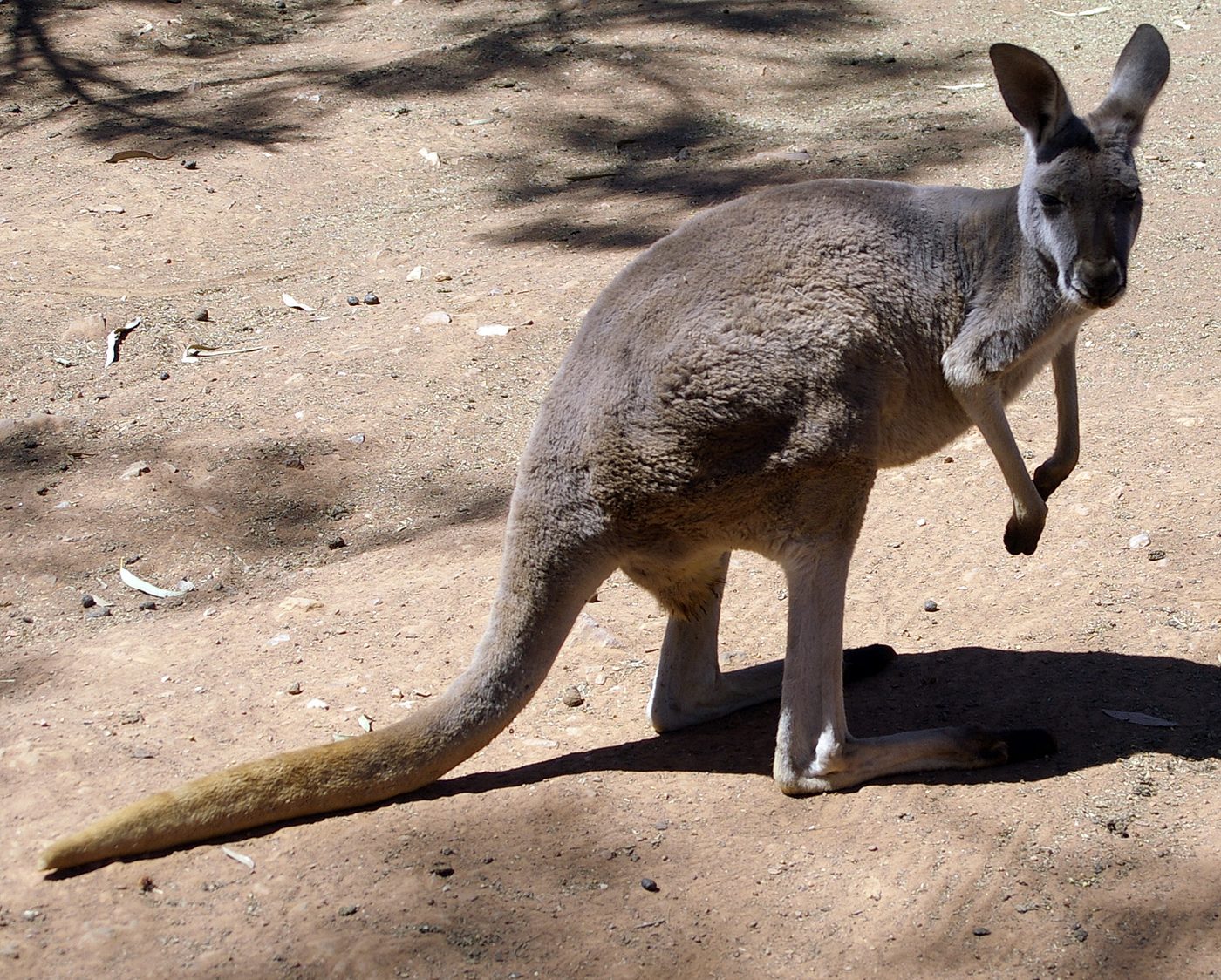
Red kangaroo
Macropus rufus
The largest living marsupial and a symbol of Australia: the red kangaroo crosses the arid plains in powerful bounds, covering great distances with surprising efficiency.
Characteristics
Temperament
Social, living in changing groups called 'mobs'. Mostly peaceful and herbivorous; males clash in ritual fights using tail and hind legs.
Diet
Herbivore: grasses and vegetation of the arid plains, with a great ability to withstand drought.
The giant of marsupials
The red kangaroo is the largest living marsupial and one of the most famous symbols of Australia. Males can reach and exceed eighty kilograms and, upright on their hind legs and tail, approach two metres in height. The male's coat tends to a characteristic red-brown, while the smaller female is often a blue-grey. The body is built for hopping: powerful hind legs, a long muscular tail used as a balance and as a third support, and small forelimbs.
A unique way of moving
The red kangaroo moves by hopping, an extraordinarily efficient gait. Thanks to the elastic tendons of its hind legs, which store and return energy like springs, it can travel long distances using little energy and reach high speeds. A single bound can cover several metres. At slow paces it moves instead by leaning on its tail and forelegs in an awkward way, but as soon as it accelerates it becomes an unmatched athlete.
Where it lives
It is found across the vast arid and semi-arid plains of the Australian interior. It is perfectly adapted to a water-poor environment: it feeds on grasses and other vegetation and can survive long periods of drought. It lives in groups, called 'mobs', whose composition changes continually.
The pouch and the young
Like all marsupials, the female has a pouch. The young, called a joey, is born after a very short gestation as a tiny embryo, climbs by itself up to the pouch and stays there for months, completing its development attached to a teat. The female can manage several reproductive stages at once, an adaptation that lets her make the most of favourable periods.
Behaviour and conservation
Males clash in famous fights, leaning on their tails to strike with their hind legs. The red kangaroo is an abundant and unthreatened species: its populations are numerous and stable across much of its range. It is a central element of Australia's arid ecosystems and a national icon known worldwide.