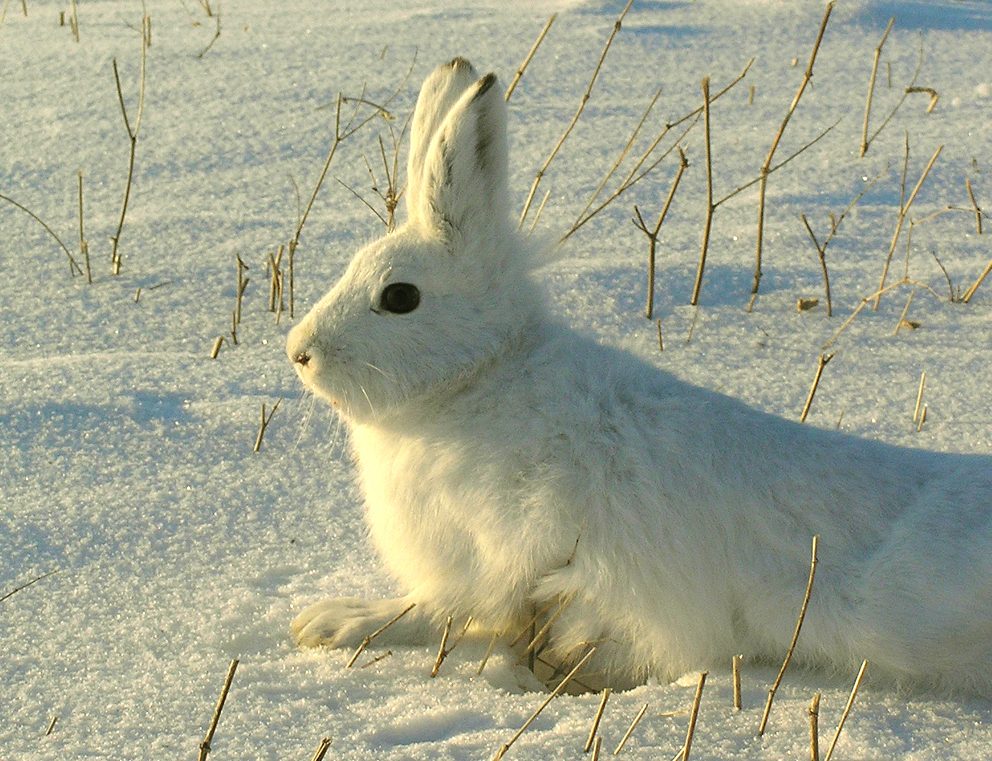
Mountain hare
Lepus timidus
The mountain hare is a hare of cold regions that changes colour with the seasons, turning white in winter to blend into the snow.
Characteristics
Temperament
Shy, crepuscular, solitary
Diet
Herbivore: grass, shoots, bark and twigs
Description
The mountain hare is a lagomorph adapted to cold climates, slightly smaller and stockier than the European hare. Its most famous feature is its seasonal moult: in summer it has a greyish-brown coat, while in winter it turns pure white, so as to blend into the snow. The tail stays white all year and the ears are shorter than the European hare's, an adaptation to reduce heat loss.
Habitat and distribution
It lives in the cold regions of the Palearctic, from Scandinavia to Siberia, with isolated populations in the Alps, Ireland and some islands. It frequents tundra, moorland and high-altitude pastures, climbing in summer to above the tree line.
Behaviour and adaptations
Its large hind feet, broad and fur-covered, act like snowshoes and let it move nimbly over the snow. It is a herbivore, feeding on grass, shoots, bark and twigs according to the season. It is mainly active at dusk and by night.
Did you know?
The change in coat colour is governed by day length rather than temperature. With climate warming and increasingly late snowfalls, white hares risk standing out on still-dark ground, exposed to predators.
Conservation
It is classed as least concern, but some populations, such as those in the Alps, are closely monitored. Climate change is the main threat to this snow-dependent species.
Pros
- Extraordinary seasonal camouflage
- Perfectly adapted to cold and snow
- Snowshoe-like feet for moving over the snow
Cons
- Threatened by climate change
- White coat exposes it when snow is absent
- Isolated, vulnerable alpine populations