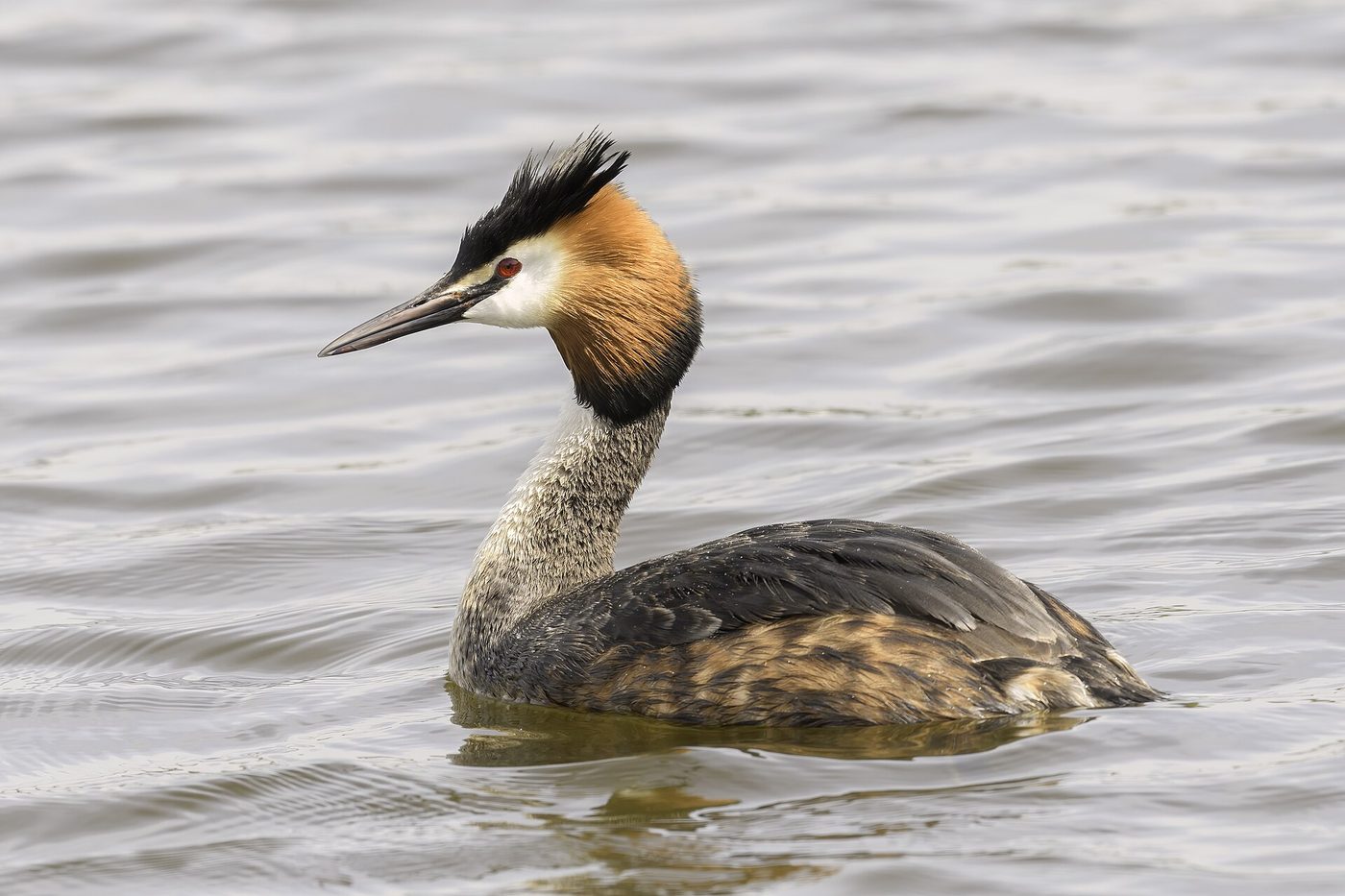
Photo: caroline legg · CC BY 2.0
Great crested grebe
Podiceps cristatus
The great crested grebe is an elegant waterbird with a long neck and a striking crest, famous for its spectacular courtship dance on the water.
Characteristics
Temperament
Aquatic, diving, elegant
Diet
Small fish, aquatic insects and crustaceans
Description
The great crested grebe is the largest and best known bird of the grebe family. It has a slender body, a long, thin neck and a pointed bill. In breeding plumage it sports a striking black crest on the head and broad frills of orange-red and black feathers on the sides of the face. Its body plumage is brown above and glossy white below. Its legs, set far back with lobed toes, make it an excellent swimmer and diver but awkward on land.
Habitat and distribution
It occurs in Eurasia, Africa and Australasia. It lives on freshwater lakes, ponds and reservoirs with reed-fringed banks, where it nests on floating platforms of vegetation. In winter it also moves to open water and sheltered coasts.
Behaviour
It is an able diver that hunts small fish underwater, its main food, along with aquatic insects and crustaceans. It is famous above all for its spectacular courtship dance: pairs perform synchronised movements, shaking their heads with crests spread and rising almost vertical from the water, face to face, offering each other tufts of weed.
Did you know?
Grebe chicks have heads striped in black and white and are often carried on their parents' backs, hidden among the feathers, even while the adults dive. The crest and frills are most developed in spring and reduce in winter.
Conservation
It is classed as least concern. It was once hunted for its feathers, but populations are now stable. It depends on wetlands with reed beds; disturbance and water pollution locally threaten its breeding.
(Note: the mass value given by Wikidata, 39.5 kg, is clearly wrong: the great crested grebe actually weighs about 0.6–1.5 kg.)
Pros
- Spectacular courtship dance on the water
- Superb swimmer and diver
- Elegant and easy to observe on lakes
Cons
- Awkward and vulnerable on land
- Depends on wetlands with reed beds
- Sensitive to disturbance and water pollution