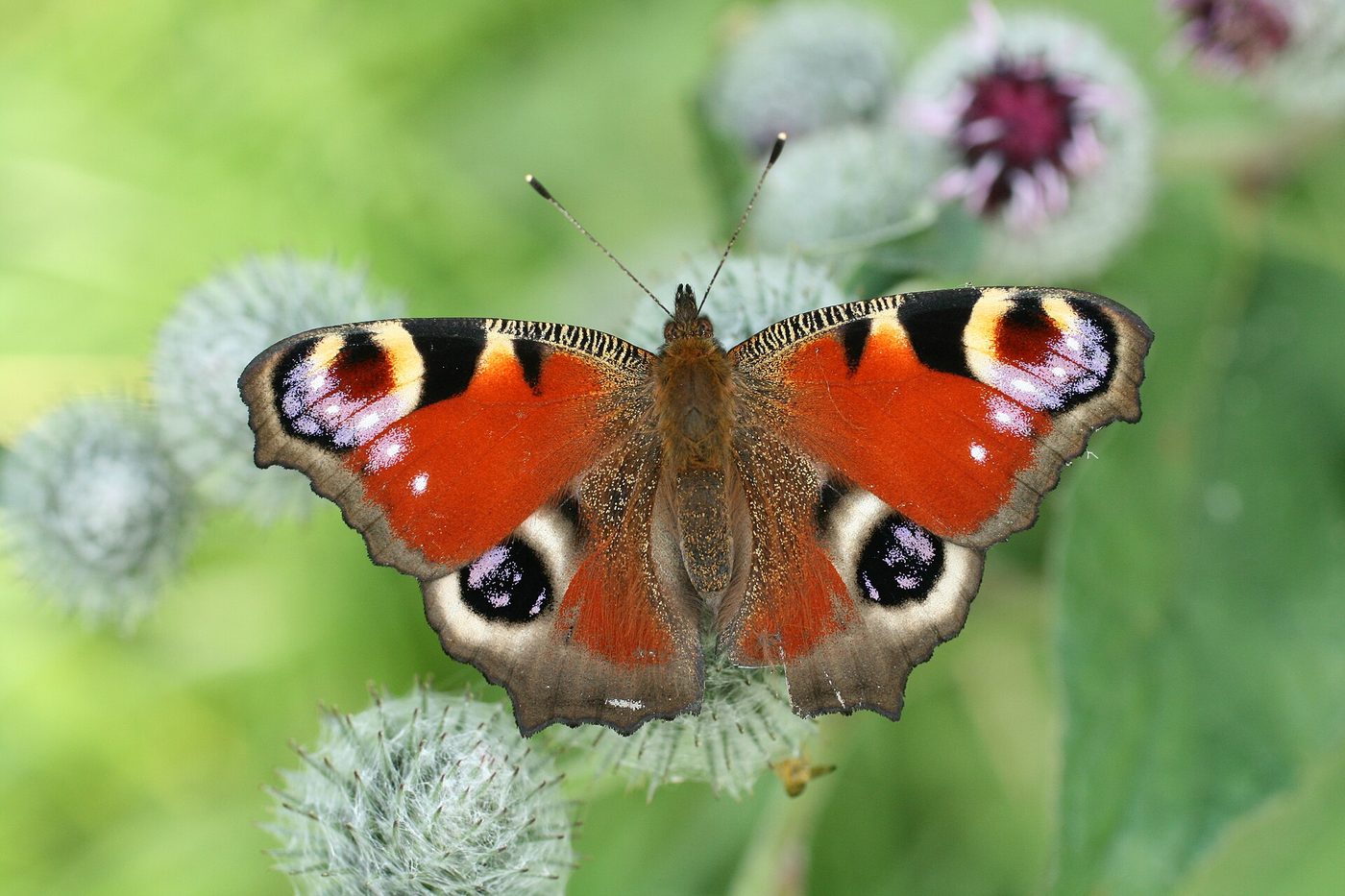
Photo: Korall · CC BY-SA 3.0
European peacock butterfly
Aglais io
With four great eyes painted on its wings, the peacock butterfly is one of the most beautiful and unmistakable butterflies of Europe, a master of visual deception.
Characteristics
Temperament
A day-flying butterfly, mobile and showy with open wings, cryptic with closed wings. It defends itself by suddenly displaying its large eyespots to startle predators.
Diet
The adults feed on nectar and, in autumn, on ripe fruit; the caterpillars feed on nettles.
A butterfly with painted eyes
The peacock butterfly is one of the most recognisable lepidopterans of Europe. Its open wings show a bright brick-red ground, on which stand out four large eye-shaped markings, called eyespots, with vivid blue and yellow reflections. The underside of the wings, by contrast, is very dark, almost black, and imitates a dead leaf to perfection: with wings closed, the butterfly becomes almost invisible.
This double appearance, cryptic when closed and gaudy when open, underlies its extraordinary defensive strategy.
The art of deception
When threatened, the peacock butterfly suddenly opens its wings, displaying the four large eyespots. To a predator such as a bird, those sudden eyes can recall the face of a much larger, more dangerous animal, making it hesitate or flee. The butterfly can also produce a faint hissing sound by rubbing its wings. It is a fascinating example of how a defenceless insect defends itself with illusion rather than force.
Life cycle
The peacock butterfly lays its eggs on nettles, the vital host plant for its caterpillars. The caterpillars, black and spiny, live in groups on these plants before turning into a chrysalis and then a butterfly. The adults feed on the nectar of flowers and, in autumn, on ripe fruit. This butterfly spends the winter as an adult, in hibernation, hidden in sheltered places such as tree hollows, log piles or attics, before reappearing in the first warmth of spring.
Where it lives
It is a very widespread and adaptable butterfly, present across much of Europe and temperate Asia. It frequents flowery meadows, gardens, open woods, edges and wetlands, wherever there are flowers to feed on and nettles for laying. It is often seen too in parks and urban gardens.
Conservation
The peacock butterfly is common and listed as least concern. As with many insects, however, its presence depends on the availability of flowers and host plants: leaving corners with nettles and flowery meadows, avoiding pesticides, is a simple way to favour this and other butterflies.