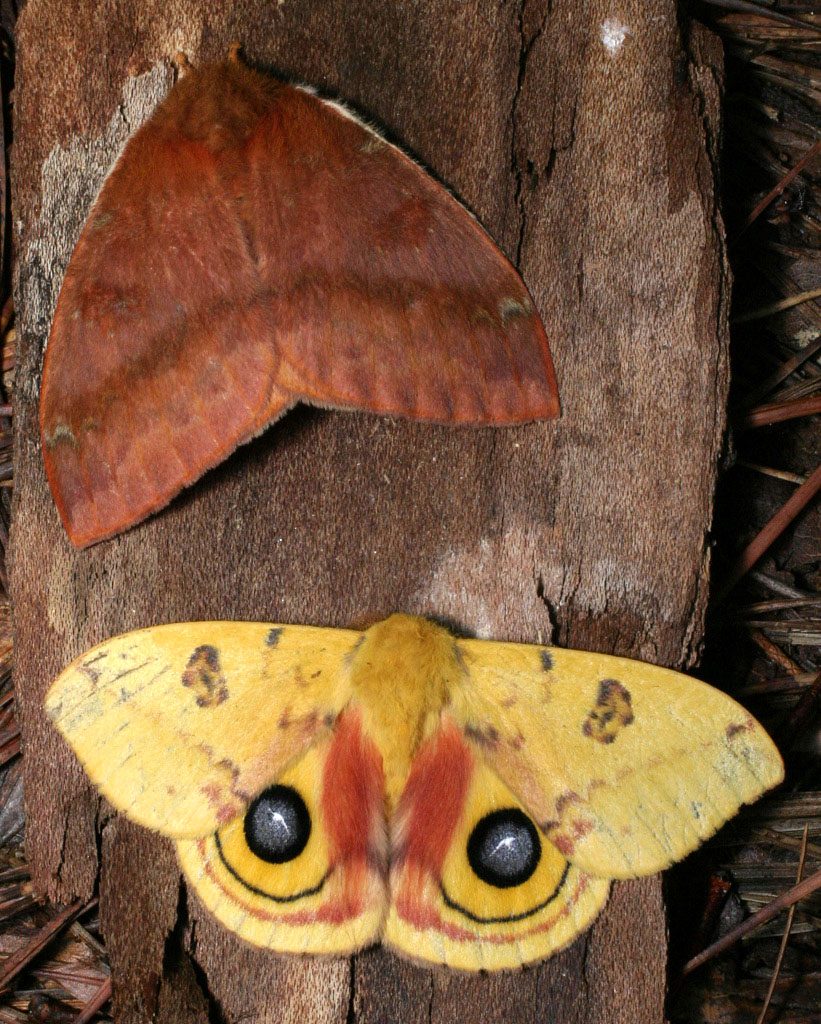
Photo: Patrick Coin (Patrick Coin) · CC BY-SA 2.5
Io moth
Automeris io
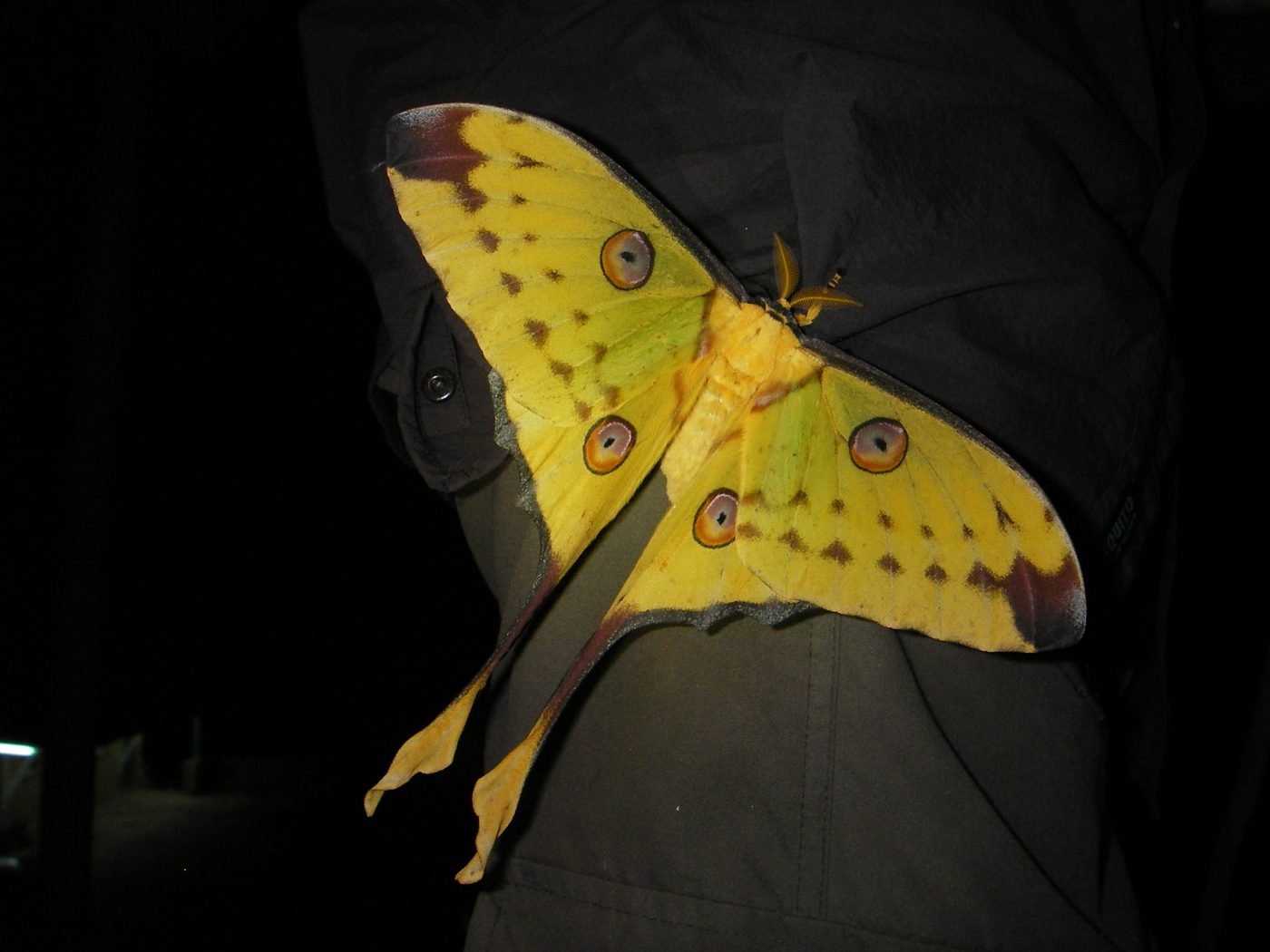
A striking North American moth of the giant silkmoth family, the Io moth flashes two large eyespots on its hindwings that mimic the eyes of a predator.
Characteristics
Temperament
Nocturnal, drawn to light; short-lived adult
Diet
Adult: does not feed. Caterpillar: leaves of various plants
A moth with false eyes
The Io moth is a striking member of the giant silkmoth family, found across much of North America. Its most spectacular feature is a pair of large eyespots — round black and blue markings — on the hindwings, normally hidden beneath the forewings. When disturbed, the insect snaps them open to reveal these "eyes": the illusion of facing the stare of a large predator startles birds and other attackers. The male has yellow forewings, the female reddish-brown.
Habitat and distribution
It ranges from southern Canada to the southern United States, in varied habitats including woodland, prairie and sandy areas. Like many giant silkmoths, the adult is attracted to light sources and is active at night.
Life cycle and stinging caterpillar
The caterpillar is bright green with lateral stripes and, above all, is covered in tufts of branching spines connected to venom glands: contact causes a burning irritation like a nettle sting. As an adult the moth does not feed at all — it has no functional mouthparts — and lives only a few days, just long enough to reproduce.
Curiosities
The name comes from Io, a figure in Greek mythology loved by Zeus. The eyespot strategy, called "deimatic", is a classic example of defence that exploits visual deception without the animal actually being dangerous.
Conservation
The species is common and widespread and not considered threatened. As with many insects, habitat loss and pesticide use can nonetheless affect populations locally.
Pros
- Spectacular large eyespots on the hindwings
- Textbook example of deimatic defence
- Common and widespread in North America
Cons
- The caterpillar stings: not to be touched
- The adult lives only a few days
- Sensitive to pesticides and habitat loss