Milk Snake
Lampropeltis triangulum
Characteristics
Temperament
A harmless, non-venomous colubrid snake, shy and active mainly at night and dusk, of generally calm, manageable character. It spends much time hidden under stones, logs and woodpiles, and hunts rodents, lizards and even other snakes, killing them by constriction. Its famous ringed livery imitates that of the venomous coral snakes (Batesian mimicry). Although a relatively "easy" and popular terrarium snake, it is NOT a toy: it requires a suitable, secure terrarium (it is a skilled escapee), a diet of thawed rodents and awareness of its long life. Captive-bred specimens are always preferable.
Diet
A carnivorous constrictor: it wraps its prey in its coils until it suffocates, then swallows it whole. A versatile hunter, it feeds on rodents (mice and small mammals), lizards, amphibians, birds and eggs, and — like the other kingsnakes — on other snakes too (it is ophiophagous), including sometimes venomous ones, to whose venom some kingsnakes show resistance. In the terrarium it should be fed rodents of suitable size, given dead and thawed (never alive). Preying on rodents and snakes makes it a useful animal in rural environments.
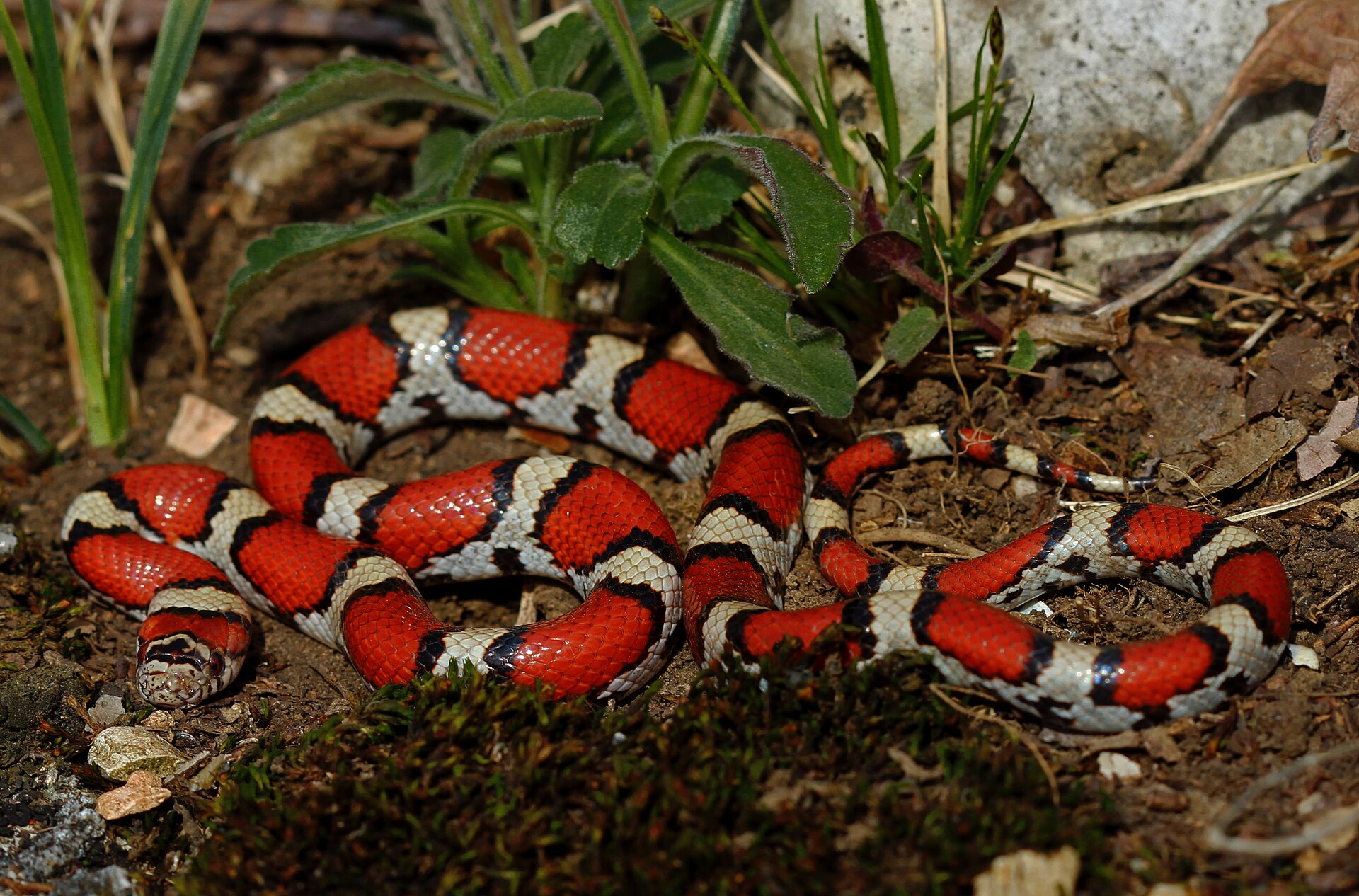
The Milk Snake (Lampropeltis triangulum) is one of the most colourful and fascinating snakes of North America: a harmless colubrid with a showy ringed livery, famous for imitating the dangerous coral snakes. Famous for:
- The gaudy rings: typically red, black and white/yellow, with a "venomous-snake" look
- Batesian mimicry: it imitates the venomous coral snakes to deceive predators, while being entirely harmless
- The curious name: from the legend that it "milked" cows' milk
- The habit of eating other snakes: like the other "kingsnakes", it is also ophiophagous
- The great variability: numerous subspecies, of different colours and patterns
- The docility: a popular and calm terrarium snake
IUCN status: Least Concern (LC). It enters the portal among the snakes, alongside native species (Western whip snake, Aesculapian snake, grass snake) and exotic ones (corn snake, anaconda, ball python): another harmless colubrid, here in the guise of one of the most successful "imitators" in the animal world.
Classification and category
Order Squamata, suborder Serpentes, family Colubridae (the colubrids). It is a kingsnake of the genus Lampropeltis; the species is Lampropeltis triangulum, divided into numerous subspecies distributed from North America to Central and northern South America. In the portal it is placed among the snakes. It is essential to tell it apart from the species it imitates or resembles, some dangerous: the coral snakes (genus Micrurus and allies) — venomous, with similar rings; they are precisely the models the milk snake imitates; in the United States a rhyme helps tell them apart, but it does NOT hold for tropical species, where identification is more complex; other kingsnakes (genus Lampropeltis) — close relatives, some banded, others with bands or blotches; the corn snake (Pantherophis guttatus), also in the portal — another terrarium colubrid, but with orange "saddles" rather than rings. Etymology: the English name "milk snake" comes from an old false belief that these snakes suck milk from cows' udders; in reality they frequented barns and stables drawn by mice, not milk; the genus name Lampropeltis means "shiny shields", referring to the glossy scales. Parameters: Length very variable, roughly 60-130 cm depending on the subspecies. Build slender. A round pupil, typical of harmless colubrids. Longevity: remarkable in captivity, where it can live 15-20 years and more. Reproduction: it is oviparous, laying eggs.
Habitat and distribution
The Milk Snake has one of the widest ranges among American snakes: its range runs from North America (southern Canada and the United States) to Central America and northern South America, with numerous subspecies adapted to different environments. Preferred habitats — varied environments, often with shelter and abundant prey: woods, clearings and forest edges; grasslands, rocky areas and agricultural land; and rural environments with barns, walls and woodpiles, where it hunts rodents. It is a shy and mainly nocturnal or crepuscular snake: it spends much time hidden under logs, stones, litter or woodpiles, coming out mainly in the cool. The very habit of frequenting barns and stables in pursuit of mice is the origin of its curious name. Its wide distribution and the variety of environments it occupies attest to a remarkable adaptability. IUCN status: Least Concern (LC). It is common and widespread across much of its vast range. As a terrarium animal it is almost always captive-bred, a correct practice that protects wild populations.
Diet
The Milk Snake is a carnivorous constrictor: it wraps its prey in its coils until it suffocates, then swallows it whole. It is a versatile hunter and feeds on: rodents (mice and small mammals, frequent prey); lizards and amphibians; other snakes (like the other kingsnakes, it is ophiophagous — it eats snakes — including sometimes venomous ones); and birds and eggs. Kingsnake peculiarities: ophiophagy (the Lampropeltis are known for hunting and eating other snakes; some species of the genus even show a degree of resistance to pit-viper venom); constriction (it kills prey by wrapping them, without venom); and in the terrarium (it is fed rodents of suitable size, given dead and thawed, never alive). Crucially, the habit of preying on rodents (and other snakes) makes it a useful animal in rural environments. The ability to eat snakes too, sometimes venomous, is a spectacular feature shared with the other "kingsnakes".
Physical features
A slender colubrid, made famous by its very colourful livery. The ringed livery — the distinguishing trait: bright rings, typically of red, black and white or yellow, arranged along the whole body; a strong resemblance to the venomous coral snakes, the basis of its mimicry; and great variability (the colours and order of the bands change a lot from subspecies to subspecies). The head and body: a slender, muscular body, suited to slipping among rocks and shelters; a head little distinct from the neck; and a round pupil, a hint (together with the shape) of its non-venomous nature. The morphs: numerous variants selected in captivity, enhancing its already bright colours, contributing to its popularity among enthusiasts.
Curiosities, mimicry and care
The Milk Snake is a shy animal, active mainly at night and dusk, and of generally calm character. Its fame stems from the combination of spectacular colours, mimetic behaviour and relative ease of keeping.
The coral-snake "disguise": the milk snake's most fascinating trait is its mimicry; though harmless, it has a livery of red, black and yellow/white rings that closely recalls that of the venomous coral snakes; it is a classic example of Batesian mimicry: a harmless species "imitates" the appearance of a dangerous one, exploiting predators' fear of the venomous model to deter them. The rhyme (that does not always hold): in the United States there is a popular saying to tell the milk snake from the venomous corals, based on the order of the colour bands; one version says that if red touches black, the snake is a "friend", while if red touches yellow it is venomous; beware, however: this rule works only for North American species and is NOT reliable for tropical coral snakes, where the band arrangement can differ; when in doubt, it is always best not to approach. The "milk" name: the name comes from a groundless folk belief that these snakes slip into stables to suck milk from cows; in reality milk snakes frequented barns and stables drawn by the mice they feed on; it is biologically impossible for a snake to "milk" a cow, but the legend has stuck in the name. The snake-eating "kingsnake": the milk snake belongs to the kingsnake genus (Lampropeltis), known for the ability to hunt and devour other snakes; some kingsnakes even show notable resistance to the venom of vipers and rattlesnakes, which they can prey on; it is a behaviour that makes these colubrids top predators among snakes, despite their harmlessness to humans. The species of a thousand faces: with its huge range and numerous subspecies, the milk snake is among the most variable snakes; the different populations differ in size, colours and band arrangement, so much so that many were once considered distinct subspecies; this variety, combined with the bright colours, has made it much loved by terrarium enthusiasts. Responsible care: although a relatively "easy" and docile snake, the milk snake is not a toy. It requires a suitable terrarium (with hides, correct temperature gradients and secure closures, as it is a skilled escapee), appropriate feeding on thawed rodents and awareness of its long life. The right choice is to opt for captive-bred specimens and to inform oneself thoroughly before purchase.
Pros
- Serpente innocuo, non velenoso, dal carattere docile e maneggevole
- Colori spettacolari ad anelli e infinite morph: amatissimo in terrario
- Mimetismo affascinante (imita i serpenti corallo): grande spunto educativo
- Utile in natura come predatore di roditori e altri serpenti; IUCN Least Concern
Cons
- Per i colori può essere scambiato per un velenoso serpente corallo (e ucciso per errore)
- NON è un giocattolo: richiede terrario adeguato, dieta a base di roditori e competenze
- Molto longevo (15-20+ anni): impegno a lungo termine
- Abile evasore: il terrario deve essere ben chiuso; scegliere solo esemplari nati in cattività