Little Owl
Athene noctua
Characteristics
Temperament
Lifelong monogamous, territorial, sedentary. Crepuscular (not strictly nocturnal). Vision 100x of human in low light. 270° head rotation. Silent flight ("comb" feathers). Symbol of goddess Athena (wisdom). Recognises individual humans.
Diet
Generalist carnivore: large insects (60-80%), micromammals, small birds, reptiles, amphibians, earthworms. 30-50 g/day. Hunts from perch. Produces 1-2 pellets per day (used in teaching).
The Little Owl (Athene noctua), also often called the Common Little Owl, is one of the most known and beloved nocturnal raptors of the Old World. Distributed in Europe, North Africa and much of central-western Asia, it lives in open rural environments, at the edges of forests, in farms, ruins and countryside. Famous for being the symbol of the goddess Athena (in Greek Athena, from which the scientific name of the genus Athene) and for its iconic presence on ancient Athenian coins, it has always been associated with wisdom, nocturnal sagacity and — unfortunately in Italian and French folklore — also with bad luck. In the last 30 years European populations are declining by 30-40% due to agricultural intensification that reduces large insects (their main diet) and nesting sites (ruins, old hollow trees).
Classification and category
The Little Owl belongs to the order Strigiformes (nocturnal raptors), family Strigidae (all owls except the barn owl), genus Athene. The genus comprises 4 species of small ground owls: A. noctua (Little Owl), A. brama (Indian Little Owl), A. cunicularia (North American Burrowing Owl), A. blewitti (Forest Owl, rediscovered in India in 1997 after 113 years of disappearance). 13 subspecies of A. noctua are recognised distributed in Eurasia and North Africa. The most widespread species in Italy is A. n. vidalii (Iberia and Western Italy) and A. n. noctua (Central and Southern Italy). The Little Owl is of small size: length 21-23 cm, wingspan 54-58 cm, weight 140-220 g (females are slightly larger than males). The name Athene noctua was attributed by Scopoli in 1769: noctua means "little owl" in Latin. The species is closely related to the American Burrowing Owl, from which it separated about 5-6 million years ago.
Habitat and distribution
The habitat of the Little Owl consists of open environments: traditional countryside with hedges and scattered trees, olive groves, vineyards, ruins and abandoned farmhouses, steppes, semi-desert areas, urban suburbs with gardens. It prefers areas with large availability of insects (its main food source) and nesting sites: cavities of old trees (oaks, century-old olive trees), wall crevices of ruins, old nests of diurnal raptors, artificial nest boxes. It is relatively tolerant of anthropisation: it lives close to humans in traditional rural areas, while it suffers from modern intensive agriculture (elimination of hedges, pesticides, demolition of ruins).
The geographic distribution covers vast territories of the Palearctic region: Europe (from Iberia to European Russia, excluding Scandinavia and northern Great Britain, where it was introduced in 1874), North Africa (Morocco, Algeria, Tunisia, Egypt), Asia (Turkey, Iran, Central Asia up to Mongolia, China, Pakistan). It was introduced to New Zealand in 1906 (stable population today). The global population is estimated at 5-12 million individuals, but declining by 30-40% in many European countries. The conservation status is listed as Least Concern (LC) by the IUCN, but with regional concern: in Holland, Belgium, Germany, Poland it is locally classified as Vulnerable or Endangered. In Italy the population is estimated at 50,000-80,000 pairs, in 20-30% decline in the last 20 years. The species is protected by the EU Birds Directive 2009/147/EC (Annex I) and in Italy by Law 157/92. The main threats are: agricultural intensification (loss of insects, elimination of hedges), use of pesticides (direct and indirect mortality), collision with cars and power lines, demolition of old ruins and farmhouses with nesting sites, predation by stray cats. Active conservation programmes (installation of nest boxes, restoration of hedges and extensive agricultural areas) are showing positive local results.
Diet
The Little Owl is a generalist carnivore but with well-defined preferences. The main diet consists of: large insects (60-80% by volume: cockchafers, crickets, locusts, grasshoppers, beetles, lepidoptera), small mammals (mice, voles, shrews), small birds (sparrows, swifts, flycatchers), reptiles (lizards, geckos, small snakes), amphibians (small frogs, tree frogs), earthworms (important in spring), occasionally grains (atypical for a raptor).
The hunting technique is predominantly from a perch: the Little Owl perches on an elevated point (pole, branch, roof) and scans the ground with excellent vision. When it spots prey, it glides silently and grabs it with its talons. Hunting is predominantly crepuscular (unlike many other Strigiformes that are strictly nocturnal), with peak activity at sunset and dawn. It can also hunt during the day, especially in winter or when raising chicks. The daily requirement is 30-50 g of food (15-25% of body weight); it accumulates stores in nests during the summer. A characteristic of Little Owls is the production of "pellets" or "pellets": compact masses of undigested hair, bones, insect exoskeletons, regurgitated 1-2 times a day. The pellets are a precious tool for ornithologists and students: by dissecting them one reconstructs exactly the diet of the individual.
Physical features
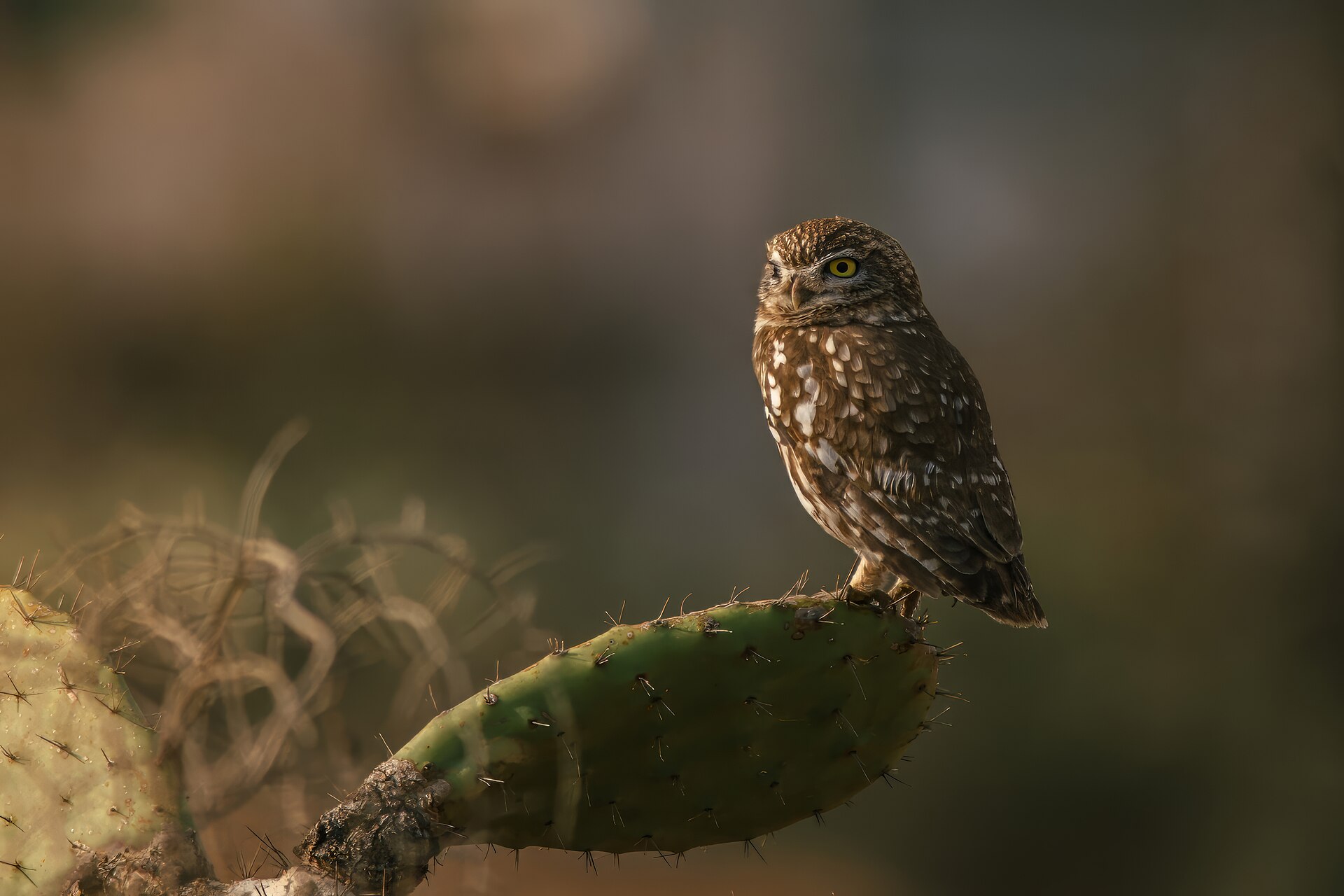
The Little Owl has a stocky, compact, well-muscled body, perfectly adapted to hunting in open environments. The plumage of adults is characteristic: dark brown-grey above with marked white streaks and spots (excellent camouflage on bark and ruins), white-cream below with dark brown longitudinal streaks. Juveniles have more uniform colouring. The plumage is very soft: the edge of the primary remiges has a special "comb" structure that almost totally cancels the noise of flight (characteristic of all Strigiformes, fundamental for their hunting style).
The head is large in proportion to the body, rounded, without ear tufts (unlike Eagle Owl, Long-eared Owl). The eyes are the most iconic trait: enormous, bright yellow, frontal (binocular vision), ability to see in low light conditions 100 times higher than humans. It has a characteristic "facial mask" white above the beak and around the eyes, which gives the Little Owl its famous "surprised" or "wise" expression. The ears are not visible externally, but are asymmetric inside (one higher than the other), allowing very precise sound localisation (it can locate a mouse in total darkness only by noise). The beak is short, yellow-grey, curved, suitable for tearing meat. The head rotation capacity is legendary: 270° in both directions (humans do a maximum of 90°), thanks to 14 cervical vertebrae (humans have 7) and a unique cardiovascular system that prevents cerebral ischemia during rotation. The legs are short but very robust, with sharp claws and legs covered with feathers down to the talons ("socks"). The plantar pads are fleshy and callous to cushion landings on prey.
Behaviour and curiosities
The Little Owl is a lifelong monogamous, strongly territorial, sedentary animal. The pair maintains the same partner for many years (documented records: 15+ years of union) and defends a territory of 5-30 hectares from other Strigiformes (also of other species). Communication is complex: it includes the characteristic territorial song of the male ("kju-kju-kju" repeated), the "meowing" of the female asking for food from the male, crepuscular alarms, threat postures (puffs up the plumage to appear larger).
Nesting takes place between April and July. Pairs choose pre-existing cavities (old hollow trees, ruin crevices, nest boxes). The female lays 3-5 white eggs in May; incubation lasts 28-30 days, performed mainly by the female while the male hunts for both. Chicks are born covered in white down and depend on parents for 35-40 days before fledging. Longevity is 9 years in nature on average, with documented records of 18+ years. Sexual maturity is reached at 1 year.
The symbolic meaning of the Little Owl is very rich and divided into two opposing traditions. In the ancient Greek world it was a symbol of the goddess Athena (Rome: Minerva), patroness of wisdom, philosophy and strategic warfare: the "Owl of Athens" appeared on all the silver coins (tetradrachmae) of the city from 510 BC, becoming the most important coins of classical antiquity. The saying "to bring owls to Athens" (noctuas Athenas portare in Latin) means "to do something useless". The Little Owl was also a symbol of philosophers: Hegel wrote that "the owl of Minerva takes flight at dusk", a metaphor for philosophy that understands the world only at the end of a historical era. On the contrary, in Italian, French, Slavic popular folklore the Little Owl has often been associated with bad luck, death, witches: its crepuscular song near houses was considered an omen of an imminent death. In particular the 17th-century Roman painter Salvator Rosa painted it as a symbol of melancholy. Ornithological curiosity: the pellets regurgitated by Little Owls are widely used in Italian schools for educational laboratories: students dissect the pellets to identify bones and skulls of micromammals, contributing to regional fauna censuses.
Pros
- Simbolo della dea Atena, della sapienza filosofica
- Icona di monete antiche di Atene (V sec. a.C.)
- Controllo biologico degli insetti dannosi all'agricoltura
- Longevità eccezionale per un piccolo rapace (record 18+ anni)
Cons
- Specie protetta (Direttiva UE Allegato I, Italia L.157/92)
- In declino del 30-40% in molti paesi europei
- Folklore italo-francese: associata erroneamente a cattiva sorte
- Vulnerabile a intensificazione agricola e pesticidi