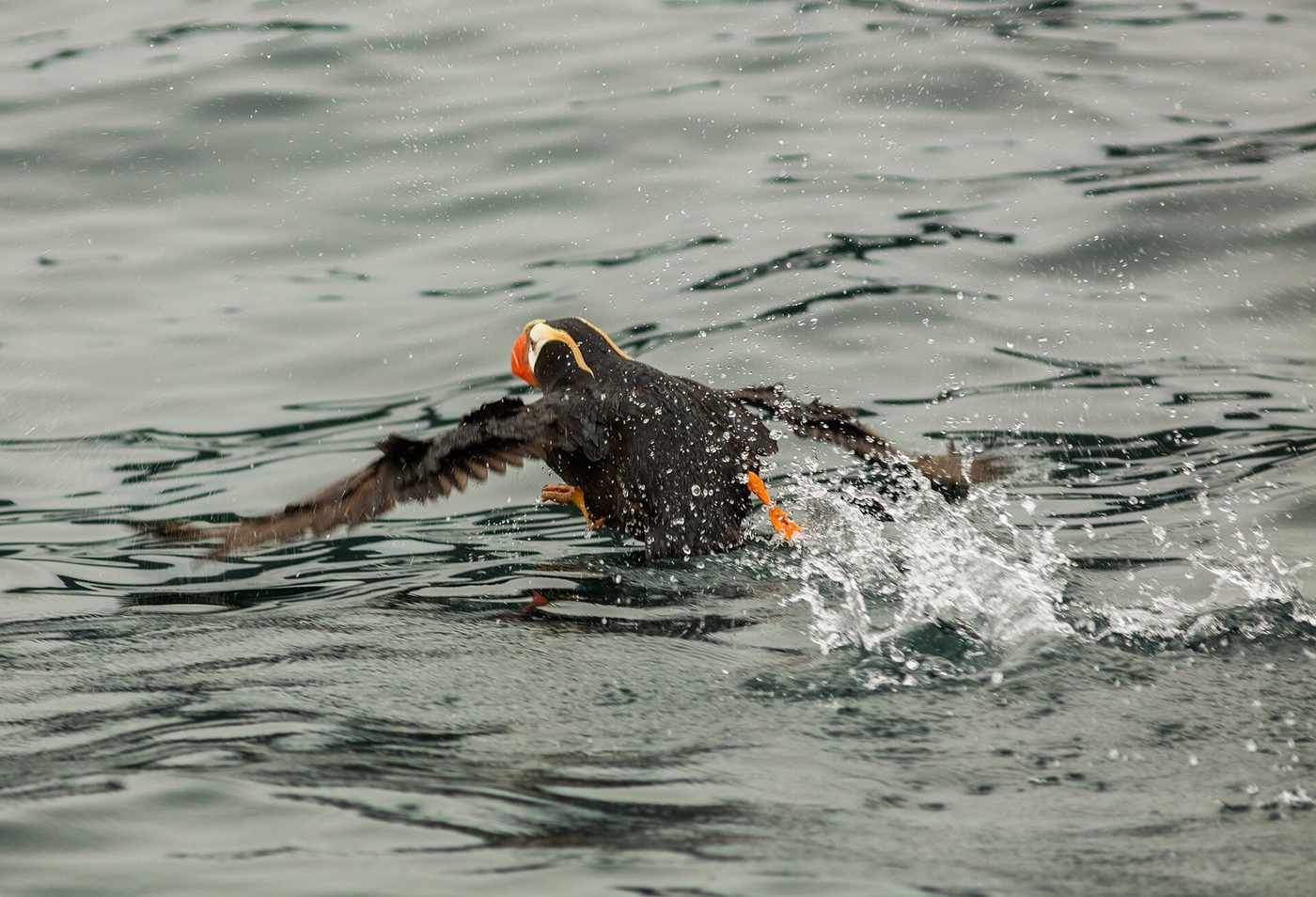
Photo: Diego Delso · CC BY-SA 4.0
Tufted puffin
Fratercula cirrhata
A seabird of the North Pacific, the tufted puffin has a thick red-orange bill and, in summer, two long golden tufts that trail back behind its head.
Characteristics
Temperament
Pelagic, colonial, an excellent diver
Diet
Carnivore: fish and small marine invertebrates
A clown of the northern sea
The tufted puffin is a medium-sized seabird of the auk family, resembling penguins only in look and lifestyle. In breeding dress it is unmistakable: a black body, white face, thick triangular red-orange bill and, above all, two long tufts of golden feathers that spring from behind the eyes and sweep back like unruly hair. Out of season the colours fade and the tufts disappear.
(Note: the mass value given by Wikidata, 87.9 kg, is plainly wrong for a bird of this size; its true weight is about 780 grams.)
Habitat and distribution
It lives in the North Pacific, along the coasts and islands of Alaska, Siberia, Japan and California, but spends much of the year out at sea. It comes ashore only to breed, on cliffs and uninhabited islands.
Behaviour and diving
It is a superb diver: it uses its wings to "fly" underwater, chasing fish and small invertebrates that it catches while submerged. It can hold many prey in its bill at once, arranging them crosswise. It nests in burrows dug in the ground of islands or in rock crevices, laying a single egg.
Curiosities
In flight it looks clumsy and beats its wings frantically, but in water it is agile and fast. Its large breeding colonies are noisy, crowded places. The showy bill, as in the Atlantic puffins, sheds part of its coloured sheaths after the breeding season.
Conservation
The IUCN lists the species as Least Concern, but some southern populations are declining due to ocean warming, reduced prey and predators introduced to nesting islands.
Pros
- Unmistakable red bill and golden tufts
- 'Flies' underwater to hunt
- Wide range, not threatened globally
Cons
- Some southern populations declining
- Sensitive to predators introduced on islands
- Not a bird to keep: specialised marine needs