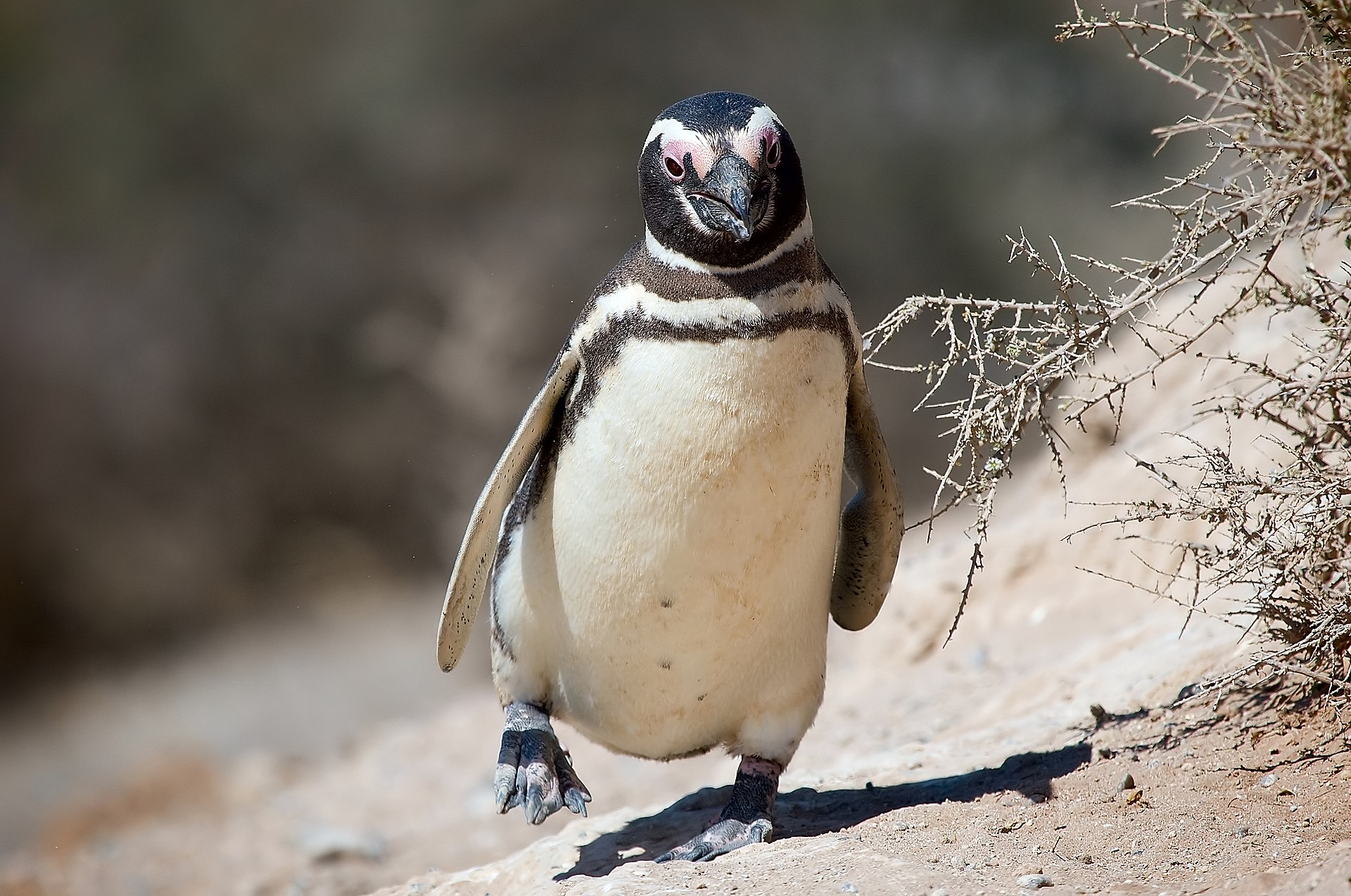
Magellanic Penguin
Spheniscus magellanicus
Characteristics
Temperament
Lifelong monogamous, gregarious, strongly social. Nesting site fidelity (same burrow every year). Communicates with "braying" (donkey bray). Story of "Dindim", penguin that returns each year 8,000 km to its human saviour. Colonies of 200,000+ at Punta Tombo.
Diet
Marine carnivore: fish (sardines, anchovies), squid, krill. Underwater pursuit, dives 30-90 sec (record 5 min). Depth 20-50 m (record 90 m). Underwater speed 6-9 km/h (15 in sprint). 0.5-1 kg food/day. Vulnerable to El Niño.
The Magellanic Penguin (Spheniscus magellanicus) is a non-flying seabird endemic to the southern coasts of South America (Argentina, Chile, Falklands/Malvinas). It takes its name from the Portuguese explorer Ferdinand Magellan, who first described it in 1520 during his circumnavigation expedition. Characterised by the classic black-white penguin plumage, with two distinctive black bands in the shape of a "necklace" (one horizontal above the chest, one in the shape of a wider "V" above the first), it is one of the most popular and photographed penguins in the world for its large coastal colonies easily accessible to tourism. It lives in colonies of hundreds of thousands of individuals (the largest, in Punta Tombo in Argentina, hosts over 200,000 breeding pairs) — a spectacular natural phenomenon visited by over 100,000 tourists per year. It is lifelong monogamous and shows a surprising nesting site fidelity: each pair returns every year to the same burrow dug in the ground.
Classification and category
The Magellanic Penguin belongs to the order Sphenisciformes, family Spheniscidae (penguins), genus Spheniscus. The genus comprises 4 species of "banded penguins": S. magellanicus (Magellanic, South America), S. humboldti (Humboldt, Pacific coast of Chile/Peru), S. demersus (African, South Africa), S. mendiculus (Galápagos, equator). It is a medium-large sized penguin: length 60-76 cm, weight 2.7-6.5 kg. Males are slightly larger than females (moderate sexual dimorphism). The species was scientifically described by Johann Reinhold Forster in 1781. It is distinguished from S. humboldti (its closest relative) by the two black bands on the chest (the Humboldt has only one), and by slightly larger dimensions. The two species can hybridise in the overlap zones of central Chile.
Habitat and distribution
The habitat of the Magellanic Penguin consists of rocky, sandy, mangrove subantarctic coasts of the South Atlantic and South-Eastern Pacific. The species is migratory: it nests on the coasts of Argentine and Chilean Patagonia (latitudes 41°S-56°S) and in the Falkland/Malvinas Islands between October and March (southern spring-summer); in winter (April-September) it migrates north in search of food, reaching the coasts of southern Brazil, Uruguay, Peru. The annual migration covers 4,000-8,000 km, one of the longest migrations among penguins.
The largest breeding colonies are: Punta Tombo (Argentina) — over 200,000 pairs, the largest in the world, declared Provincial Natural Reserve of Chubut and BBC heritage; Valdés Peninsula (Argentina) — 30,000-40,000 pairs, UNESCO site; San Lorenzo, Cabo Vírgenes, Río Deseado (Argentina); Magdalena Island (Strait of Magellan, Chile) — 60,000 pairs; Falkland/Malvinas Islands — population of 100,000+ pairs. The global population is estimated at 1.3-1.5 million breeding pairs. The conservation status is listed as Least Concern (LC) by the IUCN, but with concern for some populations in decline (Punta Tombo has lost 24% of the population between 1987 and 2010). The main threats are: climate change (alteration of ocean currents and prey availability), collisions with commercial fishing nets (40,000 estimated annual deaths), hydrocarbon pollution (over 20,000 oiled specimens in the last 30 years during transit on busy maritime routes), habitat loss for coastal constructions. The species is protected in Argentina (Punta Tombo Reserve since 1979), Chile and Falklands.
Diet
The Magellanic Penguin is a marine carnivore with varied diet: fish (main prey: Argentine sardines Sprattus fuegensis, anchovies Engraulis anchoita, hakes, mullets), squid and cuttlefish (Loligo, Sepia), krill and pelagic crustaceans. The hunting technique is based on underwater pursuit: the penguin dives to pursue and catch prey in the open sea. Operational dives last 30-90 seconds, with records of over 5 minutes; typical depth 20-50 m, record 90 m. Underwater speed is 6-9 km/h, with peaks of 15 km/h.
Food requirements are high: an adult consumes 0.5-1 kg of food per day (15-25% of body weight). During nesting, pairs divide tasks: one partner hunts at sea for 1-3 weeks, travelling up to 600 km from the colony, while the other guards the egg or chicks. The hunting penguin brings back pre-digested food to adult partners and chicks via regurgitation. Extreme hunger is characteristic: during incubation (40-42 days) the penguin remaining at the nest can lose up to 50% of body weight before the changeover. The species is strongly influenced by El Niño/La Niña climate phenomena: in El Niño years water temperature rises, currents change, prey become scarce, and infant mortality can reach 90%. In the last 30 years climate change is altering natural feeding patterns, with serious consequences on reproduction.
Physical features
The Magellanic Penguin has a hydrodynamic, fusiform body, perfectly adapted to underwater swimming. The adult plumage is the classic black-white of penguins: back, head, wings brilliant black, belly, chest, throat cream white. The most distinctive characteristic are two black bands on the chest: a narrow horizontal band crossing the chest, and below a wider "inverted V"-shaped band extending from the sides of the body towards the centre of the chest. Furthermore, a characteristic white band in the shape of a "V" extends from the upper part of the head, passing over the eyes, to the throat, separating the black head from the throat.
The beak is the second iconic characteristic: thick, slightly curved, black, with a characteristic grey or pink-orange streak at the base (more marked in adult males during the breeding season). The eyes are small, red-bordeaux in adults, black in juveniles. The wings are modified into flippers: rigid, flat, perfect for swimming but unusable for flight. They allow swimming at 6-9 km/h sustained, up to 15 km/h in sprint. The characteristic "dolphin" swimming (vertical-horizontal undulations) allows reducing friction and breathing at the surface at high speed without stopping movement. The legs are webbed (for swimming) and equipped with claws (for digging burrows). The chicks are covered in brown-greyish down for the first 2-3 months, then develop the adult black-white plumage. An exceptional physiological characteristic: the nasal salt gland allows expelling salt ingested with seawater and fish, through the nostrils as "saline tears" — common to all penguins but particularly developed in the Magellanic. The penguin can live drinking exclusively seawater.
Behaviour and curiosities
The Magellanic Penguin is a lifelong monogamous, strongly social, gregarious animal. Pairs maintain the same partner for many years (couple longevity: 10-25+ years) and show an extremely strong nesting site fidelity: every year they return to the same burrow dug in the ground (usually 30-100 cm deep) or to the same "nest" under a bush. Burrows are identified by olfactory and acoustic signals: penguins recognise their partner and chicks among hundreds of thousands through the characteristic voice (called "braying" for its incredible resemblance to a donkey's bray).
The breeding season begins in October: males return to the colonies 2-3 weeks before females to reclaim the nest. The pair reunites for "vocal recognition": each partner has a unique call that the other recognises after months of separation. The female lays 2 eggs in October-November; incubation lasts 40-42 days, conducted by both parents in turn (changes every 1-3 weeks). Chicks are born covered in brown-greyish down; infant mortality is high (40-60% in the first year) due to predation (gulls, skuas, introduced rats) and starvation in El Niño years. Sexual maturity is reached at 4-5 years. Longevity is excellent: 15-25 years in nature, with well-cared specimens in zoos exceeding 30 years.
Famous curiosities: the Magellanic penguin "Dindim" is one of the most famous animals in history. In 2011, he was found dying covered in oil on the beach of Proveta (Brazil) by a Brazilian fisherman, João Pereira de Souza. The fisherman cared for him, fed him and released him after weeks. Since then, every year (for over 12 years!), Dindim returns to the same beach, travelling 8,000 km from the Patagonian colonies, to visit and spend 3-4 months with his "adoptive dad". The story is documented by numerous documentaries and is part of the biological literature on the human-animal relationship. Ethological curiosity: the "divorce rate" in Magellanic penguins is intensively studied: only 6-12% of pairs separate voluntarily in a year, a very low percentage compared to other birds. "Divorced" pairs are usually those with poor reproductive success. The species is the subject of numerous scientific studies: the University of Washington has been conducting since 1982 the longest ongoing study of penguins in the world at Punta Tombo (Argentina), individually following thousands of tagged penguins for studies on longevity, fidelity, migration, climate impact. The Magellanic penguin is also official mascot of the Argentine province of Chubut and symbol of Patagonian Natural Reserves.
Pros
- Colonie spettacolari di 200.000+ coppie (Punta Tombo)
- Monogamo a vita (fedeltà coniugale 10-25+ anni)
- Longevità eccellente (15-25 anni, 30+ in zoo)
- Protagonista del 'caso Dindim', storia uomo-animale famosa al mondo
Cons
- Specie protetta (CITES Appendice II), detenzione vietata privata
- Mortalità 40.000/anno per pesca commerciale (reti)
- In declino in alcune colonie (-24% Punta Tombo 1987-2010)
- Vulnerabile a cambiamento climatico ed El Niño