Photo: Martybugs at English Wikipedia · CC BY 3.0
Numbat
Myrmecobius fasciatus
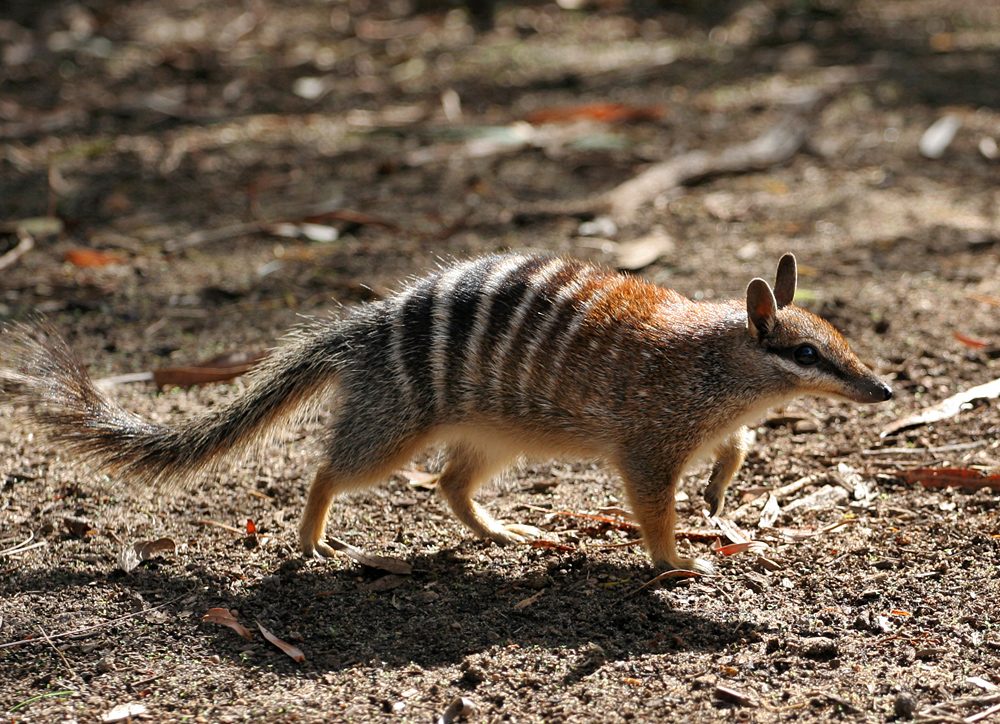
Small, striped and active by day, the numbat is a rare Australian marsupial specialised in eating termites, with a long, sticky tongue.
Characteristics
Temperament
Diurnal, solitary, shy
Diet
Insectivore: almost exclusively termites
An unusual little marsupial
The numbat is one of the most peculiar and fascinating marsupials in Australia. It is the size of a squirrel, with a slender body, a pointed snout and a bushy, bristly tail. Its most obvious feature is its coat, reddish or brown at the front and crossed on the back by a series of striking white and dark bands, which make it unmistakable. Unlike most marsupials, the female does not have a true well-developed pouch: the young simply cling to their mother's belly, protected by her fur.
Habitat and distribution
Once widespread across much of southern Australia, today the numbat survives only in a few restricted areas of Western Australia, often in protected reserves. It lives in forests and woodlands where eucalyptus trees abound and, above all, fallen logs and the termites it feeds on. It is an inhabitant of arid and temperate environments, tied to the presence of shelter and food.
Behaviour and diet
The numbat is a rare case among termite-eating mammals: it is active by day, when termites move near the surface of the ground. It feeds almost exclusively on these insects, which it gathers by the thousand thanks to its extraordinarily long, sticky tongue, inserting it into the tunnels. Its daytime activity, however, is also linked to a risk: it exposes it more to predators, which is why it shelters at night in hollow logs and burrows.
Curiosities
Despite its delicate appearance, the numbat is a tireless devourer of termites, able to consume a great number of them every day. It has become a symbol of the wildlife of Western Australia, of which it is an emblem, and is the focus of important conservation programmes.
Conservation
The numbat is classified as an endangered species. Its decline was caused above all by predators introduced by humans, such as foxes and cats, and by habitat destruction. Thanks to protection programmes, dedicated reserves and predator control, efforts are now being made to save this small and precious marsupial, a witness to a uniquely Australian fauna.
Pros
- A unique marsupial, diurnal and termite-eating
- Unmistakable striped coat
- Symbol of the wildlife of Western Australia
Cons
- Endangered species
- Threatened by introduced predators such as foxes and cats
- Range reduced to a few protected areas